| |
| Ultimi arrivi |
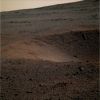
OPP-SOL3019-GB-LXTT-IPF.jpgLooking Around... - Sol 3019 (RAW Natural Colors; credits for the additional process. and color.: Dr Gianluigi Barca - Lunexit Team)72 visitenessun commentoMareKromiumLug 29, 2012
|
|

ESP_026356_1960_RED_NOMAP_browse-PCF-LXTT.jpgUnusually-looking Landforms near Grota Valles (Absolute Natural Colors; credits for the additional process. and color.: Dr Paolo C. Fienga - Lunexit Team)114 visiteThe Landforms visible in this observation are quite diverse, with a segment of the Cerberus Fossae (such as a deep Trough extending East-West) and Surrounding Terrain that has been eroded by some Fluid, either Water (actually Mud) or Lava. There are also many Boulders in places, either on steep Slopes or excavated by Impact Craters. The high Hills are Islands of older Terrain surrounded by younger Lavas.
Mars Local Time: 15:08 (Early Afternoon)
Coord. (centered): 15,724° North Lat. and 162,022° East Long.
Spacecraft altitude: 281,3 Km (such as about 175,8 miles)
Original image scale range: 28,1 cm/pixel (with 1 x 1 binning) so objects ~ 84 cm across are resolved
Map projected scale: 25 cm/pixel
Map projection: EQUIRECTANGULAR
Emission Angle: 4,7°
Sun - Mars - MRO (or "Phase") Angle: 40,5°
Solar Incidence Angle: 45° (meaning that the Sun is about 45° above the Local Horizon)
Solar Longitude: 81,7° (Northern Spring - Southern Autumn)
Credits: NASA/JPL/University of Arizona
Additional process. and coloring: Lunar Explorer ItaliaMareKromiumLug 18, 2012
|
|

ESP_027451_2635_RED-PCF-LXTT-IPF.jpgFeatures of the North Polar Regions (Absolute Natural Colors; credits for the additional process. and color.: Dr Paolo C. Fienga/Lunexit Team)103 visiteThere is an Ice-Sheet at the North Pole of Mars that is a few miles thick at its center. At some places (like in this image) it ends in steep Cliffs that can be about 800 meters (2600 feet) high.
The Slopes of these Cliffs are almost vertical, which causes "Slab-like Blocks" of Ice to periodically (and, actually, quite often) break off and crash down onto the Surrounding Plains.
A dense Network of Cracks covers these Icy Cliff faces, thus making it easier for these Blocks to break free. New piles of Debris (located at the base of many of these Cliffs) have appeared in successive HiRISE images, and so the MRO Team shall regularly monitor sites like this in order to check for new Blocks that might have fallen. Understanding how these Cliffs are formed can help Scientists to better understand the "Climatic Record" which are stored in the Ice-Sheet itself.
Mars Local Time: 13:44 (Early Afternoon)
Coord. (centered): 83,618° North Lat. and 119,827° East Long.
Spacecraft altitude: 320,5 Km (such as about 200,3 miles)
Original image scale range: 32,1 cm/pixel (with 1 x 1 binning) so objects ~ 96 cm across are resolved
Map projected scale: 25 cm/pixel
Map projection: POLAR STEREOGRAPHIC
Emission Angle: 0,1°
Sun - Mars - MRO (or "Phase") Angle: 62,8°
Solar Incidence Angle: 63° (meaning that the Sun is about 27° above the Local Horizon)
Solar Longitude: 120,0° (Northern Summer - Southern Winter)
Credits: NASA/JPL/University of Arizona
Additional process. and coloring: Lunar Explorer ItaliaMareKromiumLug 18, 2012
|
|
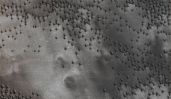
ESP_027378_2540-PCF-LXTT-IPF-1A.jpgNorthern Dunes (CTX Frame "A" - Absolute Natural Colors; credits for the additional process. and color.: Dr Paolo C. Fienga/Lunexit Team)89 visiteThis Field of crescent-shaped Dunes (located at Lat. 73,62° North and 328,215° East Long.) is located just South of the North Polar Layered Terrain. These Dunes, known as "Barchan Dunes", usually form where there is a moderate supply of Sand and a Prevailing Wind Direction (meaning that they form in Regions where there are Dominant Winds). The "Arms" (or "Horns") of the Barchan Dunes point in the downwind direction and in this case this circumstance indicates that the Dominant Winds blow towards the North/West.
Mars Local Time: 14:42 (Early Afternoon)
Coord. (centered): 73,622° North Lat. and 328,215° East Long.
Spacecraft altitude: 316,7 Km (such as about 198,0 miles)
Original image scale range: 63,4 cm/pixel (with 2 x 2 binning) so objects ~ 1 mt and 90 cm across are resolved
Map projected scale: 50 cm/pixel
Map projection: POLAR STEREOGRAPHIC
Emission Angle: 1,9°
Sun - Mars - MRO (or "Phase") Angle: 57,6°
Solar Incidence Angle: 56° (meaning that the Sun is about 34° above the Local Horizon)
Solar Longitude: 117,4° (Northern Summer - Southern Winter)
Credits: NASA/JPL/University of Arizona
Additional process. and coloring: Lunar Explorer ItaliaMareKromiumLug 18, 2012
|
|

ESP_027378_2540-PCF-LXTT-IPF-1B.jpgNorthern Dunes (CTX Frame "B" - Absolute Natural Colors; credits for the additional process. and color.: Dr Paolo C. Fienga/Lunexit Team)92 visiteThis Field of crescent-shaped Dunes (located at Lat. 73,62° North and 328,215° East Long.) is located just South of the North Polar Layered Terrain. These Dunes, known as "Barchan Dunes", usually form where there is a moderate supply of Sand and a Prevailing Wind Direction (meaning that they form in Regions where there are Dominant Winds). The "Arms" (or "Horns") of the Barchan Dunes point in the downwind direction and in this case this circumstance indicates that the Dominant Winds blow towards the North/West.
Mars Local Time: 14:42 (Early Afternoon)
Coord. (centered): 73,622° North Lat. and 328,215° East Long.
Spacecraft altitude: 316,7 Km (such as about 198,0 miles)
Original image scale range: 63,4 cm/pixel (with 2 x 2 binning) so objects ~ 1 mt and 90 cm across are resolved
Map projected scale: 50 cm/pixel
Map projection: POLAR STEREOGRAPHIC
Emission Angle: 1,9°
Sun - Mars - MRO (or "Phase") Angle: 57,6°
Solar Incidence Angle: 56° (meaning that the Sun is about 34° above the Local Horizon)
Solar Longitude: 117,4° (Northern Summer - Southern Winter)
Credits: NASA/JPL/University of Arizona
Additional process. and coloring: Lunar Explorer ItaliaMareKromiumLug 18, 2012
|
|
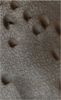
ESP_027378_2540-PCF-LXTT-IPF-2.jpgNorthern Dunes (EDM - Absolute Natural Colors; credits for the additional process. and color.: Dr Paolo C. Fienga/Lunexit Team)87 visiteThe Dunes visible in this EDM are approximately 100 meters across and they are traversing a bumpy, hard Terrain. Polygonal Patterns are evident in some areas while numerous meter-scale Boulders are strewn throughout the whole Region. The Boulders are more numerous in areas where the Polygonal Patterns are less pronounced. Repeated imaging of this large Dunefield shall reveal whether these Dunes are presently moving (so-called "Migrating Dunes") or not.
Mars Local Time: 14:42 (Early Afternoon)
Coord. (centered): 73,622° North Lat. and 328,215° East Long.
Spacecraft altitude: 316,7 Km (such as about 198,0 miles)
Original image scale range: 63,4 cm/pixel (with 2 x 2 binning) so objects ~ 1 mt and 90 cm across are resolved
Map projected scale: 50 cm/pixel
Map projection: POLAR STEREOGRAPHIC
Emission Angle: 1,9°
Sun - Mars - MRO (or "Phase") Angle: 57,6°
Solar Incidence Angle: 56° (meaning that the Sun is about 34° above the Local Horizon)
Solar Longitude: 117,4° (Northern Summer - Southern Winter)
Credits: NASA/JPL/University of Arizona
Additional process. and coloring: Lunar Explorer ItaliaMareKromiumLug 18, 2012
|
|

PSP_001700_2505-PCF-LXTT-IPF-01.jpgLouth Crater (CTX Frame - Absolute Natural Colors; credits for the additional process. and color.: Dr Paolo C. Fienga - Lunexit Team)99 visiteThis observation shows a persistent Frost Patch located on a Mound which is inside Louth Crater. The Frost Patch has remained largely stable at least since the Viking era (such as the late 1970s). The bright Frosty Region is bounded by a Dunefield on the North/East and the so-called "Size Classes" of several of the Features forming the Dunefield probably represent generations of Dunes that were created under a variety of Dominant Wind Conditions. The Frost is largely absent over the Dunes, but it is way more stable on the Ground that does not possess Dune-shaped Landforms.
Mars Local Time: 15:14 (Early Afternoon)
Coord. (centered): 70,377° North Lat. and 103,397° East Long.
Spacecraft altitude: 317,5 Km (such as about 198,4 miles)
Original image scale range: 63,5 cm/pixel (with 2 x 2 binning) so objects ~ 1 mt and 91 cm across are resolved
Map projected scale: 50 cm/pixel
Map projection: POLAR STEREOGRAPHIC
Emission Angle: 9,3°
Sun - Mars - MRO (or "Phase") Angle: 56,1°
Solar Incidence Angle: 64° (meaning that the Sun is about 26° above the Local Horizon)
Solar Longitude: 146,4° (Northern Summer - Southern Winter)
Credits: NASA/JPL/University of Arizona
Additional process. and coloring: Lunar Explorer ItaliaMareKromiumLug 18, 2012
|
|

PSP_007805_2505-PCF-LXTT-IPF-00.jpgFrost all over Louth Crater (Absolute Natural Colors; credits for the additional process. and color.: Dr Paolo C. Fienga - Lunexit Team)86 visiteThis image shows the changing Seasonal Frost Patterns on Louth Crater, located at about 70° North Latitude, in the Martian Region of Vastitas Borealis. This Crater contains a Mound (---> terrapieno) covered by Water Frost that persists throughout the year (which is an unusual circumstance for this Latitude); however, even the Seasonal Carbon Dioxide (CO2) Frost deposited during the Northern Winter can reach such a Latitude. At the time this image was acquired (such as during the Northern Spring), the Carbon Dioxide Frost was in the process of sublimating back into the Martian Atmosphere. Note that there are Sand Dunes near the edge of the Mound, which become clear of Frost in the Summer.
Mars Local Time: 14:32 (Early Afternoon)
Coord. (centered): 70,228° North Lat. and 103,538° East Long.
Spacecraft altitude: 316,2 Km (such as about 197,6 miles)
Original image scale range: 31,6 cm/pixel (with 1 x 1 binning) so objects ~ 95 cm across are resolved
Map projected scale: 25 cm/pixel
Map projection: POLAR STEREOGRAPHIC
Emission Angle: 1,7°
Sun - Mars - MRO (or "Phase") Angle: 54,7°
Solar Incidence Angle: 56° (meaning that the Sun is about 34° above the Local Horizon)
Solar Longitude: 50,3° (Northern Spring - Southern Autumn)
Credits: NASA/JPL/University of Arizona
Additional process. and coloring: Lunar Explorer ItaliaMareKromiumLug 18, 2012
|
|

PSP_001700_2505-PCF-LXTT-IPF-02.jpgLouth Crater (EDM - Absolute Natural Colors; credits for the additional process. and color.: Dr Paolo C. Fienga - Lunexit Team)99 visiteThis observation shows a persistent Frost Patch located on a Mound which is inside Louth Crater. The Frost Patch has remained largely stable at least since the Viking era (such as the late 1970s). The bright Frosty Region is bounded by a Dunefield on the North/East and the so-called "Size Classes" of several of the Features forming the Dunefield probably represent generations of Dunes that were created under a variety of Dominant Wind Conditions. The Frost is largely absent over the Dunes, but it is way more stable on the Ground that does not possess Dune-shaped Landforms.
Mars Local Time: 15:14 (Early Afternoon)
Coord. (centered): 70,377° North Lat. and 103,397° East Long.
Spacecraft altitude: 317,5 Km (such as about 198,4 miles)
Original image scale range: 63,5 cm/pixel (with 2 x 2 binning) so objects ~ 1 mt and 91 cm across are resolved
Map projected scale: 50 cm/pixel
Map projection: POLAR STEREOGRAPHIC
Emission Angle: 9,3°
Sun - Mars - MRO (or "Phase") Angle: 56,1°
Solar Incidence Angle: 64° (meaning that the Sun is about 26° above the Local Horizon)
Solar Longitude: 146,4° (Northern Summer - Southern Winter)
Credits: NASA/JPL/University of Arizona
Additional process. and coloring: Lunar Explorer ItaliaMareKromiumLug 18, 2012
|
|
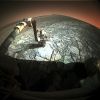
OPP-SOL2998-EB-MF-LXTT-IPF-2.jpgBright Sun, Dark Sky - Sol 2998 (Natural Colors; credits for the additional process. and color.: Elisabetta Bonora and Marco Faccin - Lunar Explorer Italia/Italian Planetary Foundation)118 visiteWe said that in the past and we have to say it again: how many times have we already read (here, there and everywhere...), that the Martian Sky should be "Blue" (actually, "Light Blue", according to the "Raleigh Scattering" Model)? Certainly a thousand times (at least!) and, well, maybe some time ago, the question could have made some sense.
But now, after so many Natural and Absolute Colorizations of the NASA - MER Spirit and Opportunity's Original b/w Frames, how could we keep doubting? Color, brightness, nuances of the Martian Sky... Let's see if we can make a little step forward, once in a while...
Among many other things (and forgetting the color of the Martian Sky for a moment), the NASA People often told us that the Sky of Mars is "bright" and we wish to say that, perhaps, at certain Latitudes and during certain times of the Martian Year (as well as at certain - and given - daytime hours), such a statement could even be reasonable.
Said that, we honestly believe that, first of all, the Martian Sky is not particularly bright at all. In fact, we believe that the Martian Sky should really (if not extremely) be dark.
Second, we believe that the Sun, even though its diameter is over one-third smaller than the one which we can see from Earth, shines VERY brightly over the Martian Landscapes: especially, we think, starting from the late morning hours (let's say 09:00/09:30 Mars Local Solar Time) and until, probably (and during the Martian Summer), 16:00 or 17:00 (always Mars Local Solar Time).
Furthermore, and according to what we have speculated in the past, the portion of the Sky visible near the Martian Horizon, should slightly be brighter than the rest of the Sky. In other words: if you were on Mars, near the Rover and looking at the Horizon of Meridiani Planum, you should see a relatively bright (lower portion of the) Sky that, the more you rise your look, the darker it will get.
Talking about the color of the Martian Sky, instead, since (and of course...) we haven't been on Mars (yet!) we cannot be one-hundred-percent certain of anything but, after so many years of studying and processing images from the Red Planet, it seems to us quite reasonable and believable to say that the Martian Sky is NOT blue, nor light-blue at all.
The Martian Sky, most likely, can show itself in quite a few different colors, but its "natural" one, should be a light-orange. Near the Sun, probably, the NASA People are correct when they say that it should be kind of pale-blue and white; but most of it - in any case and for most part of the day - is and should (almost) always be of a light white/orange color (we repeat: near the horizon), and then (as we look over and above the horizon itself), of an orange/yellowish color that the more we look towards the Zenith (or the Nadir), the darker it should get.
It is also possible that the Martian Sky might show - at certain conditions - some yellow and pink nuances: this depending on the specific time of the day that we consider, as well as on the Atmospheric Opacity - or TAU - existing at that time, on the Martian Season and on the given Martian Latitude.
In this beautiful frame, processed in Natural Colors, we can see that the Sky near the Horizon is actually (yet quite dimly) bright, while the rest of the visible Sky is dark. Almost black (we should say that its color looks like a VERY dark orange, which tends to the brown). But the Sun, that is shining (relatively) high in the Sky, is VERY bright! So bright that the Martian Paving where NASA - MER Opportunity is rolling on, appears, to the Electronic Eyes of the Rover, of a bright and sharp white color, with some light-blueish nuances (these nuances being probably caused by the blue cristals that seem to be dispersed all over the place).
In the end, and just to draw some conclusions, the Martian Sky, in our opinion - as IPF (and no matter what we often see - or think to see... - in the frames that come to us from the Red Planet) -, is usually dark (VERY dark during the Late Fall and through the entire Martian Winter), but the Sun (except during the massive Sand Storms that, sometimes, darken the whole Planet) always shines very bright, particularly during the months corresponding to the Late Spring and Summer of the Red Planet. But a bright Sun, in our opinion, does not mean AT ALL a bright Daytime Sky! And please, forgive us, if, one day, we might be proven wrong...
This frame has been colorized in Natural Colors (such as the colors that a perfect human eye would actually perceive if someone were near the NASA - MER Opportunity and then looked towards the Martian Horizon), by using an original technique created - and, in time, dramatically improved - by the Lunar Explorer Italia Team.MareKromiumLug 11, 2012
|
|
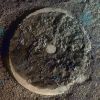
OPP-SOL3001-MF-EB-LXTT-IPF.jpgCloser than ever: Particulate, Dust and, maybe, Sylvinite Cristals? - Sol 3001 (Credits for the additional process. and color.: Elisabetta Bonora and Marco Faccin - Lunar Explorer Italia/Italian Planetary Foundation)108 visitenessun commentoMareKromiumLug 11, 2012
|
|
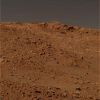
SOL187-2P142962814RAD70ASP2546L234567C1-PCF-LXTT-IPF.jpgThe "Martian Mound": a very unusual rock formation? (Enhanced Natural Colors; credits for the additional process. and color.: Dr Paolo C. Fienga - Lunar Explorer Italia/Italian Planetary Foundation) 200 visitenessun commentoMareKromiumLug 11, 2012
|
|
| 25353 immagini su 2113 pagina(e) |
 |
|
|
|
|
106 | |
|
|
|
|
|
|





