| Ultimi arrivi |

SOL0034-MH0063001000E1_DXXX-2-GB-LXTT-IPF.jpgThe First "Martian Fly" of Gale Crater? - Sol 34 (RAW Natural Colors; credits for the additional process. and color.: Dr Gianluigi Barca/Lunar Explorer Italia/Italian Planetary Foundation) 131 visiteQuante ne abbiamo viste di queste "mosche" nei frames Spirit ed Opportunity? Innumerevoli. Si tratta di un image-artifact ripetitivo? Forse. Ma va comunque detto che gli image-artifacts ripetitivi "autentici" (ossìa quelli derivanti da un vizio fisico di una delle lenti - o dei filtri/colore - delle fotocamere presenti sui Rover) si ripetono su ogni frame, nello stesso punto, e sono SEMPRE ASSOLUTAMENTE (ed ovviamente) UGUALI! Questo "vizio" lo vediamo anche in altri frames del MER Curiosity e sempre nel medesimo punto? No. Allora potrebbe anche non trattarsi di un image-artifact e SICURAMENTE non di un image-artifact derivante da vizio (lesione) della lente. Di che cosa si tratta? Non ne abbiamo idea.
Complimenti al Dr Barca per il suo solito "Occhio", davvero eccezionale (anche dopo anni di ricerche e di sforzi visivi davvero non indifferenti)!MareKromiumSet 12, 2012
|
|

ESP_023094_1640_RED_NOMAP_browse-PCF-LXTT-IPF.jpgThe Wall of Coprates Chasma (Absolute Natural Colors; credits for the additional process. and color: Dr Paolo C. Fienga/Lunar Explorer Italia/Italian Planetary Foundation)158 visiteMars Local Time: 14:08 (Early Afternoon)
Coord. (centered): 15,599° South Lat. and 300,540° East Long.
Spacecraft altitude: 258,8 Km (such as about 161,7 miles)
Original image scale range: 51,8 cm/pixel (with 2 x 2 binning) so objects ~ 1 mt and 55 cm across are resolved
Map projected scale: 50 cm/pixel
Map projection: EQUIRECTANGULAR
Emission Angle: 6,9°
Sun - Mars - MRO (or "Phase") Angle: 37,9°
Solar Incidence Angle: 31° (meaning that the Sun is about 59° above the Local Horizon)
Solar Longitude: 320,3° (Northern Winter - Southern Summer)
Credits: NASA/JPL/University of Arizona
Additional process. and coloring: Lunar Explorer Italia/Italian Planetary FoundationMareKromiumSet 10, 2012
|
|

SOL0034-PIA16134.jpgWheels... - Sol 34 (Natural Colors; credits: NASA/JPL-Caltech/Malin Space Science Systems)156 visiteCaption NASA:"This view of the 3 (three) Left Wheels of NASA's Mars Rover Curiosity combines two images that were taken by the Rover's Mars Hand Lens Imager (MAHLI) during the 34th Martian Day, or Sol, of Curiosity's work on Mars (such as September 9, 2012). In the distance is the lower Slope of Mount Sharp. The camera is located in the turret of tools at the end of Curiosity's Robotic Arm. The Sol 34 imaging by MAHLI was part of a week-long set of activities for characterizing the movement of the Arm in the Mars (Environmental) conditions.
The main purpose of Curiosity's MAHLI camera is to acquire close-up, high-resolution views of Rocks and Soil at the Rover's Gale Crater Field Site. The camera is capable of focusing on any target at distances of about 0,8" (inch), such as 2,1 centimeters, to infinity, providing versatility for other uses, such as views of the Rover itself from different angles".
Nota Lunexit: si poteva fare decisamente di meglio...MareKromiumSet 10, 2012
|
|

Craters-Gale_Crater-PIA16148-PCF-LXTT-IPF.jpgCuriosity Traverse Map through Sol 29 (Absolute Natural Colors; credits for the additional process. and color.: Dr Paolo C. Fienga/Lunar Explorer Italia/Italian Planetary Foundation)131 visiteCaption NASA:"This Map shows the route driven by NASA's Mars rover Curiosity through the 29th Martian Day, or Sol, of the Rover's Mission on Mars (such as September 4, 2012). The route starts where the Mars Science Laboratory Spacecraft placed the Rover, a Site subsequently named "Bradbury Landing". The line extending toward the right (---> Eastward) from Bradbury Landing is the Rover's Path. Numbering of the dots along the line indicate the Sol number of each drive. North is up. The scale bar is 200 meters (656 feet).
By Sol 29, Curiosity had driven at total of 358 feet (such as 109 meters). At the location reached by the Sol 29 drive, the Rover began several Soles of Arm Characterization Activities. The "Glenelg Area", which is farther East, is the mission's first Major Science Destination, selected as likely to offer a good target for Curiosity's first analysis of powder collected by drilling into a Rock".MareKromiumSet 10, 2012
|
|

OPP-SOL3058-PIA16127-PCF-LXTT-IPF-00.jpgRocky "Fins" on Cape York - Sol 3058 (Absolute Natural Colors; credits for the additional process. and color.: Dr Paolo C. Fienga/Lunar Explorer Italia/Italian Planetary Foundation)107 visitenessun commentoMareKromiumSet 10, 2012
|
|

SOL0016-FRA_398919417EDR_F0030078FHAZ00302M_.jpgUp-Sun at Gale - Sol 16 (a "Martian Fantasy" in Absolute Natural Colors; credits for the additional process. and color.: Dr Paolo C. Fienga/Lunar Explorer Italia/Italian Planetary Foundation)136 visitenessun commentoMareKromiumSet 04, 2012
|
|

Titania-PIA01979-PCF-LXTT-IPF.jpgTitania (Absolute Natural Colors; credits for the additional process. and color.: Dr Paolo C. Fienga/Lunar Explorer Italia/Italian Planetary Foundation)103 visiteCaption NASA:"Voyager 2 obtained this full-disk view of Uranus' moon Titania in the early morning hours of Jan. 24, 1986, from a distance of about 500.000 Km (approx. 300.000 miles). Many circular depressions -- probably impact craters -- are visible in this clear-filter image returned by the Voyager narrow-angle camera.
Other bright spots are distinguished by radiating rays and are probably halo craters that mark relatively more recent impacts. Even more interesting are Linear Troughs (right) that are probably Fault Canyons (Tectonic Fractures). The Troughs break the crust in two directions, an indication of some tectonic extension of Titania's crust. These features indicate that this icy satellite has a dynamic, active interior. Titania is about 1600 Km (approx. 1000 mi) in diameter; the resolution of this image is about 9 Km (approx. 6 mi) per pixel". MareKromiumSet 04, 2012
|
|
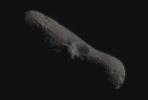
20000217a-PCF-LXTT-IPF.jpgOrbiting 433-Eros (Absolute Natural Colors; credits for the additional process. and color: Dr Paolo C. Fienga/Lunar Explorer Italia/Italian Planetary Foundation)152 visiteCaption NASA:"This picture of 433-Eros, the first of an Asteroid taken from an orbiting spacecraft, is a mosaic of 4 images obtained by NEAR on February 14, 2000, immediately after the Spacecraft's insertion into orbit. We are looking down over the North Pole of Eros at one of the largest craters on the surface, which measures 4 miles (about 6 Km) across. Inside the crater walls are subtle variations in brightness that hint at some layering of the rock in which the crater formed. Narrow grooves that run parallel to the long axis of Eros cut through the South-Eastern part of the crater rim. A house-sized boulder is present near the floor of the crater; it appears to have rolled down the bowl-shaped crater wall. A large number of boulders is also present on other parts of the Asteroid's surface. The surface of the Asteroid is heavily cratered, indicating that 433-Eros is relatively old.
(Mosaic of images 0125956839, 0125957025, 0125957087, 0125957273)MareKromiumSet 04, 2012
|
|

20000314-PCF-LXTT-IPF.jpgThe "Saddle Region" (Absolute Natural Colors; credits for the additional process. and color.: Dr Paolo C. Fienga/Lunar Explorer Italia/Italian Planetary Foundation)107 visiteCaption NASA:"This image mosaic, showing Eros' Saddle and a shadowed feature to its left, was taken on March 3, 2000 from a distance of 204 Km (about 127 miles). In this picture features as small as 20 meters (65 feet) across are visible. This is the best view to date of this area. The Sun is coming from the North-East illuminating a shadowed feature that consists of 3 large craters situated adjacent to each other. The two largest are each about 4-5 Km (2-3 miles) across.
Because the Sun is very low with respect to these craters, even small topographic features cast long shadows, making them easier to see. As a result, several boulders on the crater walls can be distinguished, ranging from about 50 to 100 meters in diameter. The Saddle (on the right of the mosaic) is relatively smooth with few impact craters, and has several grooves running across it. At the top of the saddle are several curved grooves that are brighter than the surrounding surface. Unusual brightness patterns are also visible in the crater at the top left of the mosaic. The walls of the crater appear to be more reflective and its floor less reflective than nearby parts of the asteroid.
(Mosaic of images 0127504836, 0127504898, 0127505146, 0127505208,0127505394, 0127505456)MareKromiumSet 04, 2012
|
|

Saturn-PIA09009-PCF-LXTT-IPF.jpgSaturnian Cloud Bands (Absolute Natural Colors; credits for the additional process. and color.: Dr Paolo C. Fienga - Lunar Explorer Italia/Italian Planetary Foundation)123 visiteCaption NASA:"The Cassini Spacecraft spies smooth, sometimes wavy, contours in the banded East-West flowing clouds of Saturn. This view shows clouds in Saturn's Northern Mid-Latitudes.
The image was taken using a spectral filter sensitive to wavelengths of infrared light centered at 727 nanometers. The view was obtained with the Cassini spacecraft narrow-angle camera on July 8, 2007 at a distance of approx. 2,9 MKM (about 1,8 MMs) from Saturn.
Image scale is roughly 34 Km (about 21 miles) per pixel".
Un nuovo passo in avanti per la Colorizzazione Naturale Assoluta creata da Lunar Explorer Italia: ora, infatti, inizieremo la rivalutazione (in senso di analisi cromatica) dei frames CASSINI e, quindi, la ricolorizzazione di Saturno. Ecco il primo "nato" di questa nuova serie.MareKromiumSet 03, 2012
|
|

OPP-SOL1019-1P218648789EFF7700P2436L2M1-PCF-LXTT.jpgFeatures of Victoria Crater's Inner Rim (Absolute Natural Colors; credits for the additional process. and color.: Dr Paolo C. Fienga - Lunar Explorer Italia/Italian Planetary Foundation)130 visitenessun commentoMareKromiumSet 03, 2012
|
|

Craters-Gale_Crater-ESP_028256_9022-EB-MF-LXTT-IPF.jpgFeatures of Gale Crater (Natural Colors; credits for the additional process. and color.: Elisabetta Bonora and Marco Faccin/Lunar Explorer Italia/Italian Planetary Foundation)113 visitenessun commentoMareKromiumSet 03, 2012
|
|
| 25353 immagini su 2113 pagina(e) |
 |
|
|
|
|
101 | |
|
|
|
|





