| Ultimi arrivi - The Clementine Files |

PreSunrise.JPG028 - Pre Sunrise: Solar Corona, Stars, Dark Side and Near Side60 visiteThis presunrise Startracker image shows the Solar Corona, stars in the background and the Terminator between the dark side of the Moon and the area on the right, which is illuminated by light reflected from the Earth.Nov 26, 2005
|
|

NorthPoleoftheMoon.JPG114 - North Polar Region61 visiteThis shows a 630-Km long mosaic of the Northern Polar Region along the 180° West Longitude line from 69° to 90° North Latitude.
Imaged by the UV/VIS camera.Nov 26, 2005
|
|

Moon-Clem.JPG015 - The Moon (visible and near-infrared)62 visiteOne of the major scientific goals of the Clementine mission is to map the Moon in 11 different wavelengths in the visible and near-infrared parts of the spectrum. The filter colors of the Clementine cameras were carefully chosen to differentiate types of lunar surface material. In our first look at the global color, each Clementine image made by the UV/VIS camera has been reduced to its average value, producing a picture of the Moon at low resolution (about 50 kilometers per pixel). These pictures show the albedo (brightness) and color of the Moon from three aspects: the Earth-centered view (near side) with a 0 degree central longitude, and two far side views with 120 degrees East and 120 degrees West central longitudes. These images have been made by assigning colors to the relative reflectance values obtained through various filters, resulting in a map showing the compositional variation of the Moon.
Major compositional provinces in the highlands are evident. The large dark red-gray region on the far side is the South Pole-Aitken basin, an ancient impact feature that apparently contains rocks of distinct composition. A newly discovered compositional anomaly on the east limb of the Moon (pink area near center of 120 degrees East image) may be related to ancient flows of lava. The color picture shows that very high titanium lavas (deep blue and cyan colors) appear to be largely confined to the Oceanus Procellarum, Mare Imbrium, and Mare Tranquillitatis areas (near side). These views of the Moon in three colors only hint at the scientific richness contained within the Clementine global data, which will be investigated for years to come.
Nov 26, 2005
|
|

Eartshine.JPG024 - Earthshine73 visiteThe Clementine Startracker acquired this image of the Moon glowing from the reflected light of the Earth. Nov 26, 2005
|
|

Plato Crater.JPG091 - Plato Crater72 visitePlato crater imaged by the UV/VIS camera at 1 micron, from an altitude of about 485 Km.
Plato is situated at 51° North Lat. and 9° West Long.; North is up. The strip width of this mosaic is about 90 Km.
The smallest craters visible are roughly 600 meters across. Nov 26, 2005
|
|

Rydberg Crater.JPG191 - Rydberg Crater63 visiteRydberg crater mosaic imaged by the UV/VIS camera from an altitude of about 485 Km. Rydberg is located at 47° North Lat. and 97° West Long.
Strip width is about 50 Km. Nov 26, 2005
|
|

007-The Moon from Clem-Gagarin.JPG030 - Jules Verne Crater81 visiteThis oblique image was acquired by Clementine during orbit 255. The images used to form this color composite were taken with the UV/VIS camera at wavelengths of 415, 750, and 1000 nnmts. In the lower right are seen mare materials (flood lavas) in the floor of the impact crater Jules Verne. To the left, near the Limb of Gagarin, is another mare unit in the floor of Tsiolkovsky.Nov 26, 2005
|
|
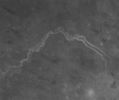
033-The Moon from Clem-Aristarchus-3.jpg041 - Aristarchus and Vallis Schroteri72 visiteThe plateau of the Aristarchus Crater has experienced intense volcanic activity, both effusive and explosive.
It includes the densest concentration of Lunar "sinuous rilles" ("snake-like" valleys) including the largest known, Vallis Schroteri, which is about 160 km long, up to 11 km wide and 1 km deep.
The rilles in this area begin at cobra-head craters, which are the apparent vents for a dark mantling deposit covering the plateau and nearby areas to the North and East.Nov 26, 2005
|
|
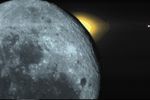
009-The Moon from Clem-Corona.JPG022 - Solar Corona82 visiteThe Earth-lit Moon, The Sun's corona, and - to the far right - Venus, are visible in this color-enhanced Startracker image. The Mare Humorum is the dark circular mare at the center of the lunar disk.Nov 25, 2005
|
|

003-The Moon and Venus from Clem.JPG021 - The Moon, Solar Corona and Venus67 visiteThis color-enhanced image of Venus, the solar corona, and the Moon was acquired by the Startracker.
The Terminator between the dark side of the Moon and the Earth-lit side can also be seen.Nov 25, 2005
|
|

002-The Moon and Planets from Clem.JPG020 - The Moon and a few planets77 visiteThe Startracker imaged this spectacular shot of the sunrise, planets, and Moon. This color-enhanced image shows, from right to left, the Moon lit by the Earth, the terminator - or boundary between light and dark - into the dark side with the solar corona just rising over the limb, and the bright planets Saturn, Mars, and Mercury. Several dimmer stars can also be seen. The Startracker algorithm achieved a star match, realizing that the Sun and planets were not in the correct position to be stars, and ignored them.Nov 25, 2005
|
|

090-The Moon from Clem-KeplerCrater.jpg152 - Kepler Crater75 visitenessun commentoNov 05, 2005
|
|
| 81 immagini su 7 pagina(e) |
 |
|
|
5 | |
|





