| Ultimi arrivi - The Clementine Files |

LUB20183.gif185 - Rydberg Crater and surroundings64 visitenessun commentoNov 28, 2005
|
|

LUB20152.gif184 - Rydberg Crater and surroundings75 visitenessun commentoNov 28, 2005
|
|

LUB20121.gif183 - Rydberg Crater and surroundings76 visitenessun commentoNov 28, 2005
|
|

LUB20090.gif182 - Rydberg Crater and surroundings63 visitenessun commentoNov 28, 2005
|
|

LUB20059.gif181 - Rydberg Crater and surroundings68 visitenessun commentoNov 28, 2005
|
|

Earth.JPG300 - The Earth from Clementine71 visiteThis was imaged by the High Resolution Camera at 750 nm on 11 April 1994 during lunar orbit 242. This mosaic was put together from over 70 HR images as the Clementine spacecraft's attitude was adjusted to scan the sensor across the Earth in strips.
The image shows a 2° by 2° field of view and has a resolution of 6 Km from a distance of about 380.000 Km.
Africa and the Middle East are clearly visible on the right, with South and Central America visible on the left.
The Caribbean, Florida and the the Eastern US (mostly under cloud cover) are visible near the top of the image. North is to the upper right.Nov 28, 2005
|
|

OrientaleBasin&SC~0.JPG027 - Earthshine and Solar Corona over the Orientale Basin74 visiteThis fantastic view of the Moon was acquired by the Attitude Determination Camera (Startracker) on board Clementine.
The Moon is illuminated only by Earthshine - that is, sunlight reflected from the Earth to the Moon.
The Sun is actually behind the Moon, though the outer portion of the Sun, the Solar Corona, is visible over the limb.
The ringed basin disappearing into the darkness is the Orientale Basin.
deep shadows cast by its steep walls give a dramatic emphasis to its classic multi-ring morphology.Nov 28, 2005
|
|

FarSideAlbedo.jpg006 - Farside Albedo68 visiteGlobal map of the albedo from the 750-nanometer filter of the Clementine UV-VIS camera and this is the FarSide of the Moon, shown in Lambert equal-area projection.
Note the lack of maria on the FarSide, as compared to the NearSide.
The relatively dark area at center-bottom outlines the extent of the South Pole-Aitken Basin. This view has been subsampled to a resolution of about 1 Km per pixel, about 5 times lower than the full-resolution data.Nov 26, 2005
|
|

MoonEclypse.JPG025 - Sun-Eclypse from Clementine73 visiteThis Startracker image shows the Moon eclipsing the Sun; the bright crescent Earth is partially visible at left, saturating the sensor.
The image was captured during orbit 164, on March 26, 1994, halfway through Moon mapping at a distance of about 3500 km.Nov 26, 2005
|
|

NearsideAlbedo.JPG007 - Nearside Albedo67 visiteGlobal map of the albedo from the 750-nanometer filter of the Clementine UV-VIS camera. This is the NearSide of the Moon, shown in Lambert equal-area projection.
Note the familiar appearance of the maria; the fresh, rayed crater near bottom center is Tycho.
This view has been subsampled to a resolution of about 1 Km per pixel, about 5 times lower than the full-resolution data.Nov 26, 2005
|
|
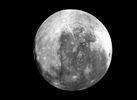
000-The Moon from Clem.JPG014 - Light-up the Moon!72 visiteMosaic of the near side of the Moon lit by Earthshine, as imaged by a Startracker camera on March 15, 1994.
The Southern Hemisphere is up.
The bright crater toward the top of the image is Tycho.Nov 26, 2005
|
|

Copernicus Crater.JPG053 - Copernicus Crater (mosaic)72 visiteMosaic of the lunar crater Copernicus produced using images obtained by the Clementine UV/VIS camera. This 95-km crater, believed to be approximately 800 million years old, is located near the center of the lunar nearside and exhibits prominent rays extending in all directions. The right section of the image is a color composite mosaic of the eastern half of Copernicus. This color mosaic was prepared using images obtained through filters of three different colors chosen to allow small lunar color differences to be mapped in a geologic context. In this image, the color assignments are: red (750/415 nm), green ( 750/950 nm), and blue (415/750 nm). The left section of the image is a mosaic of the same area prepared using frames obtained through a single filter (750 nm). This mosaic is displayed as a mirror image to the color composite to allow easy comparison of geologic features and their color.
Extensive large- and small-scale heterogeneity of materials excavated by this large crater is readily evident from the color composite mosaic. Bright blue tones typically suggest fresh material similar to Apollo 16 rocks and breccias, mottled red-orange tones indicate material similar to Apollo 16 soils, vivid red is associated with deposits of impact melt (seen most prominently in the northwestern part of the crater floor), and green-yellow tones along the southern wall imply a higher abundance of iron-bearing materials.
Impact craters can be used as windows into the interior and this multispectral image of Copernicus provides dramatic new information about how materials are excavated, melted, mixed, and deposited in a major impact event. The extensive heterogeneity around the wall of the crater indicates materials are not intimately mixed in spite of the huge energy involved during crater formation. Similarly, impact melt (target rock melted during the impact event) is not distributed uniformly, but can be seen to be concentrated in large sections of the floor and in small areas along ledges of the walls.
Nov 26, 2005
|
|
| 81 immagini su 7 pagina(e) |
 |
|
4 | |
|
|





