| Ultimi arrivi - The Lunar Surface in HR |

APOLLO 16 AS 16-4511.jpgAS 16-4511 - Crater "Rays"56 visiteThis picture shows the striking bilateral symmetry of the rays of a small (2-Km diameter) crater in the floor of the large crater Daguerre in Mare Nectaris. Continuous areas and narrow filaments of light-gray ejecta extend from the crater across the dark mare surface through 270°, but are entirely absent in the southern 90° sector. Within the crater, dark material occurs on the southern crater wall while the remaining walls are bright. (The reader may wonder about the material whose reflectivity cannot be observed because it lies in shadow on the East wall of this crater. Until the area is observed under high Sun conditions, we are forced to make the simplifying assumption that it is bright because most of the materials visible elsewhere in the walls are bright).
This crater probably resulted from the impact of a projectile traveling from South to North along an oblique trajectory.
Its pattern of ejecta distribution is similar to that of small craters produced by the impact of missiles along oblique trajectories at the White Sands Missile Range, N. Mex. Some observers postulate that the dark material is a talus deposit of mare material that has fallen into the crater.Ago 16, 2006
|
|

APOLLO 16-4136-B.jpgAS 16-4136 - Cratered Region near Mandel'shtam (2)55 visiteThis enlarged view of part of frame AS 16-4136 shows some of the smooth flows that originate near the crest of the crater rim at the left side of photograph. Arrows point to the lower ends of two flows.
The origin of the flow material is controversial.
It was probably molten material generated by shock-wave compression of lunar rocks and ejected at relatively low velocities during the late stages of the formation of the impact crater; or it may have resulted from the flow of rock debris mixed with a fluidizing agent such as gas or water; or it may have been volcanically generated lava.Ago 16, 2006
|
|

APOLLO 16-4136-A.jpgAS 16-4136 - Cratered Region near Mandel'shtam (1)56 visiteThis view looks southward near Mandel'shtam on the Lunar Far-Side. Most young lunar craters wider than about 40 Km have flows on their rims that resemble lava flows or mud flows on Earth. The unnamed crater near the top is about 14 Km wide and was recognized by H. J. Moore (1972) as being the smallest crater known to have such flows. Flows in the middle of the picture surged downhill off the high rim of the crater making lobes and tongues and leaving behind drained channels with levees.
In the area to the right of the crater, enlarged in the next frame, are some thin lobate flows that apparently rode over small hills, as if these flows were propelled outward from the crater with sufficient velocity to climb the hills. Ejecta deposits farther than about 1 Km from the rim are radially lineated and are smoother than the ground immediately surrounding the crater. The crisp, blocky zone around the crater is typical of many fresh craters.Ago 16, 2006
|
|

APOLLO 16-0692.jpgAS 16-0692 - Teophilus Crater54 visiteTheophilus is a relatively young crater similar in size but slightly older than Copernicus. It lies on the eastern edge of the Kant Plateau, an elevated area in the Central Highlands along the northwestern margin of Mare Nectaris. Part of Nectaris is visible as the smooth, dark area near the horizon at the left edge. Like Copernicus and Aristarchus, Theophilus has ruggedly terraced walls and a complex central peak protruding through a level floor. Smooth-surfaced material is present in "pools" at various levels on the terraces, on parts of the crater floor, and on the ejecta that blanket the near (North) side of the crater.
As one alternative, the pools may have been emplaced as fluid lava. Ago 15, 2006
|
|

APOLLO 15 AS 15-2510.jpgAS 15-2510 - Humboldt Crater57 visiteThe crater Humboldt, on the east limb of the Moon, as seen from Earth, is 200 km across, a little larger than Tsiolkovsky. This view by the Apollo 15 mapping camera looks southward across Humboldt's ejecta blanket and into the crater. Irregular secondary craters partly covered by the ejecta are in the foreground and a long chain of secondaries extends from Humboldt's rim to the foreground. Humboldt is one of the largest craters known to have a prominent central peak. If the crater is like terrestrial impact structures, the peak may expose rock uplifted about 10% of the crater's width, on the order of 20 Km from beneath the crater floor. This would be an exciting find for future Astronauts. A spider web of cracks on the crater floor suggested to R. B. Baldwin (1968) that the floor was bowed up in the middle. Later, dark mare lavas flooded low areas in the outer part of the floor and covered the cracks. A peculiar "bull's eye" double crater on the crater floor has several counterparts elsewhere on the Moon. The origin of these double craters is a continuing puzzle.Ago 15, 2006
|
|

APOLLO 15 AS 15-1541.jpgAS 15-1541 - Archimedes and Aristillus56 visiteThe ejecta blanket and secondary impact craters of the mare-filled crater Archimedes (80 Km in diameter) are visible on the terrain toward the viewer (South) but not on the mare surface to the crater's left and right. Yet at one time ejecta like that to the south must have completely surrounded Archimedes because similar ejecta surrounds craters such as Aristillus (upper right). Thus, the mare lavas, in addition to filling the interior of Archimedes, obviously have covered the eastern and western parts of the ejecta. In turn, ejecta from Archimedes has covered materials of the Imbrium Basin like the rugged hills in the lower left of the picture. These stratigraphic relations prove that time elapsed between formation of the Imbrium basin and its filling by mare-time enough for impacts to create Archimedes, the deeply flooded crater to its right (arrow), and similar "Imbrian-age" craters elsewhere, as was pointed out by Eugene Shoemaker in 1962.
Archimedes has no visible central peak complex. Presumably the complex exists but has been completely inundated by the mare.Ago 15, 2006
|
|

APOLLO 15 AS 15-9596.jpgAS 15-9596 - Tsiolkovsky55 visiteDrastic enlargement of a panoramic camera frame provides a wealth of detail within the small area outlined in AS 15-9591. Note the many large blocks on the slope. The largest block is about 125 mt wide. Most blocks apparently originated at the discontinuous ledge near the top of the slope. Note also the fillets on the upslope side of many of the blocks. They probably consist of fine-grained debris that was trapped behind the blocks as it moved downslope. The arrows identify what appear to be two craters in the process of being destroyed by erosion. Otherwise, craters are absent on the steeply dipping slope, although numerous craters are present on the gentler slopes above.Ago 15, 2006
|
|

APOLLO 15 AS 15-9591.jpgAS 15-9591 - Tsiolkovsky54 visiteModerate enlargement of part of a panoramic camera frame provides greater detail of the central peak complex of Tsiolkovsky. A relatively large population of superposed craters has been preserved on level areas of the peaks (near the left-center of the photograph). In contrast, very few craters are present on steep slopes-most have been destroyed by the downslope movement of erosional debris. An intermediate population of craters on the dark mare shows that the mare surface is younger than the level areas of the peak complex but older than the freshly exposed steep slopes of the peaks. The youngest part of the mare surface is the dark, smooth area adjacent to the small angular rifle in the upper left corner. Here small craters have been almost completely filled by the flow and are barely discernible. The rifle may have served as the vent for the young lavas.Ago 15, 2006
|
|

APOLLO 15 AS 15-1030.jpgAS 15-1030 - Tsiolkovsky61 visiteThis vertical view shows the central part of Tsiolkovsky in more detail. From the nature of the boundary between the dark mare lavas and the lighter materials at the base of the walls and in the central peak, we know that the lavas must have lapped upon and embayed the lighter materials. The relatively level areas of lighter material in the southwest and northwest parts of the floor have a distinctly different texture than the coarse blocky materials of slumped wall that surround the floor elsewhere. Finely cracked, furrowed, and hummocky, they closely resemble parts of the floor of the crater King. They probably consist of impact melt that solidified to form the original floor of Tsiolkovsky before it was flooded by mare lavas.Ago 15, 2006
|
|

APOLLO 15 AS 15-0757.jpgAS 15-0757 - Tsiolkovsky64 visiteTsiolkovsky is one of the most prominent features on the Far-Side of the Moon. It is a 1 90-Km- wide impact crater with a large, complex central peak that is offset from the apparent center of the crater. Differences in tone and texture between the central peak, the lava-flooded floor, the terraced walls and the ejecta blanket are dramatically displayed in this oblique view. The ejecta blanket is dominated by a coarse pattern of ridges radiating outward from the crater; superposed on this pattern are many small level pools of smooth material that are much lighter than the otherwise similar smooth dark mare in the floor of Tsiolkovsky. The pools probably originated differently. They may consist of rock that was melted by the heat and pressure generated during the impact event and that flowed into depressions before it hardened.
Cratering experiments on Earth have shown that central peaks consist of bedrock that has been displaced upward by a distance equal to about 1/10th the diameter of the resulting crater. If samples could be obtained from the central peak at Tsiolkovsky, they might be rocks that were 20 km below the Moon's surface before Tsiolkovsky was created.Ago 15, 2006
|
|
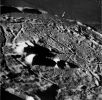
APOLLO 16 AS 16-120-19295~0.jpgAS 16-120-19295 - Gassendi56 visiteThis view into the shallow crater Gassendi shows another strongly fractured crater floor. Gassendi is about 110 Km wide. Dark mare lavas in the distance embay the rim and a little of the interior of Gassendi. They may have entered the crater through the narrow gap partly in shadow below the arrow. Most craters that have fractured floors are near areas of mare flooding. This suggests that the fracturing is a consequence of volcanic activity. An area next to the central peaks of Gassendi was the runnerup choice for a landing site for Apollo 17.Ago 15, 2006
|
|
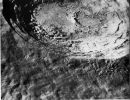
APOLLO 15-0326.jpgAPOLLO 15-0326 - Aristarchus61 visiteAristarchus is a large crater on the edge of a plateau within Northern Oceanus Procellarum. In this scene the crater is viewed obliquely from the North. One of the brightest and youngest craters of its size on the Near-Side of the Moon, Aristarchus is believed to be younger even than Copernicus. The general appearance of Aristarchus and of parts of the plateau around it led Alfred Worden, the Apollo 15 CMP, to describe this part of the Moon as "... probably the most volcanic area that I've seen anywhere on the surface". For many years before the Apollo Missions, Earth-based viewers had reported telescopic sightings of TLP's centered on Aristarchus. These brief, subtle changes in color or in sharpness of appearance have been suggested as evidence for volcanic activity or the venting of gases from the lunar interior. The sightings are controversial, but Aristarchus remains a center of interest.
About 39 Km in diameter, Aristarchus is on the borderline between medium-sized and large- sized craters. We have included it among the large craters because its welldeveloped concentric terraces are characteristic of most large craters that have not been too severely degraded. Its terraced walls, as well as its arcuate range of central peaks, are particularly well shown in this view. The walls and parts of the crater floor are extremely rough and cracked, a characteristic feature of other young impact craters of this size range, such as Tycho and Copernicus. The rough deposits in the floor are probably made up largely of shockmelted material formed at the time of the impact. The inner, rougher portions of the rim show a series of channels, lobate flows, and smooth puddlelike deposits that may represent shock-melted material deposited on the crater rim. The outer, smoother portions show the rhomboidal pattern characteristic of crater ejecta blankets.Ago 15, 2006
|
|
| 86 immagini su 8 pagina(e) |
 |
|
|
|
|
7 |
|





