| Ultimi arrivi - The Lunar Surface in HR |
APOLLO_14_AS_14-66-9292_(HR).jpgAS 14-66-9292 (HR) - Looking for the Blue Flare... (4)55 visitenessun commentoMareKromiumGiu 17, 2007
|
|

APOLLO 16 AS 16-4531.jpgAS 16-4531 - Teophilus' "Peak"55 visiteA detailed view of part of the central peak complex of Theophilus. Central peaks are typical of most young, large impact craters on the Moon-and also of many manmade craters on Earth. From experimental data using controlled explosions, central peaks are known to consist of bedrock originally lying below the crater floor that, during the explosion, was uplifted, faulted, and folded by shock wave action. The irregular light-toned mountainous mass projecting above the floor of Theophilus is split into at least three enormous blocks separated by V-shaped structural valleys. Four or five circular craters without a prominent raised rim are located near or at the bases of the steep slopes. If these craters are endogenic vents rather than impact craters, their presence further suggests structural control along major fault planes. The planar walls of the northwest-trending valley contrast with other sloping surfaces of the central peak complex. They are steeper and, except for a few outcrops of protruding bedrock, are marked by linear grooves not unlike slickensides on many fault planes on Earth. Rock chutes do not seem to be a likely explanation for the grooves because there are no talus deposits or blocks at their lower ends. The debris cover is thin enough along the southern valley wall (top of picture) to show that the southern mountain block consists of layered rocks-at least five thick, light-toned layers alternate with thin, dark layers.Ago 27, 2006
|
|

APOLLO 17 AS 17-151-23260.jpgAS 17-151-23260 - Copernicus Crater61 visiteThe large Crater Copernicus has served as a type example of Lunar Impact Craters since the classic analysis was made by E. M. Shoemaker in 1962. Bright rays of ejecta radiate outward from Copernicus across a large part of the Moon's Near-Side. Material from one of the rays may have been sampled at the Apollo 12 Landing Site, 370 Km South of the center of the crater. This photograph shows how the Crater appeared from the Apollo 17 spacecraft looking Southward over the Montes Carpatus (Carpathian Mountains).
Notice that the rim deposits immediately adjacent to the Crater have a very crisp, blocky appearance in contrast to the softer appearance of the rest of the ejecta blanket. This crisp zone is also found on many other craters and suggests the ejecta here was swept clean by some erosion process late in the cratering event. The terraced slumps on the Crater wall appear like giant stair steps leading to the floor, 3 to 4 Km below the rim. The 1-Km-high central peaks were made famous in 1966 by a "Picture of the century" view looking into the crater from the south by Lunar Orbiter 2. Now Apollo has given us scores of even more spectacular photographs.Ago 27, 2006
|
|

APOLLO 16 AS 16-5006 (1).jpgAS 16-5006 - Details of King Crater (1)56 visiteHere is an enlarged vertical view of more flow lobes inside King Crater. Fine lineations radial to King are prominent in the ejecta blanket behind (South-East of) the lobate fronts. The term "deceleration lobe" has been applied because the lobes occur only where the ejecta slowed down and came to rest on slopes that face toward King. They resemble terrestrial rock avalanche deposits that came to rest after climbing a small slope. Some lobes overlap each other outward like shingles.
The sketch (2) shows what would probably be seen in a cutaway view. The arrow shows the direction of movement of the ejecta over the old landscape.Ago 27, 2006
|
|

APOLLO 16 AS 16-5006 (2).jpgAS 16-5006 - Sketch of the details of King Crater (2)54 visitenessun commentoAgo 27, 2006
|
|
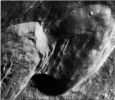
APOLLO 17 AS 17-2773.jpgAS 17-2773 - Overlapping Craters54 visiteThis pair of overlapping medium-sized craters illustrates some of the criteria used to determine relative ages: material ejected from the larger polygonal crater on the left partially fills the smaller crater on the right; thus, the crater on the left is younger. Furthermore, the wall of the large crater is complete, whereas the West wall of the smaller crater is absent, obviously having been destroyed by the larger crater.
Even if the 2 craters did not overlap, the sharp rim, terraced walls and prominent central peak of the larger crater clearly identify it as the younger of the two. The frames used in the stereogram were selected to show exaggerated relief, a technique very helpful to photointerpreters in determining shapes and relative elevations of surface features.
These 2 craters are located in the rugged terrain of the Far-Side highlands, approx. 250 Km north of Tsiolkovsky. Ago 27, 2006
|
|

APOLLO 17 AS 17-2444.jpgAS 17-2444 - Mare Imbrium & Copernicus Crater54 visiteThis oblique view across southern Mare Imbrium looks toward Copernicus, the large crater near the horizon. The distance from the lower edge of the picture to the center of Copernicus is 400 km. The mountains at the edge of Mare Imbrium are the Montes Carpatus, and the large crater near the center of the picture is Pytheas, almost 19 km in diameter. Copernicus is one of the youngest of the Moon's large craters. It is visible from Earth, even without the aid of a telescope because of its bright ejecta blanket and its extensive bright rays. The many chains and clusters of small irregular craters and the many bright streaks or rays extending across Mare Imbrium are caused by the secondary impact of debris ejected from Copernicus. The viewing angle accentuates the radial pattern of the secondary impact features. The Sun angle is sufficiently low to show their relief, but high enough to show the contrast between the bright streaks and the normal dark mare surface. As in figure 124, herringbone ridges point toward the primary crater, and the flaring sides of the secondary craters point away from it. The arrow midway between Copernicus and the left edge of the photograph points to a less common pattern of secondary craters; these are concentric to Copernicus.Ago 27, 2006
|
|

APOLLO 16 AS 16-4471.jpgAS 16-4469 and AS 16-4471 - Crater Messier "A" (stereo pair)69 visitenessun commentoAgo 27, 2006
|
|

APOLLO 15 AS 15-2405.jpgAS 15-2405 - Craters Messier and Messier "A"56 visiteMessier (1) and Messier A (2) are a pair of unusual craters in North-Western Mare Fecunditatis. Messier is elliptical and has bright walls and light rays of ejecta extending at right angles to its long axis (approx. 16,5 Km). Messier A is a doublet crater having two very long rays or filaments of ejecta extending Westward from it. The east part of the doublet has steep, bright walls, whereas the west part is dark and appears mantled. Differences between the two parts are more clearly shown in this oblique view of Messier A (see AS 16-4471). Both craters resemble some small experimental impact craters produced in sand by projectiles following shallow trajectories (4° or less from the horizontal) at velocities of approximately 1,7 Km/s. In separate experiments using single projectiles, both elliptical craters with lateral ejecta lobes and doublet craters have been produced. Thus, it can be inferred that these lunar craters were produced by high velocity projectiles following shallow trajectories. By further analogy with the experiments, the projectiles that formed Messier and Messier A apparently traveled from east to west".Ago 27, 2006
|
|

APOLLO 16 AS 16-120-19266.jpgAS 16-120-19266 - The "Playa" of King Crater56 visiteThe Apollo 16 Astronauts captured this spectacular view of the large dark "pool" on the North flank of the crater King as they approached from the East.
The pool (also known as a "lake", "pond" or "playa") is in an old crater swamped by King ejecta. The maximum width of the pool is about 21 Km. The peculiar dark material that forms the large pool and also coats adjacent hills was first discovered on Apollo 10 and was later seen again from Apollo 14.
The most exciting part of the discovery had to wait until the mapping and Panoramic Cameras of Apollo 16 showed that this material contains some of the freshest and most spectacular flow structures on the Moon.
These structures, some of which are seen in the following figures, show that the material behaved like lava.
The material is very similar in appearance to that filling parts of the floor of King.Ago 26, 2006
|
|

APOLLO 16 AS 16-120-19268.jpgAS 16-120-19268 - King Crater55 visiteThe similarity in appearance of the Southern part of the central peak and the slump terraces on the Southern wall of the crater is emphasized in this oblique view of the crater King.
The parallelism of the two arms of the central peak and the Southern segment of the peak suggests that the unique shape of the structure is caused by a preexisting tabular body that was excavated during the formation of the crater.
Numerous comical structures with summit pits are present on the crater floor in the lower right part of the photograph.Ago 26, 2006
|
|

APOLLO 16 AS 16-122-19580.jpgAS 16-122-19580 - King Crater53 visiteThis vertical view of the crater King on the Lunar Far-Side was taken with the Apollo 16 Hasselblad camera. King, approx. 75 Km in diameter and 4 Km deep, is one of the most interesting features on the Far-Side. It is a superb example of a youthful, large crater. It attracted much attention and was the object of numerous scientific studies (Young, Brennan and Wolfe, 1972).
King is the freshest crater on the Far-Side in its size range. Among its many interesting features are:
1) a unique lobster-claw-like central peak;
2) a flat poollike area of dark material on the North rim believed to have once been molten;
3) a very-well-developed field of fine ejecta extending outward for approx. two crater diameters, and
4) a massive landslide on the South-East rim (see arrow).
In this view the Southern part of the central peak has a distinctly ropey appearance and is segmented parallel to the terraces of the adjacent crater wall. The low Sun illumination enhances the fine texture of King's ejecta. Northeast of King the ejecta mantles an old large crater and in the southwest corner of the picture it mantles a relatively smooth terra unit. The slightly raised plateau on which the crater is situated may be part of the ring of an old basin.Ago 26, 2006
|
|
| 86 immagini su 8 pagina(e) |
 |
|
4 | |
|
|
|





