| Ultimi arrivi - The "Metric" frames: the Mapping |

Q-APOLLO_17_AS_17-M-1518.jpgAPOLLO 17 AS 17-M-R29-1518 - Ina125 visiteThe so-called "Conventional Wisdom! says the Moon is dead, BUT "Conventional Wisdom" may also - and often - be wrong.
In the journal "Nature" (Nov. 9th, 2006), a team of scientists led by Prof. Peter Schultz of Brown University announced evidence for fresh geologic activity on the Moon. Although lunar volcanism was supposed to have ceased billions of years ago, there's at least one place on the Moon where "outgassing" may have happened within the past 10 million years - and may still be happening today (Schultz, Staid and Pieters, Nature, 444, 184).
The site is a strange-looking geological feature named "Ina" in Lacus Felicitatis, a lake of ancient, hardened lava located at lunar coordinates of about 19° North Lat. and 5° East Long.
"Ina was first noticed by Apollo Astronauts" says Schultz. Pictured right, "it's shaped like a letter D about two kilometers wide".
Three things about Ina point to recent activity:
1) Ina has mysteriously sharp edges. "Something that razor sharp shouldn't stay around long. It ought to be destroyed within 50 million years" says Schultz. The destroyer of sharp edges on the Moon is a constant rain of small meteoroids that wear down mountains and craters to a nub, given time. Ina's sharp features suggest great youth.
2) Ina is sparsely cratered. While small meteoroids sandblast the terrain into smoothness, larger meteoroids and asteroids make craters. The older the surface, the more heavily cratered it becomes. "Ina is almost devoid of craters" notes Schultz. "We found only two clear impact craters larger than 30 meters on the 8 square kilometers of the structure’s floor". Again, Ina appears young.
3) Ina is bright and has odd colors. Rocks and dirt on the surface of the Moon grow darker as time passes. The darkening agent is space weather: a nonstop rain of cosmic rays, solar radiation and meteoroids hit the Moon and darken the ground. (The mechanisms - a.k.a.: "Space Weathering" - are too detailed to discuss here, but the effect is mostly uncontroversial)
Ina, however, is bright, as if fresh dirt has been overturned and newly exposed. Furthermore, the colors of Ina, measured by a spectrometer on the Clementine Spacecraft, are similar to the colors of the Moon's youngest craters. Yet Ina is not an impact crater.
It all adds up to outgassing: "We believe there has been a rapid release of gasses, blowing off surface deposits and exposing less weathered materials" explains Schultz. This is not necessarily a sign of active volcanism. "The appearance of the surface at Ina does not indicate an explosive release of magma, which would create visible rays of ejecta surrounding a central crater".
Instead, the gasses may have been trapped below ground for millions or billions of years and released by, say, a recent moonquake. This interpretation is appealing because Ina is located at the intersection of two linear valleys or rilles - like many geologically active areas on Earth.
"Over the years" he adds, "amateur astronomers have reported puffs or flashes of light coming from the Moon's surface". While many professional astronomers insisted the moon was inactive, the amateur sightings kept open a window of doubt. Schultz thinks it's time to start looking in earnest: "A coordinated observation campaign, including both professional and amateur astronomers, would be one way to build additional evidence for activity. A gas release itself would not be visible for more than a second or so, but the dust it kicked up might stay suspended for 30". With modern alert networks, that's long enough to move a professional telescope into position to see what's happening."
There may be plenty of targets to monitor. The researchers have identified at least four features similar to Ina associated with the same system of rilles, as well as others in neighboring rille systems.
Could these gases actually prove useful to future lunar explorers? Schultz thinks so. "CO2 and even H2O could be coming out of these vents. But first" he cautions, "we have to find out if the outgassing is real - and what the gases are". This makes Ina an intriguing site for future exploration by robots and people.
Says Schultz, "the Moon may not be so dead after all".MareKromiumAgo 04, 2009
|
|

APOLLO 15-M-0757.jpgAPOLLO 15 AS 15-M-0757 - Flying over Tsiolkovsky Crater (HR)94 visitenessun commentoOtt 23, 2006
|
|

APOLLO 16-M-3021.jpgAPOLLO 16 AS 16-M-3021- The "Dark Side" of the Moon79 visitenessun commentoOtt 20, 2006
|
|

APOLLO 16-M-2995.jpgAPOLLO 16 AS 16-M-2995 - Unusual "half-crater"92 visitenessun commentoOtt 20, 2006
|
|

APOLLO 16 AS 16-M-0692.jpgAPOLLO 16 AS 16-M-0692 - Tormented Surface71 visitenessun commentoOtt 20, 2006
|
|

APOLLO 16-M-0989.jpgAPOLLO 16 AS 16-M-0989 - Old Crater...85 visitenessun commentoOtt 20, 2006
|
|

B-apollo 16-n-as16-m-008.jpgAPOLLO 16 AS 16-M-R03-0008 - ANOMALY (detail mgnf)- ORIGINAL UNCOMPRESSED180 visiteFinalmente siamo venuti in possesso dell'Original Uncompressed Frame che aveva suscitato l'attenzione e l'interesse non solo nostro, ma anche di tanti Lettori. Ebbene, il rilievo anomalo presente all'interno del cratere sembra proprio essere un rilievo naturale: nessuna Anomalia, in senso tecnico. Però, se guardate con attenzione il frame, dopo averlo portato in full-size, non potrete non rimanere affascinati da questa meravigliosa e suggestiva visione ravvicinata della Luna e di uno dei suoi innumerevoli ammassi di crateri (o "crater-clusters").
E poi, per gli Osservatori più esperti ed attenti, una piccola segnalazione: all'interno di uno dei crateri si vede, operando con un semplice software per l'elaborazione delle immagini, una piccola (ed inspiegabile) scintilla - dimensioni: 16 pixels - che NON sembra essere un photo-artifact.
Buona caccia!!!Lug 30, 2005
|
|
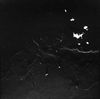
APOLLO 15 AS 15-M-R44-1851.jpgAPOLLO 15 AS 15-M-R44-1851 - Highly reflective "peaks"? (3)169 visitenessun commentoGiu 20, 2005
|
|

APOLLO 15 AS 15-M-R44-1850.jpgAPOLLO 15 AS 15-M-R44-1850 - Highly reflective "peaks"? (2)180 visitenessun commentoGiu 20, 2005
|
|

APOLLO 15 AS 15-M-R44-1849.jpgAPOLLO 15 AS 15-M-R44-1849 - Highly reflective "peaks"? (1)172 visiteTre frames rigorosamente sequenziali che ci mostrano, a ridosso della linea del Terminatore, l'incredibile riflettività (o albedo) di alcuni rilievi (forse dei picchi?!?) Lunari.
E' da immagini come questa che, a nostro parere, diventa più facile capire che cosa intendono le Agenzie Spaziali quando parlano dei 'Peaks of Eternal Sunlight'...Giu 20, 2005
|
|
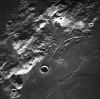
P-APOLLO 17 AS 17-M-R28-1233.jpgAPOLLO 17 AS 17-M-R28-1233 - What a view!140 visiteAnche per questo frame vale il commento svolto per l'immagine precedente. A titolo di curiosità, però, Vi facciamo notare il grande cratere visibile verso il basso della fotografia, poco distante da una montagna di notevoli dimensioni. Notate come il particolare gioco di luce/ombra, che si risolve in una falce illuminata sul bordo superiore del rilievo - segno che il Sole, rispetto all'orizzonte del cratere, è ormai molto basso -, può talvolta trarre in inganno i Ricercatori. Come? L'ingannevolezza della ripresa risiede proprio in quella falce di luce: basta, infatti, sfuocare (solo leggermente) l'immagine in questione, che la effettiva e visivamente percepibile concavità del cratere parzialmente illuminato, si modificherà, dando all'Osservatore un'illusione di convessità (noi lo chiamiamo "effetto bolla"). Ed ecco come un curioso gioco di luci può far apparire ai nostri occhi, al posto di un semplice (ancorchè suggestivo) cratere, un (purtroppo inesistente) "Lunar Dome".Nov 28, 2004
|
|
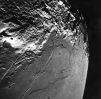
P-APOLLO 17 AS 17-M-R27-0953.jpgAPOLLO 17 AS 17-M-R27-0953 - What a view!159 visiteUna vista davvero eccezionale, da un'altezza di circa 280 Km: sul margine superiore della fotografia, una formazione montuosa che ricorda tantissimo la "cordigliera delle Ande" e poi, simili a graffiti, i letti lasciati da antichi fiumi di lava (Sn) ed alcune increspature di una pianura che potrebbero risalire al tempo in cui la Luna iniziò a raffreddarsi e, nel farlo, a "raggrinzire" leggermente (Sn ed al centro, verso il basso). Piccoli crateri isolati costellano il margine inferiore ed il lato Dx del frame.Nov 28, 2004
|
|
| 33 immagini su 3 pagina(e) |
1 |
|





