| Ultimi arrivi - Asteroids and Comets |

Haumea-1.jpgHaumea: an "Egg" in the Outer Solar System...80 visitenessun commentoMareKromiumOtt 21, 2008
|
|

Haumea2.jpgHaumea and other "Dwarf" Companions56 visiteCaption NASA:"One of the strangest objects in the Outer Solar System was classified as a Dwarf Planet last week (September 2008) and given the name Haumea.
This designation makes Haumea the 5th designated Dwarf Planet after Pluto, Ceres, Eris, and Makemake. Haumea's smooth but oblong shape make it extremely unusual. Along one direction, Haumea is significantly longer than Pluto, while in another direction Haumea has an extent very similar to Pluto, while in the third direction is much smaller.
Haumea's orbit sometimes brings it closer to the Sun than Pluto, but usually Haumea is further away.
Illustrated above, an artist visualizes Haumea as a nearly featureless ellipsoid. Quite possibly, however, Haumea has interesting craters and surface features that currently remain unknown. Originally discovered in 2003 and given the temporary designation of 2003 EL61, Haumea was recently renamed by the IAU for a Hawaiian goddess. Haumea has two small moons discovered in 2005, recently renamed Hi'iaka and Namaka after the daughters of the Goddess".MareKromiumOtt 21, 2008
|
|

Steins-1.JPG2867 Šteins (3D)58 visitenessun commentoMareKromiumSet 08, 2008
|
|

Steins-0.jpg2867 Šteins98 visiteCaption NASA:"Cruising though space, sometimes you'll come across an unusual object. Such was the case on Friday for ESA's Rosetta Spacecraft on it's way to comet Churyumov-Gerasimenko. Robotic Rosetta buzzed right by the main belt asteroid 2867 Šteins, taking many pictures, some of which have been compiled into a short video.
At first glance, Steins looked like a 5-Km wide diamond, but as Rosetta shot by, craters and a more extended shape become evident. In the above sequence of 6 images, a notable chain of craters is evident vertically on the Asteroid's Surface, most probably caused by a chance collision with a stream of meteors. Space scientists will now study the data taken by Rosetta of asteroid Steins in an effort to better understand its composition, origin, and why the asteroid reflects light so well.
As the Earth-bound scientists toil, Rosetta itself will continue to zoom across our Solar System, next swooping again by the Earth in 2009 November, flying by asteroid 21 Lutetia in July 2010, and finally landing on Comet Churyumov-Gerasimenko in November 2014".
Nota Lunexit: un nuovo (ed eclatante) esempio di Asteroide il quale ci mostra, fra le diverse Surface Features che ne caratterizzano le fattezze, un gigantesco cratere (da impatto?!?) il quale - nonostante le usuali spiegazioni degli Scienziati Planetari NASA ed ESA - non potrebbe (nè dovrebbe) esistere.
Altri tre esempi di piccoli asteroidi che presentano un inspiegabile (per dimensioni e fattezze) "Mega-Cratere" sulla loro superficie: Annefrank; Mathilde e Dactyl (senza dimenticare Phobos, come ovvio, anche se Phobos - tecnicamente - non è un asteroide. O almeno: non lo è più...).MareKromiumSet 08, 2008
|
|

EROS-GIFMovie-050_frame02.gifRolling and Floating: 433-Eros (GIF-Movie; credits: Dr G. Barca)57 visitenessun commentoMareKromiumAgo 02, 2008
|
|

EROS-GIFMovie-051.gif433-Eros: features in motion! (GIF-Movie; credits: Dr G. Barca)59 visitenessun commentoMareKromiumAgo 02, 2008
|
|

EROS-PIA02905-1.jpgEros (Position of the BIG Pseudo-Anomaly)57 visitenessun commentoMareKromiumAgo 02, 2008
|
|

EROS-GIFMovie-049.gifRolling and Floating: 433-Eros (GIF-Movie; credits: Dr G. Barca)57 visitenessun commentoMareKromiumAgo 02, 2008
|
|

LLR-Itokawa-ST_2485860275_v.jpgItokawa: the First (and, so far, the only) "Space Potato" (MULTISPECTRUM; credits: Lunexit)56 visitenessun commentoMareKromiumGiu 16, 2008
|
|
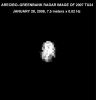
Asteroids-Asteroid_2007-TU24.jpgAsteroid 2007 TU24 (Radar View)57 visiteAsteroid 2007 TU24 passed by the Earth yesterday, posing no danger. The space rock, estimated to be about 250 mt across, coasted by just outside the orbit of Earth's Moon. The passing was not very unusual - small rocks strike Earth daily, and in 2003 a rock the size of a bus passed inside the orbit of the Moon, being detected only after passing. TU24 was notable partly because it was so large. Were TU24 to have struck land, it might have caused a magnitude 7 earthquake and left a city-sized crater. A perhaps larger danger would have occurred were TU24 to have struck the ocean and raised a large tsunami.
This radar image was taken 2 days ago. The Arecibo Radio Telescope in Puerto Rico broadcast radar that was reflected by the asteroid and then recorded by the Byrd Radio Telescope in Green Bank, West Virginia. The resulting image shows TU24 to have an oblong and irregular shape. TU24 was discovered only three months ago, indicating that other potentially hazardous asteroids might lurk in our Solar System currently undetected. Objects like TU24 are hard to detect because they are so faint and move so fast. Humanity's ability to scan the sky to detect, catalog, and analyze such objects has increased notably in recent years.
MareKromiumGen 30, 2008
|
|

Asteroids-Asteroid_2002JF56-PIA09230-01.jpgFormer "Unknown Asteroid" is now "Asteroid 2002 JF56"59 visiteThe two "spots" in this image are a composite of two images of asteroid 2002 JF56 taken on June 11 and June 12, 2006, with the Multispectral Visible Imaging Camera (MVIC) component of the New Horizons Ralph imager. In the bottom image, taken when the asteroid was about 3,36 MKM (approx. 2,1 MMs) away from the Spacecraft, 2002 JF56 appears like a dim star. At top, taken at a distance of about 1,34 MKM (such as about 833.000 miles), the object is more than a factor of six brighter.
The best current, estimated diameter of the asteroid is approx. 2,5 Km.
The asteroid observation was a chance for the New Horizons team to test the spacecraft's ability to track a rapidly moving object. On June 13 New Horizons came to within about 102.000 Km of the small asteroid, when the Spacecraft was nearly 368 MKM (about 228 MMs) from the Sun and about 273 MKM (approx 170 MMs) from Earth.MareKromiumGen 30, 2008
|
|
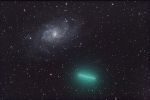
Comets-Comet_Tuttle_and_M33.jpgComet 8-P/Tuttle and M-3358 visiteCaption NASA:"This gorgeous galaxy and comet portrait was recorded on December 30th, 2007, in the skies over Hoogeveen (NL). The combined series of 60-by-60" exposures finds the lovely green coma of Comet 8P/Tuttle near its predicted conjunction with the Triangulum Galaxy.
Aligning each exposure with the stars shows the comet as a streak, slowly moving against the background stars and galaxy. An alternative composition with exposures centered on the comet, shows the background stars and galaxy as streaks.
The alluring celestial scene would also have been a rewarding one for the influential 18th Century comet hunter Charles Messier. While Messier scanned French skies for comets, he carefully cataloged positions of things which were fuzzy and comet-like in appearance but did not move against the background stars and so were definitely not comets. The Triangulum Galaxy, also known as M-33, is the 33rd object in his famous not-a-comet catalog.
The modern understanding holds that the Triangulum Galaxy is a large spiral galaxy some 3 MLY distant. Comet 8P/Tuttle, just bright enough to be visible to the unaided eye in dark, Northern Skies, is about 40 MKM (such as 2 LM - Light Minutes) away".MareKromiumGen 02, 2008
|
|
| 282 immagini su 24 pagina(e) |
 |
|
|
|
|
9 | |
|
|
|
|





