| Ultimi arrivi - Asteroids and Comets |

Asteroids-Asteroid_1994-CC-PIA12134.jpgTriple Asteroid 1994-CC56 visitenessun commentoMareKromiumSet 12, 2009
|
|

Orcus-GIF.gif90482 Orcus58 visiteCaption NASA:"A newly discovered object in the Outer Solar System moves like an anti-Pluto. 90482 Orcus was first discovered in 2004 and is slightly smaller than Pluto, although still one of the largest Kuiper Belt objects known.
Orcus may one day have the same IAU designation as Pluto: a dwarf planet.
Orcus and Pluto have similar orbits: each achieves nearly the same maximum and minimum distances from the Sun, each orbits on a similarly shaped ellipse, and each orbital ellipse is tilted toward the other planets' orbital ellipse by roughly the same angle. The great mass of Neptune causes each to circle the Sun twice for every three Neptune orbits.
Orcus is like an anti-Pluto, however, because the two objects always remain across the Solar System from each other. Orcus can be found as the spot near the center of these discovery frames moving slightly down from the top.
Until the end of next week, the discoverers of Orcus ask for your help in naming its newly discovered moon".MareKromiumMar 25, 2009
|
|

Comets-Comet_Lulin_05.jpgComet Lulin and distant Galaxies57 visiteCaption NASA, da "NASA - Picture of the Day" del giorno 7 Marzo 2009:"Now fading in our night sky, Comet Lulin has provided some lovely cosmic vistas. Moving rapidly against the background of stars, Lulin briefly posed with the likes of Saturn and Regulus (Alpha Leo).
But here it is seen against a field of distant galaxies. To reveal the faint background galaxies and trace the Comet's fading tail, the remarkable picture is a blended composite of telescopic exposures aligned with the both the stars and the speedy comet. The largest galaxies seen left of the comet's head or coma are cataloged as NGC 3016, NGC 3019, NGC 3020 and NGC 3024 and lie at a distance of 100 MLY or so.
When the exposures were made, on February 28, the Lulin was about 3,6 Light-Minutes from Earth".MareKromiumMar 07, 2009
|
|
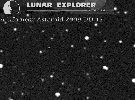
Asteroid_DD-45-d.gifAsteroid 2009 DD-45 (GIF-Movie)149 visitenessun commentoMareKromiumMar 06, 2009
|
|

Asteroid_DD-45-b.gifAsteroid 2009 DD-45 (GIF-Movie)66 visiteVersione accelerata, leggermente ingrandita ed a contrasti amplificati della GIF-Movie che potrebbe aprire (anzi: che APRIRA'!) un autentico "caso ufologico": guardate e stupite!
...E complimenti al "mitico" Marco Faccin, anche lui puntuale come la Clock-Tower di Londra!MareKromiumMar 05, 2009
|
|

Asteroid_DD-45-a.gifAsteroid 2009 DD-45 (GIF-Movie)77 visiteUn bellissimo GIF-Movie; da notare ed apprezzare il movimento irregolare dell'asteroide il quale, più che "ruotare" su se stesso, sembra "rotolare" (come fa la Luna Saturniana Iperione).
Il movimento (se non altro apparentemente) caotico dell'asteroide DD-45 attorno al proprio asse di rotazione può essere spiegato non solo dalla forma irregolare ("a tubero") posseduta da questo minuscolo Corpo Celeste, ma anche dalla marcata influenza mareale (---> gravitazionale) su di esso esercitata dalla "vicina" Terra (distante circa 70.000 Km).MareKromiumMar 04, 2009
|
|

Comets-Comet_Lulin04-Lodriguss.jpgLulin and Saturn near Opposition59 visiteDa "NASA - Picture of the Day" del giorno 27 Febbraio 2009:"Tracking through the constellation Leo on February 23rd, bright planet Saturn and Comet Lulin were both near Opposition -- such as opposite to the Sun in Planet Earth's Sky.
They also passed within only 2° of each other creating a dramatic celestial photo-op. Comet Lulin was near its closest approach to planet Earth at the time, at a distance of some 61 MKM, but was orbiting in the opposite direction.
As a result it swept remarkably rapidly across the background of stars. This telephoto image captures both bright Saturn and greenish Lulin in the same field in a scene not too different from binocular views.
Don't recognize ringed Saturn? The rings are presently tilted nearly edge-on to our view and the brighter Planet is overexposed to record details of the fainter comet. At the upper right, Saturn is marked by multiple diffraction spikes created by the aperture blades in the telephoto lens".
MareKromiumFeb 28, 2009
|
|
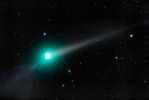
Comets-Comet_Lulin03-Richins.jpgThe Two Tails of Comet Lulin56 visiteCaption NASA:"Go outside tonight and see Comet Lulin. From a dark location, you should need only a good star map and admirable perseverance -- although wide-field binoculars might help. Yesterday, Comet Lulin passed its closest to Earth, so that the comet will remain near its brightest over the next few days. The comet is currently almost 180° around from the Sun and so visible nearly all night long, but will appear to move on the sky about 10 full moons a night. Pictured above, Comet Lulin was captured in spectacular form two nights ago from New Mexico, USA.
The central coma of the comet is appearing quite green, a color likely indicating glowing cyanogen and molecular carbon gasses. Bright stars and a distant spiral galaxy are clearly visible in the image background. The yellow dust tail, reflecting sunlight, is visible sprawling to the coma's left trailing behind the comet, while the textured bluish-glowing ion tail is visible to the coma's right, pointing away from the Sun. Over the past few weeks, from the current vantage point of Earth, these two tails appeared to point in opposite directions. Comet Lulin is expected to slowly fade over the next few weeks".MareKromiumFeb 25, 2009
|
|

Comets-Comet_Lulin-01.jpgStill Comet Lulin57 visiteDa "NASA - Picture of the Day" del giorno 7 Febbraio 2009:"Sweeping through the Inner Solar System, Comet Lulin is easily visible in both Northern and Southern Hemispheres with binoculars or a small telescope. Recent changes in Lulin's lovely greenish Coma and Tails are featured in this two panel comparison of images taken on January 31st (top) and February 4th, 2009.
Taken from dark New Mexico Skies, the images span over 2°. In both views the comet sports an apparent Anti-Tail at the left - the comet's Dust Tail appearing almost edge on from an earth-based perspective as it trails behind in Lulin's orbit.
Extending to the right of the coma, away from the Sun, is the beautiful Ion Tail. Remarkably, as captured in the bottom panel, Comet Lulin's Ion Tail became disconnected on February 4, likely buffeted and torn away by magnetic fields in the Solar Wind.
In 2007 NASA satellites recorded a similar disconnection event for Comet Encke. Don't worry, though: comet tails can grow back".MareKromiumFeb 07, 2009
|
|

Comets-Comet_Lulin-00.jpgComet Lulin is approaching...59 visiteDa "NASA - Picture of the Day", del giorno 2 Febbraio 2009:"How bright will Comet Lulin become? No one knows for sure. Although it is notoriously difficult to accurately predict the brightness of newly discovered comets, Comet Lulin could well become visible to the unaided eye later this month (such as February 2009).
As Comet Lulin moves into the Northern Sky in mid February to rise around midnight, it should at least be spotted by comet watchers with binoculars and a good sky chart. Tracking observations indicate that the comet officially designated C/2007 N3 (Lulin) has now swung by the Sun and is approaching Earth on a trajectory that will bring it within half the Earth-Sun distance in late February.
Comet Lulin's orbit indicates that this is likely the comet's first trip into the Inner Solar System. The comet was discovered by Quanzhi Ye of Sun Yat-sen University, on images obtained by Chi-Sheng Lin at the Lu-Lin Observatory of National Central University.
In this picture, taken from Italy last Friday, are Comet Lulin's coma and tails, one tail pointing away from the Sun, and an anti-tail - dust that trails the comet in its orbit and may appear to point toward the Sun".MareKromiumFeb 02, 2009
|
|
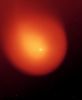
Comets-Comet_Holmes-UZ_PIA11228-1.jpgComet 17-P Holmes now in the Outer Solar System (IR)57 visiteNASA's Spitzer Space Telescope captured the picture of comet Holmes in March 2008, 5 months after the comet suddenly erupted and brightened a millionfold overnight. The contrast of the picture has been enhanced (see the next frame) to show the anatomy of the comet.
Every 6 years, comet 17P/Holmes speeds away from Jupiter and heads inward toward the Sun, traveling the same route typically without incident. However, twice in the last 116 years, in November 1892 and October 2007, comet Holmes mysteriously exploded as it approached the Asteroid Belt. Astronomers still do not know the cause of these eruptions.
Nota Lunexit: la "causa" di queste repentine eruzioni della Cometa 17-P Holmes le quali avvengono - guarda caso - durante il transito della medesima attraverso la Fascia degli Asteroidi potrebbe essere RAGIONEVOLMENTE rinvenuta nella verificazione di impatti con corpi erranti di piccole/piccolissime dimensioni (l'occorrere di impatti con uno o più oggetti di dimensioni medie o medio/grandi porterebbe inevitabilmente alla frammentazione/distruzione completa del nucleo di 17-P Holmes ed alla sua relativa e definitiva sparizione). Che gli "outbursts" possano essere (anche) l'ovvia conseguenza di un impatto ad altissima velocità è stato recentemente dimostrato dall'esperimento (come ricorderete contestatissimo) effettuato dalla NASA sulla Cometa Tempel-1, la quale fu centrata da un'ogiva metallica e, all'atto dello "scontro spaziale", aumentò la sua luminosità in maniera agevolmente percepibile anche da Terra.MareKromiumOtt 22, 2008
|
|

Comets-Comet_Holmes-UZ_PIA11228-2.jpgComet 17-P Holmes now in the Outer Solar System57 visiteSpitzer's infrared picture at left hand side of this frame reveals fine dust particles that make up the Outer Shell, or "Coma", of the Comet. The Nucleus of the Comet is within the bright whitish spot in the center, while the yellow area shows solid particles that were blown from the Comet in the explosion.
The Comet is headed away from the Sun, which lies beyond the right-hand side of these pictures.
The contrast-enhanced picture on the right shows the Comet's Outer Shell, and strange "filaments", or "Streamers", of dust. The Streamers and shell are a yet another mystery surrounding Comet Holmes. Scientists had initially suspected that the Streamers were small dust particles ejected from fragments of the Nucleus, or from hyerpactive jets on the Nucleus, during the October 2007 explosion.
If so, both the Streamers and the Shell should have shifted their orientation as the Comet followed its orbit around the Sun.
Radiation pressure from the Sun should have swept the material back and away from it. But pictures of Comet Holmes taken by Spitzer over time show the Streamers and Shell in the same configuration, and not pointing away from the Sun. The observations have left astronomers stumped.
The horizontal line seen in the contrast-enhanced picture is a trail of debris that travels along with the Comet in its orbit.
The Spitzer picture was taken with the Spacecraft's multiband imaging photometer at an infrared wavelength of 24 microns.MareKromiumOtt 22, 2008
|
|
| 282 immagini su 24 pagina(e) |
 |
|
|
|
|
8 | |
|
|
|
|





