| Ultimi arrivi - Asteroids and Comets |

Comets-Hartley_2-PIA13626.gifSnowballs near Comet Hartley-2100 visiteCaption NASA:"This movie shows the motion of some Icy Particles in the Cloud around Comet Hartley 2, as seen by NASA's EPOXI mission Spacecraft. A star moving through the background is marked with red and moves in a particular direction and with a particular speed, while the Icy Particles move in random directions. The Icy Particles are marked in green, blue and light blue.
The images for the movie were obtained by the Medium-Resolution Imager on Nov. 4, 2010, the day the EPOXI mission Spacecraft made its closest approach to the Comet".MareKromiumLug 21, 2011
|
|

Tempel1-ZZ-ZJ-Stardust_1023-MF-LXTT-HD3D.jpgComet Tempel-1 from Stardust NeXT Spacecraft (Hi-Def-3D; credits for the additional process.: Dr Marco Faccin - Lunexit Team)121 visitenessun commentoMareKromiumFeb 24, 2011
|
|

Tempel1-ZZ-ZJ-Stardust_1024-MF-LXTT-HD3D.jpgComet Tempel-1 from Stardust NeXT Spacecraft (Hi-Def-3D; credits for the additional process.: Dr Marco Faccin - Lunexit Team)67 visitenessun commentoMareKromiumFeb 22, 2011
|
|

Tempel1-ZZ-ZJ-Stardust_1024-PIA13860-PCF-LXTT.jpgComet Tempel-1 from Stardust NeXT Spacecraft (Natural Colors; credits for the additional process. and color.: Dr Paolo C. Fienga - Lunexit Team) 118 visiteCaption NASA:"This image mosaic shows 4 different views of comet Tempel-1 as seen by NASA's Stardust Spacecraft as it flew by it on February 14, 2011.
The images progress in time beginning at upper left, moving to upper right, then proceeding from lower left to lower right. When the Spacecraft first approached, it got a clear look at the same Surface that was imaged previously by NASA's Deep Impact Spacecraft in 2005. Deep Impact sent a projectile into the Comet, creating a crater that is located in the upper left image, but is difficult to see at this particular contrast level.
As Stardust flew closer to the Comet, it began to see New Territory that had not been imaged before. The New Territory appears on the left side of the upper right image. The Deep Impact Crater is also located in this view, on the right side.
Both the upper right and lower left images are the Closest Approach images for Stardust, taken at 3" before, and 3" after it. The images were taken from a distance of about 185 Km (approx. 115 miles). In the lower left image, the vast majority of Terrain pictured had not been seen until now. The fourth image, at lower right, shows Stardust's view as the Spacecraft was on the way out.
The image at upper left was taken 15" before the Encounter (or Closest Approach) from a distance of approx. 244 Km (about 152 miles); the image at lower right was taken 15" after the Encounter, from a distance of approx. 245 Km (about 152 miles)".MareKromiumFeb 18, 2011
|
|

Tempel1-ZZ-ZJ-Stardust_1024-PIA13867.jpgComet Tempel-1 from Stardust NeXT Spacecraft (Natural Colors; credits for the additional process. and color.: Dr Paolo C. Fienga - Lunexit Team) 122 visiteCaption NASA:"At the time of the encounter, comet Tempel-1 was approx. 335 MKM (about 208 MMs) away from Earth.
Tempel-1 is oblong in shape and has an average diameter of about 6 Km (approx. 4 miles). Stardust-NExT is an extended mission for the comet chaser, which previously flew past comet Wild 2 and returned some samples from its Coma to Earth.
During this latest encounter, the Spacecraft took images of the Comet's Surface and observed changes that occurred since a NASA Spacecraft last visited it (NASA's Deep Impact Spacecraft had an encounter with Tempel-1 in July 2005).
Stardust-NExT is a low-cost mission that is expanding the investigation of comet Tempel-1 initiated by the Deep Impact Spacecraft.
The mission is managed by the Jet Propulsion Laboratory, a division of the California Institute of Technology, Pasadena, Calif., for NASA's Science Mission Directorate in Washington. Lockheed Martin Space Systems in Denver built the Spacecraft and manages day-to-day mission operations".MareKromiumFeb 18, 2011
|
|

Tempel1-ZZ-ZJ-Stardust_1024-PCF-LXTT.jpgComet Tempel-1 from Stardust NeXT Spacecraft (Natural Colors; credits for the additional process. and color.: Dr Paolo C. Fienga - Lunexit Team)104 visiteCaption NASA:"No Comet has ever been visited twice before. Therefore, the unprecedented pass of the Stardust-NeXT Spacecraft near Comet Tempel-1 in February 2011 gave Humanity a unique opportunity to see how the Nucleus of a Comet changes over time.
Changes in the Nucleus of Comet Tempel-1 were of particular interest because the Comet was hit with an impactor from the passing Deep Impact Spacecraft in 2005. Here is one digitally sharpened image of Comet Tempel-1 near the closest approach of Stardust-NeXT.
Visible are many features already imaged in 2005, including Craters, Ridges and seemingly smoother areas. Few firm conclusions are yet available, but over the next few years astronomers who specialize in Comets and the understanding the early Solar System will be poring over these images looking for new clues as to how Comet Tempel-1 is composed, how the 2005 Impact Site now appears, and how general features of the Comet have evolved".MareKromiumFeb 17, 2011
|
|

Comets-Comet_Hartley_2-MF-LXTT4.jpgComet "Hartley 2" (Absolute Natural Colors; credits for the additional process. and color.: Dr Paolo C. Fienga - Lunexit Team)171 visite...Come da richiesta del nostro Amico e Socio, "AndreaGG"...MareKromiumNov 15, 2010
|
|

Comets-Comet_Hartley_2-NASA-0.jpgComet "Hartley 2" (an Image-Mosaic by NASA, JPL-Caltech, UMD, EPOXI Mission)89 visiteDa "NASA - Picture of the Day" del giorno 5 Novembre 2010:"Follow these 5 frames clockwise starting from the top left to track the view from the EPOXI Mission Spacecraft as it approached, passed under, and then looked back at the nucleus of comet Hartley 2 on November 4.
Its closest approach distance was about 700 Km. In fact, this encounter was the 5th time a spacecraft from planet Earth has imaged a comet close-up. But Hartley 2's Nucleus is definitely the smallest one so far, its long axis spanning only about 2 Km (such as approx. 1,2 miles).
Though Hartley 2 is small, these stunning images showing Jets of Dust and Gas indicate an impressively active surface. The Jets are seen originating from the rough surface areas, with Sunlight illuminating the Nucleus from the right. Remarkably, rough areas at both ends of the elongated Nucleus are joined by a narrower, smooth waist.
The EPOXI mission reuses the Deep Impact Spacecraft that launched a probe impacting the Nucleus of comet Tempel 1 in 2005".MareKromiumNov 07, 2010
|
|

Comets-Comet_Hartley_2-NASA-1.jpgComet "Hartley 2" (Dimensions)96 visitenessun commentoMareKromiumNov 07, 2010
|
|

Comets-Comet_Hartley_2-NASA-2.jpgComet "Hartley 2" (Close-up and Dimensions)89 visitenessun commentoMareKromiumNov 07, 2010
|
|

Comets-Comet_Hartley_2-EB-LXTT1.jpgComet "Hartley 2" (credits for the additional process. and color.: Elisabetta Bonora - Lunexit Team)77 visitenessun commentoMareKromiumNov 07, 2010
|
|
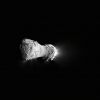
Comets-Comet_Hartley_2-EB-LXTT2.jpgComet "Hartley 2" (credits for the additional process. and color.: Elisabetta Bonora - Lunexit Team)73 visitenessun commentoMareKromiumNov 07, 2010
|
|
| 282 immagini su 24 pagina(e) |
 |
|
|
5 | |
|
|
|
|
|
|





