| Ultimi arrivi - Asteroids and Comets |

Comets-Comet_Ikeya_Zhang_3.jpgComet Ikeya-Zhang - the "ion tail"73 visiteThis composite color image from March 3rd, 2002, captured with a wide-field telescope, shows this active comet's bright, condensed coma and a delightful array of subtle structures in its developing tail. The bluish tail stretches for 5 degrees or so against a background of stars in the constellation Pisces. Cataloged as comet C/2002 C1, improved orbit determinations now make it seem very likely that Comet Ikeya-Zhang has been around here before. Refined calculations indicate this comet's last trip through the inner Solar System was 344 years ago, in 1661, when it was recorded as a bright comet. Dic 15, 2004
|
|

Comets-Comet_Ikeya_Zhang_2.jpgComet Ikeya-Zhang (from Colorado)64 visiteThis lovely early evening view of the comet in Rocky Mountain skies looks northwest over ridges and low clouds. The time exposure was recorded on March 31st from an 8.000 foot elevation near Yampa, Colorado, USA. Sporting a sweeping yellowish dust tail and blue ion tail eight to ten degrees long, Ikeya-Zhang is nestled near the horizon in the northern constellation of Andromeda. To the comet's left is the bright star Mirach or Beta Andromedae while the stretched celestial fuzzball to the comet's right is M 31 or the Andromeda galaxy, the nearest bright spiral galaxy to our own Milky Way. As the days pass, Comet Ikeya-Zhang's apparent motion through the sky is towards the right in this image. Tonight, comet-watchers blessed with clear skies should find Ikeya-Zhang posing perfectly for binoculars and cameras just above M 31, less than two degrees from the center of the bright galaxy.Dic 15, 2004
|
|

Comets-Comet_Ikeya_Zhang_4.jpgComet Ikeya-Zhang - the "ion tail"69 visiteAs Comet Ikeya-Zhang approached the Sun, it developed a complex blue "ion tail". The "ion tail" is composed of ions that boiled off the nucleus and were pushed away from the Sun by the out-flowing fast-moving particles of the solar wind. Complexity in the tail is created by comet nucleus rotation, variability in the comet surface evaporation rate and variability of the Sun's magnetic field and solar wind. Dic 15, 2004
|
|
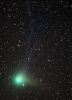
Comets-Comet_Mach_Holz.jpgThe C/2004 Q2 Comet105 visiteScoperta solo pochi mesi fa, la Cometa C/2004 Q2 (Machholz) è già chiaramente visibile (a magn. 5 o superiore) nei Cieli del Sud. Ma nessuna paura, non occorrerà viaggiare per vederla: essa si sta rapidamente portando verso i nostri Cieli e, nel frattempo, continuerà ad aumentare il suo splendore (probabilmente sino alla prima metà di Gennaio 2005). La luminosità massima che C/2004 Q2 potrà raggiungere non ci è ancora nota; ciò che sappiamo, invece, è che essa resterà nei "nostri" Cieli per buona parte del 2005 e la potremo anche vedere in prossimità della Stella Polare nei primi giorni di Marzo. L'immagine che Vi proponiamo (da "NASA - Picture of the Day" del 13.12.2004) è stata ripresa ai primi di Dicembre e, come potete vedere, la cometa già ci mostra una consistente "chioma", un'abbondante coda di polveri e detriti (di colore bianco e verde) ed un'abbastanza intricata "coda ionica" (andante verso la Dx dell'Osservatore), che presenta delle increspature verso la fine. Dic 13, 2004
|
|

Eros-PIA02495_modest.jpgSide view and front view of a bright crater56 visiteLighting and viewing geometries make a huge difference in the appearance of Eros' surface features. One of the most striking examples is the 2.7 Km diameter crater shown in these two images. The image at left, looking at the crater nearly edge-on, was taken February 16, 2000, from a range of 341 Km. The image at right was taken high over the crater on March 2, 2000, from a range of 226 Km. In the first image the only visible part of the crater's interior is the far, bright wall, which at the time was well-lit. The lighting, in combination with the particular viewing angle, make the crater appear stunningly bright. In the second view, the brighter material occupies only part of the slightly-shaded interior, greatly reducing the overall brightness contrast between the crater and the surrounding terrain.Dic 03, 2004
|
|

Asteroids-1992-CO.jpgAsteroid 1992 CO58 visitenessun commentoNov 07, 2004
|
|

Asteroids-Pallas.jpgAsteroid 2 Pallas56 visitenessun commentoNov 07, 2004
|
|

Asteroids-Hygiea.jpgAsteroid 10 Hygiea81 visiteGrazie al lavoro della "Two Micron All Sky Survey - 2MASS" siamo in grado di offrirvi le immagini di qualche asteroide del tutto sconosciuto (crediamo) a coloro che non siano - in qualche modo - direttamente "addetti ai lavori" nei Campi dell'Astronomia e/o dell'Astrofisica (Studenti delle due Discipline inclusi).
Si tratta di immagini che non ci dicono molto, dal punto di vista di un eventuale studio delle caratteristiche superficiali di questi oggetti (a dire il vero una cosa sembrano dirla: si tratta di oggetti davvero molto luminosi!), ma che, in ogni caso, rimangono molto suggestive e sono capaci di mostrarci dei "frammenti" di Cielo che contengono, oltre ai cosiddetti "corpi fissi" (cioè stelle e galassie), anche degli oggetti "mutevoli e transitori" (almeno dal punto di vista di chi li osserva).
Gli Asteroidi, appunto.Nov 07, 2004
|
|

Asteroids-Opportunity-041007163946.jpgThe path to immortality: an asteroid named "Opportunity"57 visiteL'immortalità (o quasi), in qualche modo, le Sonde Spirit ed Opportunity sono riuscite a guadagnarsela: il lavoro svolto dai due Rover, infatti, è stato (ed è tuttora) così prezioso e scientificamente significativo che si è pensato - ed è la prima volta in assoluto che accade una cosa simile - di dedicare ai due robot (e NON, quindi, ad un "essere umano"...) due asteroidi scoperti all'inizio degli anni '60, ma definitivamente riconosciuti e codificati - mediante l'assegnazione di un numero seriale ufficiale - solo nel 2002 (in questo caso, però, non si è trattato di inefficienza, bensì di ottemperanza alle rigide regole stabilite dalla IAU - International Astronomical Union - le quali "...require asteroids to be observed during 4 separate cycles around the Earth and Sun before they become eligible for numbering and naming...").Nov 02, 2004
|
|

Asteroids-Spirit-041007163903.jpgThe path to immortality: an asteroid named "Spirit"56 visiteEd ora qualche dato NASA ufficiale relativamente ai due asteroidi: Spirit dovrebbe avere un diametro compreso fra i 4 ed i 9 Km mentre il diametro di Opportunity oscillerebbe fra i 3 ed i 7. Sia Spirit che Opportunity sono fisicamente posizionati ad una distanza intermedia fra Marte e Giove, all'interno di un piccolo Gruppo di asteroidi conosciuto come "Hilda" ed entrambi impiegano poco meno di 8 anni per compiere un'intera orbita attorno al Sole. Nessuno dei due corpi celesti si muove su una traiettoria tale da poterlo condurre ad incrociare l'orbita di altri Pianeti e nè Spirit, nè Opportunity, inoltre (ed in base ai dati in nostro possesso), dovrebbero mai risentire in maniera critica e decisiva dell'immensa influenza gravitazionale di Giove. Ed infine una curiosità: il Gruppo di asteroidi "Hilda" si caratterizza per avere un periodo di "risonanza orbitale", rispetto a Giove, di 3 a 2 (solo un modo difficile per dire che, per ogni 2 orbite complete di Giove attorno al Sole, il Gruppo "Hilda" ne compie 3).Nov 02, 2004
|
|

Eros from 120 mt - PIA03148_modest.jpgFalling down: Eros from 120 mt56 visiteCaption originale:"This is the last image of asteroid 433 Eros received from NEAR Shoemaker. Taken from a range of 120 meters, it measures 6 meters across. What we can see of the rock at the top of image measures 4 meters across. The streaky lines at the bottom indicate loss of signal as the spacecraft touched down on the asteroid during transmission of this image". La Sonda - probabilmente - si ribalta al momento del touch-down, il segnale si perde e la Missione termina per sempre. Sin qui l'ufficialità. Ufficiosamente, possiamo dirVi che la Sonda ha continuato a trasmettere dati ancora per molto tempo dopo l'impatto, ma su come abbia potuto farlo e di quali dati si trattasse, come potrete agevolmente intuire, non siamo riusciti a sapere assolutamente nulla. E' strano, però: la NASA avrebbe dovuto celebrare trionfalmente la sopravvivenza della Sonda NEAR all'impatto con l'asteroide, così come sta trionfalmente celebrando la sopravvivenza "oltre le più rosee aspettative" dei Mars Rovers, e invece...Silenzio.Ott 28, 2004
|
|

Eros from 250 mt - PIA03147_modest.jpgFalling down: Eros from 250 mt66 visiteCaption NASA:"...The image is 12 meters across. The cluster of rocks at the upper right measures 1.4 meters across...". Vale quanto già detto in precedenza: riuscite a vedere dei dettagli già presenti nel frame precedente?!?
NEAR, scendendo, fotografa "random"?Ott 28, 2004
|
|
| 282 immagini su 24 pagina(e) |
 |
|
|
|
|
|
|
|
22 | |
|





