| Ultimi arrivi - Asteroids and Comets |

Comets-Wild_2-01.jpgApproaching Wild 2 (2)62 visiteCaption NASA originale:"On January 2, 2004 NASA's Stardust spacecraft made a close flyby of comet Wild 2.
Among the equipment the spacecraft carried on board was a navigation camera.
This is the 34th of the 72 images taken by Stardust's navigation camera during close encounter. The exposure time was just 10 milliseconds". Gen 20, 2005
|
|
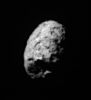
Comets-Wild_2-00.jpgApproaching Wild 2 (1)60 visiteCaption NASA originale:"This image was taken during the close approach phase of Stardust's Jan 2, 2004 flyby of comet Wild 2. It is a distant side view of the roughly spherical comet nucleus. One hemisphere is in sunlight and the other is in shadow analogous to a view of the quarter moon. Several large depressed regions can be seen. Comet Wild 2 is about 5 Km (3,1 miles) in diameter".Gen 20, 2005
|
|

Comets-Wild_2-03.jpgSome surface features of Wild 259 visiteCaption NASA originale:"These images taken by NASA's Stardust spacecraft highlight the diverse features that make up the surface of comet Wild 2. The three pictures on the left side show a variety of small pinnacles and mesas seen on the limb of the comet. The picture on the right shows the location of a 2-Km (1,2-mile) series of aligned scarps, or cliffs, that are best seen in the stereo images".Gen 20, 2005
|
|

Comets-Wild_2-02.jpgWild 2 - stereo image pair61 visitenessun commentoGen 20, 2005
|
|

Comets-Wild_2-05.jpgWild 264 visiteCaption NASA originale:"This image is the closest short exposure of the comet, taken at an 11,4° phase angle (phase angle is the angle between the camera, the comet and the Sun). Gen 20, 2005
|
|

Comets-Wild_2-04.jpgThe map of Comet Wild 259 visiteUna mappa - non particolarmente dettagliata ma comunque idonea a farci vedere e riconoscere le aree maggiormente importanti - della Cometa Wild 2. La mappa in oggetto è stata ottenuta sulla base delle riprese della cometa effettuate dalla Sonda "Stardust" il 2 Gennaio 2004 e, in particolare, impiegando il frame che Vi mostriamo nel quadro successivo.
I nomi indicati per le diverse aree di Wild 2 sono quelli utilizzati dallo "Stardust Team".
Da notare, infine, che il "bacino Shoemaker" potrebbe (a dispetto delle apparenze) NON aver avuto origine da un impatto.Gen 20, 2005
|
|

Comets-Comet_Machholz-Pleiades.jpgComet Machholz and M 4576 visiteRipresa amatoriale (ma di grande effetto scenico) effettuata il giorno 9 Gennaio 2005 dalla Germania - Baviera (località Oberjoch) dal Sig. Stefan Seip. Perfetta la visione della chioma - color verde/acqua - della Cometa (le dimensioni stimate della chioma stessa si aggirano intorno ai 500.000 Km mentre il suo nucleo roccioso dovrebbe avere un diametro compreso fra i 5/7 Km) e molto suggestiva la combinazione (ma si tratta, come ovvio, di un semplice effetto prospettico) fra l'alone blu proprio di M 45 e la coda ionica (anch'essa vagamente bluastra) della Cometa Machholz. Da notarsi che le dimensioni ridotte (ma solo in apparenza) della coda di Machholz (la quale si estende per svariati milioni di Km - 8/10) dipendono anch'esse da un semplice effetto prospettico il quale sfavorisce la nostra osservazione. Gen 11, 2005
|
|

Comets-Comet_Machholz.jpgComet Machholz74 visiteDa "NASA - Picture of the Day" del 5 Gennaio 2005:"Good views of Comet Machholz are in store for northern hemisphere comet watchers in January. Now making its closest approach to planet Earth, the comet will pass near the lovely Pleiades star cluster on January 7th and the double star cluster in Perseus on January 27th as Machholz moves relatively quickly through the evening sky. Currently just visible to the unaided eye from dark locations, the comet should be an easy target in binoculars or a small telescope. In fact, this telephoto time exposure from January 1, shows Comet Machholz sporting two lovely tails in skies over Colorado, USA. Extending to the left, strands of the comet's ion or gas tail are readily affected by the solar breeze and point away from the Sun. Dust, which tends to trail along the comet's orbit, forms the tail jutting down and to the right".Gen 05, 2005
|
|

EROS-PIA02493_modest.jpgSunset on Eros58 visiteEros' irregular shape gives rise to some stunning vistas at the time of sunrise or sunset. On March 6, 2000, the imager on the NEAR Shoemaker spacecraft caught this view of a stunning sunset. In the pitch black foreground the Sun has already set, but just over the horizon another part of the asteroid remains lit. Eros' rotation period is just 5 hours, 16 minutes, so in the course one 24-hour Earth day an observer on Eros would be treated to four full cycles of sunrises and sunsets.Dic 22, 2004
|
|

EROS-PIA02901_modest.jpgCraters on the limb of Eros57 visiteIn this image, taken April 17, 2000, from a height of 101 Km (63 miles), the shadows highlight small-scale surface features. The surface is pockmarked with craters ranging in size up to the 2,8 Km (1,74 mile) diameter crater in the center of the image. The smallest craters which can be resolved are about 20 meters (65 feet) across. In lower right corner of the image, 20-meter boulders can be seen that were not evident in images from higher altitudes.Dic 22, 2004
|
|

EROS-PIA02906_modest.jpgHorizon view59 visiteThis image of Eros, taken from the NEAR Shoemaker spacecraft on May 2, 2000, from an orbital altitude of 52 kilometers (32 miles), shows a view toward Eros' horizon. The section shown is about 1.8 kilometers (1.1 miles) across. This particular view provides a snapshot of three of the most common types of features seen on the asteroid: craters whose rims have been rounded by erosion due to smaller impacts and blanketing by the impact debris, or regolith (impact debris); variations in the brightness of material on the walls of the craters; and a scattering of boulders ranging in size from nearly 100 meters (328 feet) down to about 8 meters (26 feet).Dic 22, 2004
|
|

EROS-PIA02907_modest.jpgA strange drawing made by lights and shadows...63 visiteEros' irregular shape creates interesting and beautiful scenes where the Sun shines obliquely on the surface. In the absence of an atmosphere, and hence no secondary illumination reflecting from atmospheric molecules, shade appears nearly as black as space. This image, taken from the NEAR Shoemaker spacecraft on May 2, 2000, from an orbital altitude of 50 kilometers (31 miles), shows one of the more telling and yet comical combinations of light and shadow. The entire scene is about 1.8 kilometers (1.1 miles) across. High spots near the edges of shadows, like the 35-meter (115-foot) diameter boulder just below the center of the frame, seem almost to "float" above the surface. With a little imagination, the shadow dominating the right side of the frame could be seen as a small, long-eared terrier bending over to sniff his dinner!Dic 22, 2004
|
|
| 282 immagini su 24 pagina(e) |
 |
|
|
|
|
|
|
21 | |
|
|





