| Ultimi arrivi - Asteroids and Comets |

Mathilde-PIA02494.jpgMathilde and Eros: C-Type and S-Type60 visiteCaption NASA originale:"In this montage, Mathilde (at left) and Eros (at right) are shown at the same scale, as they were imaged by NEAR Shoemaker from about 1.800 Km on June 27, 1997, and February 12, 2000, respectively. Mathilde is 56 Km across and Eros is 33 Km long and 13 Km wide. However, Mathilde's brightness is greatly exaggerated for viewing purposes - it's actually 6 times darker than Eros, with about the same reflectivity as soot! In a scheme that reflects how asteroids have historically been a topic for astronomy, not geology, they are classified into groups based on their colors as observed through telescopes. The 2 major classes of asteroids are called S-Types and C-Types. S-Types, whose colors are consistent with "stony" or rocky compositions, prevail among asteroids that orbit closer to the Sun than the mid-point of the asteroid belt. Eros and the 2 asteroids encountered briefly by the Galileo spacecraft on its way to Jupiter - Gaspra and Ida - are all S-Types. C-Types like Mathilde have a dark gray color consistent with a "carbonaceous" composition, rich in carbon compounds and other dark materials. They prevail in the outer part of the asteroid belt".Mar 17, 2005
|
|

Eros-PIA02499.jpgA deep impact on Eros means short daylight hours...58 visiteCaption NASA originale:"For people who live in mountain valleys, daylight can be a short-lived experience. Mountains to the east make the Sun rise later in the morning, while mountains to the west make the Sun set earlier in the evening. The brevity of daytime in a valley is accentuated during the shortened days of winter. The floor of the 5,5-Km (3,4-mile) diameter impact crater that dominates one face of Eros experiences the ultimate in short daylight hours. Three factors conspire to make this true. Firstly, Eros rotates rapidly, once every 5,27 hours. Secondly, the crater's 0,9-Km (0,56-mile) high walls tend to block direct sunlight from the floor, even while the outside of the crater is illuminated. Thirdly, during the current season on Eros, the Sun never makes it high in the sky in this location".Mar 17, 2005
|
|

Eros-NP-PIA02498.jpgThe North Pole of Eros58 visiteCaption NASA originale:"For a long time, imaging activities on the NEAR Shoemaker spacecraft have focused on the high northern latitudes of Eros. The point at which the Sun is directly overhead - known as the "subsolar point" - has been steadily moving from Eros' Northern Regions toward the equator as the asteroid's seasons progress. As this happens, the Northern Hemisphere is illuminated less and less and previously dark southern latitudes progressively come into view. In this image, taken March 19, 2000, from a range of 205 Km (approx. 127 miles), the asteroid's North Pole is in the upper right of the frame. The whole scene is 7,4 Km (approx. 4,6 miles) across".Mar 17, 2005
|
|

Eros-NorHem-PIA02923.jpgThe Northern Hemisphere of Eros57 visiteCaption NASA originale:"This spectacular view - looking down on the North Polar Region of Asteroid Eros - was constructed from 6 images taken February 29, 2000, from an orbital altitude of about 200 Km (approx. 124 miles). This vantage point highlights the major physiographic features of the Northern Hemisphere: the saddle seen at the bottom; the 5,3-Km diameter crater at the top and a major ridge system running between the two features that spans at least one-third of the asteroid's circumference".
Note: this a mosaic of images 0127275100, 0127275164, 0127275246, 0127275310, 0127275456, 0127275520Mar 17, 2005
|
|
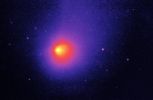
Comets-Schwassmann_Wachmann_1-00.jpgComet Schwassmann-Wachmann I and two asteroids60 visiteSchwassmann-Wachmann 1 (its nucleus is about 30 Km in diameter and is too small to be resolved by the SST while the micron-sized dust grains in the coma and tail stream out away from the Sun) is thought to be a member of a relatively new class of objects called "Centaurs," of which 45 objects are known. These are small icy bodies with orbits between those of Jupiter and Neptune. Astronomers believe that Centaurs are recent escapees from the Kuiper Belt, a zone of small bodies orbiting in a cloud at the distant reaches of the Solar System. Two asteroids, 1996 GM36 (left) and 5238 Naozane (right) were serendipitously captured in the comet image. Because they are closer to us than the comet and have faster orbital velocities, they appear to move relative to the comet and background stars, thereby producing a slight elongated appearance. The SST data have allowed astronomers to use thermal measurements, which reduce the uncertainties of visible-light albedo (reflectivity) measurements, to determine their size.Mar 07, 2005
|
|

EROS-G-TouchDown.jpg433 Eros: 4 years after the "touch-down"!60 visiteCaption da "NASA - Picture of the Day" del 12.02.2005:"On 12 February, 2001, the NEAR-Shoemaker spacecraft gently touched-down on the the surface of Eros - the first ever landing on an asteroid. During the descent, the spacecraft's camera recorded successive images of the diminutive world's surface, revealing fractured boulders, dust filled craters, and a mysterious collapsed channel. The last frame, seen in the above montage at the far left, was taken at a range of 128 meters. Expanded in the inset, it shows surface features a few centimeters across. Stereo experimenter Patrick Vantuyne, constructed this montage from the final images in the landing sequence, carefully identifying the overlapping areas in successive frames. Frames which overlap were taken by the spacecraft from slightly different viewpoints, allowing Vantuyne to construct close-up stereo images of the surface of asteroid 433 Eros".Feb 12, 2005
|
|

Comets-Machholz___Meteor.jpgComet Machholz and a "corkscrew" meteor59 visiteCaption NASA originale:"Meteor trains (train--->trajectory) that twist noticeably are rare but have been noted before. The underlying reason for unusual meteors trains is that many meteors are markedly non-spherical in shape and non-uniform in composition. Meteors, usually sand sized grains that originate in comets, will disintegrate as they enter the Earth's atmosphere. Non-uniform meteors may evaporate more on one side than another. This may cause a rotating meteor to wobble slightly in its path, and also to spray fast moving debris in a nearly spiral path. The fast moving meteor debris ionizes molecules in the Earth's atmosphere that subsequently glow when they reacquire elections. Surely no meteor is perfectly uniform and spherical, so that a slight swagger that is below perceptibility is likely typical. Meteors may well have seeded Earth with the prebiotic molecules that allowed for the development of life".Feb 02, 2005
|
|
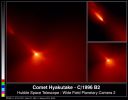
Comets-Comet_Hyakutake-PIA01290_modest.jpgThe "Hyakutake" Comet56 visiteFULL-FIELD VIEW (Left)--->This image is 3340 Km acroos and shows that most of the dust is being produced on the sunward-facing hemisphere of the comet. Also at upper left are 3 small pieces which have broken off the comet and are forming there own tails. Icy regions on the nucleus are activated as they rotate into sunlight, ejecting large amounts of dust in the jets that are faintly visible in this image. Sunlight striking this dust eventually turns it around and "blows" it into the tailward hemisphere. What might be another jet is emanating from the nightside of the nucleus, but this direction might be misleading due to the angle of the jet relative to our line-of-site.
CLOSE-UP OF NUCLEUS (Bottom Right) This expanded view of the near-nucleus region is only 760 Km across. The nucleus is near the center of the frame, but the brightest area is probably the tip of the strongest dust jet rather than the nucleus itself. Presumably, the nucleus surface lies just below this bright jet.
CLOSE-UP OF COMET FRAGMENTS (Top Right) This image shows pieces of the nucleus that apparently broke off and were first detected during ground-based observations on March 24. The Hubble image shows at least three separate objects that are probably made up of coarse-grained dust. Large fragments of the nucleus would not be accelerated into the tail, which appears to be the case in this image.
Gen 28, 2005
|
|
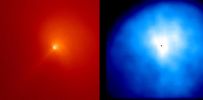
Comets-Comet_Hyakutake-PIA01288_modest.jpgThe "Hyakutake" Comet59 visiteOriginal caption:"These are 2 images of the inner coma of Comet Hyakutake made on April 3 and 4, 1996, using the NASA HST-WFPC2. The 1st one, shown in red, was taken through a narrow-band red filter that shows only sunlight scattered by dust particles in the inner coma of the comet. The 2nd one, shown in blue, was taken with an ultraviolet "Woods" filter image that shows the distribution of scattered ultraviolet radiation from H atoms in the inner coma (the "coma" is the head - or dusty-gas atmosphere - of a comet). The square field of view is 14.000 Km on a side and the Sun is toward the upper right corner of the image. H atoms represent the most abundant gas in the whole coma of the comet. They are produced when solar ultraviolet light breaks up molecules of water, the major constituent of the nucleus of the comet. The inner yellow region near the center of the red dust image is dominated by the contribution from the dust which shows sunward directed spiral jets to the upper right". Gen 28, 2005
|
|

Comets-Hale-Bopp-01.jpgHale-Bopp - HST (2)58 visiteIn questi 8 frames HST l'Anomalia di cui parlavamo per il quadro precedente si vede ancora solo nelle prime due immagini (26 Settembre e 23 Ottobre). Noi diciamo con chiarezza che si tratta di qualcosa di reale e di inspiegabile; magari non sarà una Nave Spaziale aliena che si è accodata ad Hale-Bopp ma è certo che qualcosa era vicino alla cometa e 1) la seguiva oppure 2) faceva parte di essa.
Le Fonti Ufficiali non hanno detto MAI nulla, ma queste immagini parlano - chiaramente - da sole.
Che cosa, dunque, seguiva e/o accompagnava Hale-Bopp?!?...Gen 22, 2005
|
|

Comets-Hale-Bopp-00.jpgHale-Bopp - HST (1)79 visiteDue immagini della famosissima Cometa Hale Bopp che, qualche anno fa, ci tenne tutti con il naso "all'insù" per qualche tempo.
Queste immagini (HST) nascondono un'Anomalia che hanno evidenziato (a quanto ne sappiamo) solo pochi Ricercatori: alla Sn del nucleo di Hale-Bopp - per di chi guarda il secondo dei due frames - si vede qualcosa (una sorta di "nuvoletta") che gli Scienziati si sono ben guardati dal tentare di interpretare (forse per paura di fare figuracce e/o di dire sciocchezze...). Di che cosa si tratta? Un frammento della Cometa? Un difetto dell'immagine? O forse, come dicono i Ricercatori più smaliziati, una "Nave Spaziale" che seguiva la cometa - ed ora perdonateci il gioco di parole - "accodandosi" ad essa?!?...Gen 22, 2005
|
|

Gaspra-Deimos-Phobos-PIA00078_modest.jpgGaspra, Deimos and Phobos57 visiteCaption NASA originale:"This montage shows asteroid 951 Gaspra (top) compared with Deimos (lower left) and Phobos (lower right), the moons of Mars. The three bodies are shown at the same scale and nearly the same lighting conditions. Gaspra is about 17 Km (10 miles) long. All three bodies have irregular shapes, due to past catastrophic conditions. However their surfaces appear remarkably different, possibly because of differences in composition but most likely because of very different impact histories. The Phobos and Deimos images were obtained by the Viking Orbiter spacecraft in 1977; the Gaspra image is the best of a series obtained by the Galileo spacecraft on October 29, 1991". Gen 20, 2005
|
|
| 282 immagini su 24 pagina(e) |
 |
|
|
|
|
|
20 | |
|
|
|





