| Ultimi arrivi - Asteroids and Comets |

Tempel1-U-HST.jpgDeep-impact from HST56 visiteCaption NASA originale:"These 2 pictures of comet Tempel-1 were taken by NASA's HST. They show the comet before and after it ran over NASA's Deep Impact probe".Lug 04, 2005
|
|

Tempel1-S-ImpactConfirmation.jpgTempel-1 from Kitt Peak National Obs.59 visiteOriginal caption:"The image was taken through an R band filter and has the smoothed dust light profile removed to enhance the jets. North is up, East to the left, the Sun at PA (Position Angle) 290 and the FOV is 2,5 arcmin (which is now 96.500 km at the comet)".
T. Farnham and Jianyang Li
(University of Maryland) Lug 04, 2005
|
|

Tempel1-r-ImpactConfirmation.jpgDeep-impact...58 visiteTime of Impact: July 4, 05:52:15.0 +/- 17 sec UT as seen from Earth (1-sigma uncertainty)
Impact successfully occurred on July 4 at 05:52:24 UT as seen from Earth
Lug 04, 2005
|
|

Tempel1-q.jpg13 MKM from Comet Tempel 157 visiteDa "NASA - Picture of the Day" del 29 Giugno 2005:"The Deep Impact spacecraft continues to close on Comet Tempel 1, a comet roughly the size of Manhattan. Early on July 3 (EDT), the Deep Impact spacecraft will separate in to 2 individual robotic spaceships, one called Flyby and the other called Impactor. During the next 24 hours, both Flyby and Impactor will fire rockets and undergo complex maneuvers in preparation for Impactor's planned collision with Comet Tempel 1. On July 4 (1:52 am EDT) if everything goes as scheduled, the 370-Kg Impactor will strike Tempel 1's surface at over 14.000 Km p.h.. Impactor will attempt to photograph the oncoming comet right up to the time of collision, while Flyby photographs the result from nearby. The above image was taken on 19 June from about 13 MKM out and used to help identify the central nucleus of the comet inside the diffuse coma. Telescopes around the Earth, including the HST, will also be closely watching the distant silent space bullet".Giu 29, 2005
|
|
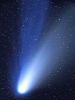
Comets-Hale_Bopp-02.jpgThe "Dust" and "Ion" Tails of Hale-Bopp79 visiteLo splendore e la magnificenza della Cometa Hale-Bopp, durante il suo passaggio del 1997. Nell'immagine, vediamo le due code di Hale-Bopp: la coda ionica (blu intenso), composta da molecole di gas ionizzati - è il monossido di carbonio che, quando viene 'eccitato', risplende di luce azzurra - la quale si crea dall'interazione fra le particelle contenute nel Vento Solare ed i gas presenti in prossimità del nucleo della cometa. La coda ionica, in quanto spinta dal Vento Solare, si muove come una sorta di banderuola e si dirige sempre in posizione diametralmente opposta rispetto al Sole (la sorgente del "Vento"). Anche la coda di polveri (grigio-celeste) segue le leggi della coda ionica, ma essa si orienta in maniera meno netta rispetto al Sole. Questa seconda coda è formata da particelle di roccia e polveri - le cui dimensioni variano dal micron al metro ed oltre - staccatisi dal nucleo della cometa durante - ed a causa - della sua "Corsa verso il Sole".Mag 22, 2005
|
|

Tempel1-PIA07881.jpgTempel-1, from Kitt Peak (pseudo-colors)61 visiteCaption NASA originale:"The Kitt Peak National Observatory's 2,1-meter telescope observed comet Tempel 1 on April 11, 2005, when the comet was near its closest approach to the Earth. A pinkish dust jet is visible to the SouthWest, with the broader neutral gas coma surrounding it. North is up, East is to the left and the field of view is about 80.000 Km wide. The Sun was almost directly behind the observer at this time. The red, green and blue bars in the background are stars that moved between the individual images.
This pseudo-color picture was created by combining three black and white images obtained with different filters. The images were obtained with the HB Narrowband Comet Filters, using CN (3870 A - shown in blue), C2 (5140 A - shown in green) and RC (7128 A - shown in red).
The CN and C2 filters capture different gas species (along with the underlying dust) while the RC filter captures just the dust".Mag 20, 2005
|
|

Tempel 1-PIA07879.jpgComet "Tempel 1"57 visiteCaption NASA originale:"Sixty-nine days before it gets up-close-and-personal with a comet, NASA's Deep Impact spacecraft successfully photographed its quarry, comet Tempel 1, at a distance of 39,7 MMs. The image, taken on April 25, 2005, is the first of many comet portraits Deep Impact will take leading up to its historic comet encounter on July 4, 2005". Apr 28, 2005
|
|

Comets-Halley-30155.jpgThe Halley Comet, from Giotto60 visiteCaption ESA originale:"A composite image of the nucleus of comet Halley. This image is composed of 68 images of varying resolution. The data at the brightest point on the nucleus is at the highest resolution (50 m).
The Sun comes from 30° above the horizontal to the left and is 17° behind the image plane (observation phase angle of 107°). The night side of the nucleus can be seen silhouetted against a background of bright dust in the far-field. Jets can be seen originating from 2 regions on the nucleus. Structure can be seen within the jets. A bright area is seen within the night side of the nucleus. We believe this to be a hill or mountain approximately 500 mt high. Other surface details can be seen in the illuminated region".Apr 18, 2005
|
|

Asteroids_from_HST-01.jpgAsteroids, from HST (2)58 visite"Many asteroids remain undiscovered. In fact, 1 was discovered in 1998 as the long blue streak in the above archival image taken by the Hubble Space Telescope. In 2002 June, the small 100-mt asteroid 2002 MN was discovered only after it whizzed by the Earth, passing well within the orbit of the Moon. 2002 MN passed closer than any asteroid since 1994 XM1 but not as close as 2004 MN4 will pass in 2029. A collision with a large asteroid would not affect Earth's orbit so much as raise dust that would affect Earth's climate. One likely result is a global extinction of many species of life, possibly dwarfing the ongoing extinction occurring now".
Dopo aver letto questi commenti la nostra memoria ritorna allo tsunami del Dicembre 2004 ed al paventato spostamento dell'asse terrestre: l'ipotesi più plausibile per spiegare l'accaduto sembra essere proprio quella che la NASA stessa ci suggerisce commentando questi frames HST: un asteroide di circa 100 metri potrebbe aver impattato l'Oceano Indiano.
C'è da riflettere.Apr 18, 2005
|
|

Asteroids_from_HST-00.jpgAsteroids, from HST (1)70 visiteCaption NASA originale da "NASA - Picture of the Day" del 18 Aprile 2005:"Rocks from space hit Earth every day. The larger the rock, though, the less often Earth is struck. Many kilograms of space dust pitter to Earth daily. Larger bits appear initially as a bright meteor. Baseball-sized rocks and ice-balls streak through our atmosphere daily, most evaporating quickly to nothing. Significant threats do exist for rocks near 100 meters in diameter, which strike the Earth roughly every 1000 years. An object this size could cause significant tsunamis were it to strike an ocean, potentially devastating even distant shores. A collision with a Massive asteroid, over 1 Km across, is more rare, occurring typically millions of years apart, but could have truly global consequences". Apr 18, 2005
|
|

Mathilde-PIA02479.jpgMathilde72 visiteCaption NASA originale:"Two different views of asteroid 253 Mathilde were obtained by the NEAR spacecraft on June 27, 1997. The image at left was obtained as the spacecraft approached Mathilde with its camera pointed near the direction of the Sun; only a few of the prominent ridges on Mathilde are illuminated. The visible area at left is 29 Km (approx. 18 miles) high and the phase angle (the angle from Sun-Mathilde spacecraft) is 136°. As the spacecraft receded from Mathilde, it observed the asteroid (about 60 Km - or 38 miles across) almost fully lit by the Sun at a phase angle of 43° (right image). Mathilde's irregular shape results from a long history of severe collisions with smaller asteroids. The largest visible crater is about 30 Km (19 miles) in diameter".Mar 17, 2005
|
|

Eros-PIA02488.jpgCraters' "Trio"57 visiteCaption NASA originale:"The Near Earth Asteroid Rendezvous (NEAR) spacecraft snapped the image on the left (Image of the Day Feb. 13, 2000 B) during its approach to Eros on Feb. 11, 2000, from a range of 2590 Km (approx 1.609 miles). This image shows a heart-shaped depression about 5 Km long. The image mosaic on the right was taken from 204 Km on March 3, 2000 and reveals that the mysterious heart-shaped feature is actually 3 separate craters. The oblique lighting conditions and low resolution of the earlier image created the illusion of a heart shape".Mar 17, 2005
|
|
| 282 immagini su 24 pagina(e) |
 |
|
|
|
|
19 | |
|
|
|
|





