| Ultimi arrivi - Asteroids and Comets |

Tenth_Planet-00.jpgThe 10th Planet? (1)58 visiteDa "NASA - Picture of the Day", del 31 Luglio 2005:"Is that a Tenth Planet? A faint, slowly moving dot discovered by computer shows clear signs of being a deep Solar System object at least as large as Pluto. The object, designated 2003 UB313, is currently situated nearly 100 times the Earth-Sun distance - over twice the average Pluto-Sun distance. That far out, the only way a single round object could be as bright as 2003 UB313 would be if it is at least as large as Pluto and completely reflective.
Since 2003 UB313 is surely not completely reflective, it could be substantially larger. One of the discovery frames is shown above digitally expanded and artificially brightened. 2003 UB313 was identified initially on frames taken by the automated 1.2-meter Samuel Oschin Telescope at Palomar Observatory in California, USA".Lug 31, 2005
|
|

Tempel1-Z-L-050719deepseq.jpgImpact Sequence57 visiteUn nuovo Sito (segnalatoci dal Dr Feltri) il quale, staccandosi dagli schemi di ricerca convenzionali, propone - sommessamente - un nuovo Modello Interpretativo per alcuni dei fenomeni dell'Universo ("...Exploring the electric universe: from ancient mythology to cosmic plasma discharge..."). Il Modello proposto dai Ricercatori di Thunderbolts è, secondo il nostro linguaggio, un "Modello di Confine": il confine che separa i dogmi della Scienza Convenzionale dagli Archetipi della Nuova Scienza. C'è molto da discutere, ovviamente, ma c'è anche molto da leggere, meditare ed apprendere, conservando il senso comune, ma adottando logiche di grande apertura.
EccoVi l'indirizzo: http://www.thunderbolts.info/default.htmLug 19, 2005
|
|

Tempel1-Z-I-HST.jpgThe impact sequence from HST69 visiteDa "NASA - Picture of the Day", del giorno 18 Luglio 2005:"It was a human-made event visible across the Solar System. At the direction of terrestrial scientists, a refrigerator-sized probe from the Deep Impact mission struck Comet Tempel-1 on July 4 at over 35.000 Km per hour.
The unexpectedly bright explosion was not nuclear but rather originated from a large plume that reflected back sunlight. Pictured above is how the event looked to the Earth-orbiting HST. A large cloud of bright material is seen emanating from the comet's nucleus and then dispersing. The area encompassing the comet became over two times brighter in the hours after the impact. Astronomers will continue to study the images and data returned by Deep Impact to better determine the nature of Comet Tempel-1 and discern clues about the formation dynamics of the early Solar System".
Nota: leggendo questa poche righe non serve uno Scienziato per capire che, al momento, l'unico scopo chiaro dell'esperimento era quello di fare propaganda...Lug 18, 2005
|
|

Tempel1-Y.jpgThe South-Pole of Tempel-1 and the impact area60 visiteDa "NASA - Picture of the Day" del 6 Luglio 2005:"This diverse landscape is the surface of comet Temple-1's nucleus as seen by the Deep Impact probe's Impactor Targeting Sensor. Within minutes of recording the rugged view, the landscape had changed dramatically though, as the impactor smashed into the surface near the two large, half kilometer-sized craters at picture center. Indications are that the probe penetrated well below the surface before vaporizing, sending a relatively narrow plume of debris blasting back into space. Researchers are still speculating on the final size of the crater produced by the July 4th comet crash, but material continues to spew from the impact site and has caused the faint comet to brighten significantly. Determining the crater dimensions and analyzing the debris ejected from the comet's interior will provide premier insights into the formation of comet Tempel 1, a primordial chunk of our own Solar System". Lug 13, 2005
|
|

Tempel1-XXXX-ITS_PressRelease2.jpgThe nucleus of comet Tempel-161 visite...e su questi aspetti (critici) dell'esperimento, non abbiamo ancora dati da presentare e commentare.
Dati che, a quanto dice il Prof. R. Hoagland, non verranno MAI (?) resi noti.
Vi suggeriamo, a tal proposito, di leggere il suo nuovo (discutibile, ma comunque interessante) editoriale, pubblicato sul Sito "The Enterprise Mission" e dal titolo "Captain's Blog - Space News & General Commentary by Richard C. Hoagland".
Nota: questa bella immagine del nucleo della cometa è stata ottenuta dai sensori di puntamento dell'Impactor, circa 5 minuti prima dell'urto.
L'impatto, a titolo di curiosità, è avvenuto fra i due piccoli crateri dal bordo scuro che possiamo vedere in basso, quasi a ridosso del margine inferiore del nucleo stesso (o del Polo Sud, se preferite).Lug 13, 2005
|
|

Tempel1-XXX-streakoflight.jpgSpace Fireworks...60 visiteCaption NASA originale:"...In the almost 2 hours of time that elapsed during the imaging of the comet, its position changed against the background stars. When all of the images of the motion are added together, the resulting streak of light is shown in the image above. Starting from the left, the comet was its natural brightness. The streak brightens significantly in the middle, immediately after impact of the probe".
Nota: i primi resoconti sui risultati scientifici dell'esperimento ci dicono che la NASA ha "scoperto" che sulla superficie della cometa Tempel-1 c'era (c'è) uno strato di polvere simile al borotalco, ergo più sottile di quanto ci si aspettasse. Inutile dire che, se messo in questi termini, il significato dell'esperimento va ad esaurirsi in un qualcosa che fa solo sorridere (di imbarazzo).
La realtà è molto più complessa e coinvolge la natura, la struttura e la composizione dei cd. "corpi cometari" in rapporto agli altri "corpi rocciosi" presenti nel Sistema Solare...Lug 13, 2005
|
|

Tempel1-ZZ-ZHRI_PressRelease1-PIA02133-br.jpgOne hour after the impact61 visiteE', a nostro parere, la filosofia - perversa e pervertitrice? - che si cela dietro questi "esperimenti" (o presunti tali) che fa rabbrividire: essa dice, molto chiaramente, che la Terra ed il Cielo, per chi può (e 'chi può' vuol dire 'chi ha la FORZA di potere') sono soltanto luoghi di esercizio.
Sono oggetti, cose delle quali si può disporre come si vuole e quando si vuole. E non importa se, nel performare questi "esperimenti", si mette a repentaglio la Natura stessa: ciò che conta è fare, fare quello che si vuole, mascherando la reale arroganza con la falsa sete di conoscenza.
Ecco il punto (e perdonateci l'acredine che emerge da queste poche righe): i Padroni del Mondo non solo fanno quello che vogliono e lo fanno in maniera violenta e discutibile, ma lo fanno anche, sempre più spesso, mascherando la loro immensa ignoranza e presunzione dietro un volto amichevole che dice "quello che facciamo, lo facciamo per il bene di tutti".
Per il bene di tutti? Davvero?!?...Lug 06, 2005
|
|
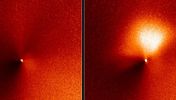
Tempel1-Z-HST-1-061405.jpgDeep Impact from HST63 visiteLa NASA - anzi: l'attuale Amministrazione USA - dunque, ce l'ha fatta: per festeggiare il 4 di Luglio, dato che la siccità domina in quasi tutti gli Stati Uniti ed i "fireworks" sono stati vietati, i fuochi artificiali si è pensato bene di andare a farli nello Spazio. Abbiamo letto i commenti della Dott.ssa M. Hack su questo evento e, sebbene le sue motivazioni sul fatto che sia stata una cattiva idea sono diverse dalle nostre, per stavolta ci troviamo in sostanziale sintonia con quanto espresso da questo 'Monumento Vivente' della divulgazione scientifica in Italia. Però il punto nodale di tutta le questione è, a nostro parere, un altro: quando la Francia, in passato, ha utilizzato Mururoa come poligono nucleare, il Mondo si è indignato, ma l'esperimento è stato eseguito lo stesso. Ora sembra che qualcuno abbia deciso di inziare a fare esperimenti 'sparando addosso' a corpi celesti ed il fatto che non sia stata usata (ancora...) una testata nucleare, secondo noi, non rende il fatto meno grave.Lug 06, 2005
|
|

Tempel1-VV-nhvcaxf9000910-PIA02131.jpgImpact Time!59 visiteWhen NASA's Deep Impact probe collided with Tempel-1, a bright, small flash was created, which rapidly expanded above the surface of the comet. This flash lasted for more than a second and its overall brightness is close to that predicted by several models. After the initial flash, there was a pause before a bright plume quickly extended above the comet surface. The debris from the impact eventually cast a long shadow across the surface, indicating a narrow plume of ejected material, rather than a wide cone. The Deep Impact probe appears to have struck deep, before gases were heated and explosively released. The impact crater was observed to grow in size over time. A preliminary interpretation of these data indicate that the upper surface of the comet may be fluffy, or highly porous. The observed sequence of impact events is similar to laboratory experiments using highly porous targets, especially those that are rich in volatile substances. The duration of the hot, luminous gas phase, as well as the continued growth of the crater over time, all point to a model consistent with a large crater.
Lug 06, 2005
|
|

Tempel1-XX-HRI_937_1.jpgDeep-impact...67 seconds after collision!58 visitecaption NASA originale:"This spectacular image of comet Tempel 1 was taken 67 seconds after it obliterated Deep Impact's impactor spacecraft. The image was taken by the HR camera on the mission's flyby craft. Scattered light from the collision saturated the camera's detector, creating the bright splash seen here. Linear spokes of light radiate away from the impact site, while reflected sunlight illuminates most of the comet surface. The image reveals topographic features, including ridges, scalloped edges and possibly impact craters formed long ago".Lug 06, 2005
|
|

Tempel1-X.jpgDeep-impact...16 seconds after collision!56 visiteCaption NASA originale:"This image shows the initial ejecta that resulted when NASA's Deep Impact probe collided with comet Tempel-1 at 10:52 p.m. Pacific time, July 3 (1:52 a.m. Eastern time, July 4) . It was taken by the spacecraft's medium-resolution camera 16 seconds after impact".Lug 04, 2005
|
|

Tempel1-W.jpgDeep-impact...13 seconds after collision!58 visiteCaption NASA originale:"This image shows the initial ejecta that resulted when NASA's Deep Impact probe collided with comet Tempel-1 at 10:52 p.m. Pacific Time, July 3 (1:52 a.m. Eastern time, July 4). It was taken by the spacecraft's high-resolution camera 13 seconds after impact. The image has been digitally processed to better show the comet's nucleus".Lug 04, 2005
|
|
| 282 immagini su 24 pagina(e) |
 |
|
|
|
|
18 | |
|
|
|
|





