| Ultimi arrivi - Asteroids and Comets |

Comets-Comet_Pojmanski-2.jpgThe "Pojmanski" Comet59 visiteE' passata inosservata, lontana dalla nostra Terra, ed è stata ben lungi dall'essere spettacolare come lo fu, qualche anno fa, la meravigliosa Hale-Bopp.
Certo, la cometina Pojmanski non aveva - forse - i numeri giusti per entrare nell'Albo delle (cosiddette) Grandi Comete, ma certo è che i media (TUTTI!) se ne sono guardati bene dal pubblicizzarla. E la NASA? Leggerete Voi stessi le scarne note prodotte al riguardo nel "NASA - Picture of the Day" del giorno 6 Marzo 2006. Noi, nel nostro piccolo, dato che ci meravigliamo per niente, siamo andati in cerca di fotografie di questa cometa ed abbiamo "scoperto" una straordinaria somiglianza fra C/2006 A1 (la Pojmanski Comet appunto) e la C/2004 Q2 (meglio nota come Machholz Comet). Uguale tipologia - o classe visuale - di appartenenza (nucleo sferico e chioma filiforme) e, soprattutto, uguale colore (ergo uguale - o comunque molto simile - composizione chimica). Deduzione logica: si tratta di "Sister-Comets". Domanda: ci sono altre "sorelle" in arrivo?!?
Have you ever seen a comet? Comets bright enough to be visible to the unaided eye appear only every few years. Right now, however, a new comet has brightened unexpectedly and is visible as a faint streak to the unaided northern observer in the eastern morning sky just before sunrise. Binoculars may help. Comet Pojmanski, officially designated C/2006 A1 and discovered only in January, now sports a turquoise tail several times longer than the full moon. Comet Pojmanski's ion tail is due to gas particles expelled by the comet being pushed away from the Sun by the solar wind, the same wind that ionizes gas in the tail causing its blue tint. Pictured above as it appeared only last week, Comet Pojmanski has now begun to fade as its orbit around the Sun takes it further from the Earth. Mar 06, 2006
|
|
LLL-Itokawa.jpgTarget Marker located on Itokawa (2)57 visiteThe spacecraft shifted to safe-hold mode because of its attitude dispersion during ascent, and Sagamihara Deep Space Control Room is now carrying out the recovery operation to three-axis control mode.
It therefore takes a few more days to obtain detailed data relating the procedure. Instruments onboard are functioning very well so far.
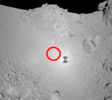
Spacecraft Hayabusa could find, on the surface of Itokawa, the Target Marker dropped on Nov. 20 among the images taken during descent phase on Nov. 26.
On the Target Marker are etched 880.000 names from 149 Countries.
The previous images show the area named "MUSES Sea" and they were taken at 04:58 of Nov. 20, 2005 (left) and at 06:24 of Nov. 26, 2005 (right).
In this frame, the white light spot inside the red circle is the Target Marker with the 880.000 names!Nov 29, 2005
|
|

LL-Itokawa.jpgTarget Marker located on Itokawa (1)58 visiteOn Nov. 26, spacecraft "Hayabusa" challenged the second trial to execute landing on and sampling from the asteroid Itokawa. Hayabusa team confirmed the whole process to have been implemented and it is sure that the team succeeded in sampling materials on the surface of an asteroid for the first time in World History. Detailed data to be sent from Hayabusa will further verify the sampling.
Hayabusa started its last descent phase from the altitude of 1 km above Itokawa by command from Earth around 10:00 p.m. Nov.25 (JST). It was followed by starting the vertical descent from around 6:00 a.m. Nov.26., and, around 6:25 a.m., Sagamihara Deep Space Control Room sent a command to continue the descent.
Hayabusa challenged landing and sampling operation after a hovering phase. Hayabusa team is now sure, through the analysis of telemetry data, that a series of sequence for sampling was successfully done. Hayabusa then flew up to several kilometers altitude with normal solar paddles power, spacecraft attitude, etc.Nov 29, 2005
|
|

L-Itokawa.jpgThe Target Marker separated from Hayabusa (close-up)57 visiteThe Target Marker that separated from Hayabusa carried the names of 880.000 people who participated in the campaign from the World.
It was placed in the South-West area of the MUSES-Sea.
When it hit to the surface, the descent speed was about 9 cm/sec. The Target Marker was specifically designed and fabricated with an aluminum shell filled with polyimide balls (so to absorb kinetic energy through multi-collisions). This design is capable to dramatically suppress the bouncing of the probe and its function has been tested and verified via drop tower tests in a vacuum chamber on Earth.
The Target Marker (è il minuscolo punto luminoso - cerchiato in nero - che si vede accanto all'ombra di Hayabusa nel close-up di Sx) was illuminated by onboard flash lamps every 2' (...).Nov 25, 2005
|
|
Itokawa-13.jpgGravity and Slope Map57 visiteThe purpose of the Rehearsal Descent is, first of all, to make sure that the proximity laser range finder works as intended, as its function has not been calibrated during cruise. The second purpose is to confirm whether the target marker image can be extracted against the asteroid surface, using onboard image processing that illuminates it using flash lamps onboard the spacecraft. The third purpose is to deploy and place the hopping robot MINERVA on the asteroid surface. Deploying MINERVA conflicts with the touch-down sequence, so it will be separated in advance of the sampling runs.
In conjunction with this very big challenge, JAXA is also starting a nation-wide campaign called ‘You Name the Landing Site’. The names assigned to the sites may not be officially registered by the IAU as the sites are very small. However, JAXA, as a finder, declares that the sites will be given those selected names.Nov 22, 2005
|
|

Itokawa-12.jpgNear Infrared Spectra of Candidates for Sampling Sites57 visiteIn view of the scientific results described above, JAXA has determined the landing/sampling sites candidates and the descent target point for rehearsal, along with their planned dates and times.
The landing/sampling sites must be free of obstacles and smooth enough to ensure safety, a top priority, while at the same time the surface inclination and the ground station coverage for Hayabusa must be taken into account. Taking these issues into consideration, the candidate
sites and schedule were determined.
The first site candidate is the regolith expanse in the middle of Itokawa, known as the MUSES-SEA Area and the second candidate site is the Woomera desert at the tip end of Itokawa, where the terrain is broad and flat. The rehearsal target is the area located close to the spin axis, a little east of the first site. The date and time of the planned events
(JST) are as follows:
1. Rehearsal Descent: Nov. 4, '05 - h.14:00
2. 1st Touch-down: Nov. 12, '05 - h. 15:00
3. 2nd Touch-down: Nov. 25., '05 - h. 15:00Nov 22, 2005
|
|

Itokawa-11.jpgThe Landing Procedure56 visiteThe gravity and slope information and estimates of the density of boulders and regolith distribution on the surface, combined with comparisons with meteorites, will advance our interpretation and understanding of asteroid planetology.
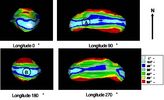
D) Using the laser altimeter and optical navigation camera, along with range and range-rate measurements fromground-tracking stations, have led to a successful mass and density estimate for Itokawa. The density has been estimated to be 2,3 +/-0,3 gram/cc, which is a little lower than that measured for rocks on the ground or for other S-type asteroids measured to date. This may indicate that there is substantial porosity for this body and forces conventional views of these small objects to be changed drastically. When the samples are successfully returned and recovered, the actual porosity will be clarified and our knowledge of how the Earth relates to meteorites will be greatly improved.Nov 22, 2005
|
|

Itokawa-10.jpgSurface details (3)60 visite(B) Taking advantage of the observations made with the onboard instruments, sufficiently detailed information about the sampling sites has been obtained, and the relation between the potential samples and the spectroscopic data has been correctly correlated. As a technology demonstration mission, Hayabusa has already finished the preliminary steps towards the primary sample and return goal. These samples will provide important scientific clues concerning the puzzlingly inconsistent correlations between S-type asteroids and ordinary chondrites, and lead to an improved understanding of the space weathering effect, which may clarify our understanding of the early Solar System and Earth.
(C) Combinations of the Itokawa images along with spacecraft navigation information has enabled shape and gravity models to be numerically defined. The Science Team has started to study and identify the special mechanisms that can move boulders and regolith in the ultra-low gravity environment associated with small objects.Nov 22, 2005
|
|

Itokawa-09.jpgSurface details (2)58 visiteA) Morphological and geological discoveries about Itokawa: the a-priori theoretical assumption that small near-Earth asteroids should have geologically homogeneous features was completely overturned by the observation of a wide variety of surface features and types at Itokawa. The surface is covered with huge boulders and, for the first time, naked surfaces not covered with regolith have been exposed. Previously visited asteroidswere covered with thick regolith, thus Itokawa’s surface is like nothing that has seen before, which is quite fortunate for the Hayabusa Mission. The opportunity to observe the true asteroid surface, which isusually concealed from view, advancesour understanding of spectroscopic observations of asteroids taken from Earth, and allows us to expand our knowledge of near Earth asteroids.Nov 22, 2005
|
|

Itokawa-08.jpgSurface details (1)58 visiteFor the scientific aspects of the mission, Hayabusa carries 4 instruments that have
performed successful observations to date:
1) AMICA, a Visible Imager with multi-band filters, has exposed 1500 images amounting to almost 1 GB of data;
2) NIRS, a near infrared spectrometer that has already taken 75.000 measurements distributed globally over the body;
3) LIDAR, a laser altimeter that has accumulated 1,4 million measurements globally, and
4) XRS, an X-ray spectrometer that has already received and integrated its signal for 700 hours.
In addition to these, spacecraft tracking data has been used to measure properties of the asteroid as well.
These unprecedented scientific measurements are briefly described and reported in what follows.Nov 22, 2005
|
|

Itokawa-07.jpgOrbiting around Itokawa (4)58 visiteThe deep-space exploration technologies that the Top World's Space Agencies are pursuing consist of 3 major elements:
1) high efficiency electric propulsion for cruise;
2) rendez-vous with target destinations and
3) round-trip flights back to the Earth.
As of this time Hayabusa has accomplished the first and second of these elements, leading the way for the Space Exploration Agencies of the World.
Furthermore, robotic sample collection and return from an extra terrestrial object has not been executed before, and is not currently planned, except for Hayabusa, which will attempt to gather a bulk sample from Itokawa.
Hayabusa’s success clearly shows that Japan’s deep space exploration technology has reached the level of the World’s most developed Space Agencies, and that Japan is now in a Leadership Position in some select engineering fields.
Thus Hayabusa opens a New Era in the exploration of the Solar System.Nov 22, 2005
|
|

Itokawa-06.jpgOrbiting around Itokawa (3)59 visiteSpecifically, at the time of arrival at Itokawa, Hayabusa had driven its proprietary new ion engines for 26.000 hours, including their operation during an Earth flyby.
It has also perfectly completed a period of hybrid optical navigation followed by
precise guidance and navigation of the spacecraft during its station keeping period around Itokawa.
These engineering achievements are the primary mission of Hayabusa and their successful completion is a great achievement.Nov 22, 2005
|
|
| 282 immagini su 24 pagina(e) |
 |
|
|
|
|
16 | |
|
|
|
|





