| |

| Ultimi arrivi - Before the Moon and Walking on the Moon (partially edited) |
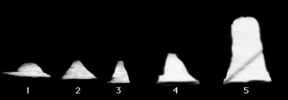
ZZ-ZZ-The Blair Cuspids-M.jpgThe "Blair Cuspids": possible shapes and visual appearance from Lunar datum (3)138 visite“I profili che vedete in questo frame sono, in realtà, i negativi delle ombre dei 5 rilievi (conosciuti come “Cuspidi” o “Colonne”) mostrati nel frame precedente. Lo sfondo è stato rimosso in maniera tale da conferirsi una maggior enfasi alla forma di ciascun rilievo.
Le ombre sono state compresse assecondando la direzione della loro lunghezza ed in accordo alla relazione trigonometrica espressa dalla seguente equazione: H=Ls tan(A) dove:
H è l’altezza del rilievo;
Ls è la lunghezza della sua ombra;
tan(A) è la tangente all’angolo definito dall’altezza del Sole rispetto all’orizzonte (in un determinato momento).
Poiché i primi 4 rilievi sembrano sorgere su una superficie sostanzialmente orizzontale (o con inclinazione minima), il valore dell’angolo A (che, ripetiamo, è l’angolo definito dall’altezza del Sole rispetto all’orizzonte Lunare in un momento determinato) è stato preso dagli stessi dati forniti dalla NASA, ed è fatto pari a 10,9°.
Le immagini delle ombre sono quindi state compresse calcolando la tangente all’angolo A ed il valore ottenuto è fatto pari a 0,193.
Una compressione maggiore, invece (se A=8° etan(A)= 0,14) è stata usata per il rilievo n. 5, poiché l’ombra di questa cuspide NON cade su una superficie (presumibilmente) orizzontale, bensì su un modesto dislivello la cui morfologia sembra indicare un suo “abbassamento” orientato nella direzione opposta rispetto alla provenienza della luce Solare (e così inevitabilmente producendo una diminuzione dell’altezza del Sole – effettiva in e per quel solo punto - rispetto all’orizzonte del luogo considerato).
Purtroppo, il dettaglio (i particolari) dei rilievi, operando questa elaborazione, vengono persi non solo a causa delle irregolarità che caratterizzano la superficie della Luna anche in quelle zone dove essa appare (è) pianeggiante, ma anche in ragione dell’algoritmo di compressione impiegato nella creazione dell’immagine.
Ad ogni modo, la forma approssimata di tutti i rilievi (ad eccezione del primo), è già da sola sufficiente a dimostrare che le caratteristiche esteriori di queste “Cuspidi” sono tali da renderle RADICALMENTE DIVERSE (e cioè ANOMALE) rispetto alle forme usualmente riscontrate nei macigni e nella maggior parte dei rilievi Lunari superficiali.
I profili teorici delle Cuspidi 2, 3, 4 e 5 suggeriscono l’eventualità che questi rilievi abbiano un’altezza maggiore della loro larghezza il che implicherebbe:
1) non solo la rarità di questi “oggetti” ma anche, di fatto, la loro intrinseca instabilità (teorica) e
2) la loro concentrazione su un’area relativamente piccola verrebbe a rendere la loro esistenza un evento tanto reale, quanto, in sé, improbabile.
Ricordate infatti: le colline, le montagne ed i crinali Lunari tendono ad essere bassi ed arrotondati (pensate, ad esempio, al Monte Pico – Mare Imbrium – la cui altezza è pari solo al 16% della sua larghezza).
Le Cuspidi 2, 3 e 4 appaiono di forma conica o piramidale, mentre la Cuspide n. 5 (la più alta), sembra essere di forma vagamente cilindrica.
Ora, muovendoci sull’assunto per cui l’altezza del Sole rispetto alla superficie su cui sorge la Cuspide n. 5 (e cioè il pendìo su cui evidenziamo l’ombra del rilievo) sia fatta pari ad 8°, ne consegue, dopo aver operato gli opportuni calcoli, che l’oggetto in questione potrebbe avere un’altezza pari a circa 15 metri”.
Come Lunar Explorer Italia, nel ringraziare il Dr Lan Fleming per la brillante prolusione, esprimiamo la nostra convinzione che le Cuspidi in oggetto sìano, in realtà, MOLTO più alte – in generale – della più alta di esse così come calcolata dal Dr Fleming stesso.
In particolare, conoscendo l’altezza dalla quale è stata effettuata la ripresa e l’estensione (come fosse un rettangolo) dell’area fotografata, abbiamo calcolato la lunghezza di ciascuna ombra e quindi, operando con il sistema suggerito dal Dr Fleming, abbiamo calcolato l’altezza (teorica) di ciascuno dei 5 rilievi.
I risultati ottenuti – i quali sono tuttora sotto scrutinio tecnico – ci dicono che la Cuspide n. 5 è effettivamente la più alta, ma che la sua altezza si aggirerebbe intorno ai 180 metri (!).
Ci rendiamo conto della (notevole) discrepanza rispetto ai calcoli operati dal Dr Fleming e della conseguente – e teoricamente altissima – instabilità del rilievo ma…tant’é.
Dic 08, 2005
|
|

ZZ-ZZ-The Blair Cuspids-L.jpgThe "Blair Cuspids": possible shapes and visual appearance from Lunar datum (2)116 visiteThese profile images are really negative images of the shadows of the 5 objects indicated by the numbers in the previous frame. The background has been blacked out by hand to emphasize the overall shape of each object. The shadows have been compressed in the direction of their length, according to the trigonometric relationship between an object's height (-->H), the length of its shadow (-->Ls), and the tangent of the Sun's elevation angle (-->A), above the surface on which the shadow falls. This relationship is: H = Ls tan(A).
Because the first four Cuspids appear to be situated on a fairly horizontal surface, the value of angle A was taken from the NASA support data to be the Sun's elevation above the horizon - 10,9° - and the images of the shadows were compressed by the value of that angle's tangent, such as 0,193°.
A greater compression, corresponding to a Sun angle of 8° (tan(8) = 0,14) was used for the profile of Cuspid 5 because its shadow falls over the surface of the rectangular "trench", which is sloping downward away from the Sun, thus effectively decreasing the Sun's elevation above the surface. (…)
The detailed contours of the objects are lost in these profiles due to the irregularities of the lunar surface and due to the blurring caused by the image compression algorithm. However, the general shapes of all the objects – except the first – can still be clearly seen to differ radically from the shapes of common lunar boulders and ridges.
The profiles suggest that Cuspids 2 through 5 have heights greater than their widths, which would be a very unstable placement for a randomly placed boulder and even more unusual for a cluster of them.
The hills and ridges of the Moon tend to be very low and rounded. The great lunar mountain Pico Mons in Mare Imbrium, for example, has a height only 16% of its width.
Cuspids 2 though 4 are conical or pyramidal, while Cuspid 5 (still the tallest even with a lower Sun angle assumed) appears to be a cylinder. Based on the assumption that the sun's elevation is 8° above the slope on which Cuspid 5's shadow is being cast, the object itself would have a height of approximately 15 meters. (…)
Dic 08, 2005
|
|

ZZ-ZZ-The Blair Cuspids-H.jpgThe "Blair Cuspids": possible shapes and visual appearance from Lunar datum (1)138 visitevedi il commento al frame successivoDic 08, 2005
|
|

29-G-Surveyor6_full.jpgSurveyor 6 - Panorama142 visiteOriginal caption:"This panorama of the cratered lunar surface was constructed from images returned by the US Surveyor 6 lander.
Surveyor 6 was not the first spacecraft to accomplish a soft landing on the Moon ... but it was the first to land and then lift off again! After the spacecraft touched down near the center of the Moon's nearside in November of 1967, NASA controllers commanded it to hop. Briefly firing its rocket engine and lifting itself some 4 mt above the surface, the Surveyor moved about 2,5 meters to one side before setting down again. The hopping success of Surveyor 6 essentially marked the completion of the Surveyor series main mission - to determine if the lunar terrain was safe for the planned Apollo landings".Nov 12, 2005
|
|

54-The Castle.jpgApollo 10 - AS 10-4822: a VERY controversial frame: the Castle - detail mgnf (2)180 visiteBellissima immagine e misteriosa oltre ogni misura ma...incommentabile.Ott 07, 2005
|
|
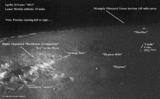
53-Apollo 10 frame AS 10-4822.gifApollo 10 - AS 10-4822: a VERY controversial frame (1)200 visiteUn fotogramma Apollo 10 famosissimo (e che Vi proponiamo in versione originale non compressa negli Archivi della Reserved Area) che ci porta, letteralmente, a metà strada fra Scienza e Fantascienza.
Un considerevole numero di Anomalie, infatti, è stato individuato (da più Ricercatori) in questo frame e, fra tutte, campeggia (alla Vostra Dx) quella conosciuta come "The Castle" (il suggestivo nome di battesimo datole dal Prof. Hoagland) che Vi proponiamo ancora come detail mgnf nel prossimo quadro.
Commenti? Impossibile farne: il frame è vecchio e rovinato (che cosa è reale, in esso, e che cosa è solo photo-artifact?) e noi, purtroppo, non abbiamo disponibili immagini recenti della stessa area.
Vedete Voi...Ott 07, 2005
|
|

52-The Shard-02.jpgThe famous "Shard", on the Moon (3)148 visitenessun commentoOtt 07, 2005
|
|

51-The Shard-01.gifThe famous "Shard", on the Moon (2)198 visitenessun commentoOtt 07, 2005
|
|

50-The Shard-00.gifThe famous "Shard", on the Moon (1)153 visiteThe Shard is a very anomalous structure which rises above the Moon's surface by more than a mile (about 1750 mt). Its overall irregular spindly shape - containing a regular geometric pattern - with constricted nodes and swollen internodes, if natural, has got to be a real wonder of the Universe and no known natural processes can explain such a structure. Computer enhancement with about 190 feet (about 60 mt) resolution shows an irregular outline with more reflective and less reflective surfaces. The amount of sunlight reflecting from parts of the Shard indicate a composition inconsistent with that of most natural substances. Only crystal facets and glass can reflect that much light (polished metallic surfaces are unnatural). Single crystals the size of city blocks are currently unknown. Prof. Hoagland says that the Shard may be a highly eroded remnant of some sort of artificial structure made of glass-like material. Other larger structures and their reflectivity in the area support this theory.Ott 07, 2005
|
|

15-V-Parry.jpgFrà Mauro, Parry and Bonpland Crater, from Lunar Orbiter 5 (3D)104 visiteOriginal caption:"Stereoscopic view of 3 adjoining craters; Frà Mauro to the North (left), Parry (upper right) and Bonpland (lower right). The area where the 3 rims meet is about 1200 meters higher than the crater floors. The two linear rilles form a "V" whose apex is at the left edge of the photograph. They dissect the crater floors and rims alike. The more westerly rille is bordered on the West (near the center of the anaglyph) by a chain of domes. The adjacent areas of the rille is nearly filled with dark, smooth material that appears to have come from the domes".Ott 07, 2005
|
|

15-U-Tobias.jpgTobias Mayer Crater, from Lunar Orbiter 5 (3D)102 visiteOriginal caption:"Stereoscopic view of an area sw of the Crater Tobias Mayer in Oceanus Procellarum. The highland ridge in the middle portion of the anaglyph is about 35 Km long and 2 Km high. A smooth mare dome abuts the western flank of the ridge. The dome is about 20 Km in diameter and exhibits an elongate summit crater, about 5 Km long.
A sinuous rille meanders across the lower part of the photograph, detouring around the base of the dome. Note the presence of several crater chains in the lower half and a large highland mass at upper left".Ott 07, 2005
|
|

15-T-SchroteriVallis.jpgSchroteri Valley, from Lunar Orbiter 5 (3D)113 visiteOriginal caption:"Stereoscopic view of a part of Schroter's Valley, the meandering depression running from the upper right to the lower left corner of the anaglyph. This rille is about 7 Km wide and up to 1300 m deep. Within its flat floor is a second, sinuous rille whose tightly packed meandor loops are about 200 m deeper. The ridge that is seen in the upper left portion of the photograph is about 1600 m higher than the plateau surface into which the Valley is cut".Ott 07, 2005
|
|
| 143 immagini su 12 pagina(e) |
|
3 | |
|
|
|
|
|
|
|
|
|
|





