| Ultimi arrivi - Mars Opportunity Anomalies and Maps |

ZY-Z-MERB_Sol1162_1.jpgRolling around Victoria: Opportunity Traverse Map from Sol 943 up to Sol 116278 visitenessun commentoMareKromiumMag 04, 2007
|
|

ZY-Victoria_Campaign_Traverse-B951R1_br2.jpgVictoria Crater: the Map107 visiteThis image from the Mars Orbiter Camera aboard NASA's MGS Spacecraft shows an overview of Victoria Crater and a portion of the area NASA's Mars Exploration Rover Opportunity has covered to reach the enormous depression.
Images such as this one from the MOC on NASA's MGS are helping scientists and engineers decide the best path for NASA's MER Opportunity as it approaches Victoria Crater.
The blue dot indicates Cape Verde and the red dot Cabo Frio. These two points mark the extent of the crater visible from the Rover's position on its 945th Sol (such as Sept. 20, 2006), a location it had reached two Soles earlier and from which much of this monster depression was still out of sight. The green annotations indicate Duck Bay, a location expected to allow a view to the other side of the crater. A dune, or ripple, is to the left of the crater, right in front of the green dot location.
This is where the team initially talked about sending Opportunity for the rover's first view down into the crater. After further consideration, the team opted for a drive to the right of that ripple (south of the green dot) near the rim.
The yellow lines that surround and intersect Victoria Crater are used to measure the crater and the distance to the far "bays." North is up. Victoria Crater is about 800 meters (half a mile) in diameter.Set 26, 2006
|
|

ZW-MERB_914_br2.jpgFrom "Eagle" to "Victoria"...96 visitenessun commentoSet 24, 2006
|
|

ZX-Victoria-PIA08749.jpgVictoria Crater139 visiteCaption NASA originale:"After driving more than 9 Km (about 5,6 miles) from the site where it landed in January 2004, NASA's MER Opportunity approached "Victoria Crater" in September 2006. The crater is about 750 mt (a little less than half a mile) across.
That is about six times wider than "Endurance Crater" where Opportunity spent six months examining in 2004, and about 35 times wider than "Eagle Crater" where Opportunity first landed. The walls of Victoria hold the scientific allure of much taller stacks of geological layers -- providing the record of a longer span of the area's environmental history -- than Opportunity has been able to inspect on the Meridiani plains or at smaller craters.
This image created by the U.S. Geological Survey uses a digital elevation model generated from computer analysis of three images taken by the Mars Orbiter Camera aboard NASA's Mars Global Surveyor orbiter. The vertical dimension is not exaggerated relative to the horizontal dimensions. The crater is about 70 mt (230 feet) deep.
The images used for providing the stereo information to calculate relative elevation were taken on Feb. 1, 2004 (http://www.msss.com/moc_gallery/r10_r15/images/R14/R1401689.html) and April 16, 2005 (http://www.msss.com/moc_gallery/s05_s10/images/S05/S0500863.html).
Opportunity is approaching Victoria from North-West". Set 13, 2006
|
|

ZW-MERB_930_br2.jpgAll the way, until Victoria...100 visiteCaption NASA originale:"The team managing NASA's MER Opportunity had set Victoria Crater as a long-term destination even before the Rover climbed out of Endurance Crater, in December 2004. As of early September 2006, Opportunity has driven more than 7,2 Km (about 4,5 miles) since leaving Endurance and is now approaching Victoria.
Victoria is the large crater near the bottom of this map made from images taken by the Mars Orbiter Camera on NASA's Mars Global Surveyor. The gold line traces Opportunity's path Eastward then Southward from Eagle Crater, where it landed, to Endurance Crater, where it spent six months, and nearly to Victoria. The south end of the line indicates the Opportunity's location as of the Rover's 930th Sol (such as Sept. 5, 2006). Victoria is about 750 mt (approx. 0,47 mile) in diameter, or about six times wider than Endurance and 35 time wider than Eagle. The scale bar at lower right shows the length of 800 meters (about 0,50 mile)".Set 08, 2006
|
|

OPP-SOL0004-200426133654_anomalia_marte_opportunity2.jpgMartian "Bunny" or Martian "Shell"? Probably just a Martian Entity (3)512 visite"...Ebbene è proprio questo “frastagliamento” che mi ricorda tanto quello di una conchiglia “terrestre”: la conchiglia che vedete in questo frame, accanto alla sua (quasi) "Gemella Marziana". (Fabio Italiano)
***
Che dire? Il modello di Fabio Italiano, basato su un'analisi comparativa visuale, ha dei validi punti a favore ed a noi piace.
L'idea del "coniglio", d'altra parte, era totalmente una boutade mentre quella della "conchiglia" ci sembra molto più ragionevole e, visto anche il probabile passato di Meridiani Planum, anche ben ragionata.
L'unica posizione che, invece, resta veramente difficile da difendere è, ancora una volta, quella della NASA: un pezzo di airbag... E dove è andato a finire il "pezzo di airbag" nei Soles successivi? Spazzato via dal vento? E no, cari Amici di Pasadena: tra i Soles 4 e 12, su tutta Meridiani Planum e, comunque, nell'area di landing di Opportunity, la NASA stessa dice "winds absent".
E allora? Che cosa è successo alla "conchiglia" (se Vi piace l'idea) o al "frammento di airbag" (se volete sposare la tesi NASA)?
Chi lo ha "portato via", dato che l'Imputato n. 1 per il "furto" - il Vento - era...assente?!?
Set 02, 2006
|
|
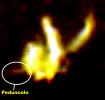
OPP-SOL0004-200426133625_resized_contrasted_ped.jpgMartian "Bunny" or Martian "Shell"? Probably just a Martian Entity (2)335 visite"...La NASA ci viene a dire che è un pezzo di airbag?
Ma ditegli di farci il piacere!…
Ma secondo voi è un pezzo di airbag? Secondo me non lo è: sia per una questione di dimensioni, sia per la sua forma e sia perchè al suolo, di tracce idonee a confortare la tesi NASA (trascinamenti, segni di impatto o di un qualsiasi genere) NON ce ne sono.
Io ipotizzo, a questo punto, una forma vivente - che tanto mi ricorda una conchiglia con ospite annesso.
Guardate questo dettaglio super-contrastato dell'Anomalia, fatto per meglio interpretarne la forma; si vede benissimo (in basso a Sx) una sorta di “peduncolo” o comunque di continuazione del “frastagliamento” del bordo inferiore dell’anomalia..."Set 02, 2006
|
|

OPP-SOL0004-200426133625_resized.jpgMartian "Bunny" or Martian "Shell"? Probably just a Martian Entity (1)334 visiteUn nuovo - anche se riferito ad una possibili Anomalìa di Superficie ormai molto "vecchia" (Sol 4 del MER Opportunity) - ed assai intrigante Lavoro del nostro caro Amico e Socio, Fabio Italiano (SpazioUFO.com): si tratta di una nuova interpretazione sul famoso "Coniglio Marziano" che, secondo la NASA, era solo un frammento di airbag. Inutile dire che, dopo oltre due anni di discussioni, la materia è stata dimenticata e le risposte non sono mai arrivate.
Ma sentiamo che cosa ha da dirci il nostro bravissimo Fabio Italiano al riguardo...
"Entità Marziana?
Avevo già analizzato questa Anomalia appena pubblicata sul sito della NASA ed avevo postato questo mio pensiero sia su Ufologia.net che su Spazioufo.com, ma rivediamo meglio il tutto.
Non eravamo di certo presenti al momento dello scatto, ma qualcosa di interessante doveva sicuramente esserci, visto che tutto è sparito senza lasciare traccia!..."Set 02, 2006
|
|

OPP-SOL0106-ANOMALY-2-1P137595411ESF2208P2579L4M1.jpgBright Object on Mars (extreme detail mgnf) - Sol 106305 visiteIncommentabile, specie alla luce delle fattezze del presunto Heat-Shield diffuse dalla NASA dopo l'avvicinamento ad esso operato da Opportunity - dopo la sua uscita da Endurance Crater (vedi, per le immagini in questione, quanto proponiamo nella Sez. "Walking on Mars").Lug 10, 2006
|
|

ZV-Victoria Crater_traverse_labels-A810R1_br2.jpgNext Stop: Victoria Crater!128 visiteCaption NASA originale:"This image from the Mars Orbiter Camera on NASA's Mars Global Surveyor highlights the MER Opportunity's approach toward Victoria Crater.
North is to the left. Opportunity's location at Sol 804 (such as April 29, 2006) is marked, as are the left and right edges of Victoria's rim from the Rover's point of view. The labeled "promontory" is a bright spot that scientists believe is an outcrop on the far side of the crater. Marked in light purple is a small, 35-mt (about 115-foot) crater.
Victoria Crater is 800 mt (nearly half a mile) in diameter, about six times wider than Endurance Crater, where Opportunity spent several months in 2004 examining rock layers affected by ancient water". Mag 06, 2006
|
|

ZU-Opp-Path-R1400021R22640MERBannot-2.jpg...and all-the-way to Victoria! (HR)126 visiteOriginal caption:"The MER Opportunity initially examined sedimentary rock outcrops and sandy, windblown regolith within Eagle Crater; then it was driven by the Rover Team out of Eagle Crater and on into Endurance Crater.
By the end of 2004, Opportunity left Endurance and started investigating the site where the Heatshield impacted the surface.
After that, the Rover spent much of the year 2005 driving from the Heatshield location down to the shallow Erebus Crater.
Long-term plans call for driving Opportunity from Erebus to Victoria Crater, where a substantially thicker sequence of layered rock is expected to be found, relative to previous outcrops examined in the craters Endurance and Eagle".
Location near: 2,0°S and 5,6° W
300 mt scale bar = 984 ft
Illumination from: leftGen 24, 2006
|
|

ZT-Opp-Path-R1400021R22640MERBannot-1.jpgFrom the Landing Site up to Endurance Crater (HR)113 visiteOriginal caption:"It was two years ago that the MER Opportunity landed on Meridiani Planum.
The Rover marked its first Mars-year (equivalent to 687 Earth Days - and therefore 2 Earth years) in December 2005.
In the picture shown here the "key-sites" have been labeled and the colored portion is a 3D stereo-anaglyph which can be viewed using red (left eye) and a blue (right eye) glasses.
During the landing in January 2004, rockets were fired to slow the final descent, just before the inflated airbags (containing the folded-up Lander and Rover) were released. The rockets disturbed the sandy surface at the location labeled "blast effects".
Following release, the airbags bounced and rolled until coming to rest inside Eagle Crater. The Lander, in fact, can be seen as a bright spot near the center of Eagle Crater.
Meanwhile, the jettisoned parachute and backshell landed to the South-West of Eagle while the Heatshield fell just South-West of Endurance Crater".Gen 24, 2006
|
|
| 110 immagini su 10 pagina(e) |
 |
3 | |
|
|
|
|
|
|





