| Ultimi arrivi - A Tribute To Mars Global Surveyor |

North_Polar_Regions-The_Erg-PIA07282.jpgOutcrops in the North polar Erg (Original NASA/MGS/MSSS b/w Frame)112 visiteCaption NASA originale:"This Mars Global Surveyor (MGS) Mars Orbiter Camera (MOC) image, acquired during Northern Summer in December 2004, shows dark, windblown Sand Dunes in the North Polar Erg: a vast Sea of Sand Dunes that surrounds the North Polar Cap. These landforms are located near 80,3° North Lat. and 144,1° West Long. Light-toned features in the image are exposures of the substrate that underlies the immense Erg. The image covers an area of about 3 Km (1,9 mi) wide and is illuminated by sunlight from the lower left".
Nota Lunexit: le "light-toned features", a nostro avviso, sono soltanto degli affioramenti rocciosi (Rocky Outcrops). Gen 21, 2005
|
|

Volcanoes-Pavonis_Mons.jpgPavonis Mons (Darkened Natural Colors; credits: NASA/MGS/MSSS)97 visiteCaption NASA originale:"This Mars Global Surveyor (MGS) Mars Orbiter Camera (MOC) wide angle color composite image, obtained in December 2003, shows the middle of the three Tharsis Montes, Pavonis Mons.
This is a broad shield volcano -similar to the volcanoes of Hawaii - located on the Martian equator at 113° W.
The volcano summit is near 14 Km (~8.7 mi) above the Martian Datum (0 elevation); the central caldera (crater near center of image) is about 45 Km (~28 mi.) across and about 4.5 Km (~2.8 mi.) deep.
Sunlight illuminates the scene from the lower left".Gen 07, 2005
|
|
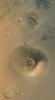
Volcanoes-Ceraunius_and_Uranius-E14-1248-1249_ceraunius50.jpgCeraunius and Uranius (Over-Saturated Natural Colors; credits: NASA/MGS/MSSS)107 visiteCaption NASA originale:"Acquired in March 2002, this Mars Global Surveyor (MGS) Mars Orbiter Camera (MOC) wide angle view shows the martian volcanoes, Ceraunius Tholus (lower) and Uranius Tholus (upper). The presence of impact craters on these volcanoes, particularly on Uranius Tholus; indicates that they are quite ancient and are not active today. The light-toned area on the southeastern face (toward lower right) of Ceraunius Tholus is a remnant of a once more extensive deposit of dust from the global dust storm events that occurred in 2001. The crater at the summit of Ceraunius Tholus is about 25 Km (15,5 mi) across. Sunlight illuminates the scene from the lower left".Gen 07, 2005
|
|

Craters-Pollack_Crater-01.jpgThe "White Rock" inside Pollack Crater96 visiteCaption NASA originale:"The layering in White Rock suggests that the material is sediment deposited at some time in the distant past within Pollack Crater. The fact that the material erodes to form steep cliffs suggests that it is hard like rock. Thus, White Rock is interpreted to be an outcrop of sedimentary rock. It is probably a small remnant of a larger body of rock that may have once covered the entire floor of Pollack Crater; this view is supported by the observation that more extensive layered rocks are seen in other craters across the surface of the Red Planet (e.g., the crater at 8°N, 7°W)".Gen 07, 2005
|
|

Craters-Pollack_Crater-00.jpgThe "White Rock" inside Pollack Crater (NASA/JPL/MSSS)101 visiteCaption NASA originale:"White Rock" is a ridged mound that was first seen and informally named "White Rock" in pictures from the Mariner 9 orbiter in 1972. In black-and-white photos, the feature appears much brighter than its surrounding terrain, giving the impression that the material is white. Later analyses of Mariner 9, Viking and MGS data showed that the feature isn't actually white: it is somewhat red and reflects only about 20-25% of the sunlight that falls upon it (a white surface would reflect 100%). Located in Pollack Crater, a 95 Km wide impact basin at 7.9°S, 334.7°W, White Rock is the light-red/orange feature with the rectangular white box drawn on it in the context view. The light-toned material that gives White Rock its name forms steep cliffs with valleys between them covered by dark, windblown, rippled sand". Gen 07, 2005
|
|

Craters-Lomonosov_Crater.jpgLomonosov Crater in Wintertime111 visiteCaption NASA originale:"On April 20, 2000 (Wintertime on Mars), the Mars Orbiter Camera (MOC) onboard Mars Global Surveyor (MGS) captured this view of a chilly Lomonosov Crater. The rims of the crater appear white because they are covered with wintertime frost. A dark patch just right of center on the crater floor is a sand dune field. Both low-lying ground fogs (fuzzy, patchy areas around the lower perimeter of the crater) and higher cloud layers (fuzzy white arcs seen within the crater and towards the upper right) obscure much of the surface. The Sun, only 12° above the horizon, bathes the scene in a reddish-brown hue. Lomonosov Crater is about 150 Km (93 mi) across and located on the martian northern plains at 64.8° N, 8.8° W. The crater is named for the 18th Century Russian chemist, Mikhail V. Lomonosov (1711-1765)".Gen 07, 2005
|
|

Craters-Newton_Crater-00-39S_166W_30.jpgGullies inside Newton Crater - Terra Sirenum (Natural Colors; credits: NASA/MGS/MSSS)116 visiteCaption NASA originale:"Both pictures show gullies (gully--->plur.: gullies: "gole" o "crepacci scoscesi") on the walls of two different meteor impact craters that occur in Newton Basin in Sirenum Terra, Mars. This picture, showing gullies in a crater at 42.4°S, 158.2°W, exhibits patches (patch-->geol.: "placche" o "macchie") of wintertime frost on the crater wall and dark-toned sand dunes on the floor. Its resolution is 1,5 meters (5 feet) per pixel - objects the size of school buses can be resolved in the full size image. The gullies in these craters originate at a specific layer and may have formed by release of groundwater to the martian surface in geologically recent times".Gen 07, 2005
|
|

Craters-Newton_Crater-01-42S_158W_30.jpgGullies inside Newton Crater - Terra Sirenum (Natural Colors; credits: NASA/MGS/MSSS)123 visiteCaption NASA originale:"This picture shows gullies in a crater at 39.0°S, 166.1°W and it is one of the highest-resolution images ever obtained from Mars. Also in this case the resolution is 1,5 meters (5 feet) per pixel".Gen 07, 2005
|
|

Craters-Unnamed_Crater_in_Noachis_Terra-PIA07202_modest.jpgUnnamed Crater in Noachis Terra (Original NASA/MGS/MSSS b/w Frame)92 visiteCaption NASA originale: "This Mars Global Surveyor (MGS) Mars Orbiter Camera (MOC) image shows an impact crater, a little over 2 Km (> 1,2 mi) in diameter, located in Noachis Terra near 50.4°S, 14.3°W. The crater's bouldery ejecta blanket has protected underlying material from being eroded away by wind, leaving the ejecta up on a low pedestal. This picture covers an area about 3 km (1.9 mi) across, and is illuminated by sunlight from the upper left".Gen 07, 2005
|
|

Dunes-PIA07152-00.jpgDark Dunes and Yardangs inside Herschel Crater (Original NASA/MGS/MSSS b/w Frame)99 visiteImmagine ripresa dal Mars Global Surveyor (MGS) Mars Orbiter Camera (MOC) che ci mostra Dune di colore scuro, scolpite dal vento, che giacciono sul fondo del Cratere Herschel. La superficie di queste Dune sembra caratterizzarsi per il fatto che ci appaiono - anche da una notevole distanza... - consistenti fessure scavate al loro interno. Questo sta a significare che la sabbia che le forma NON è semplicemente "accatastata" (ma, granuloscopicamente parlando, "libera"), così come accade per la maggior parte delle Dune Terrestri! Questo fenomeno ci dice che la sabbia di queste Dune Marziane è "cementata e compatta", simile a roccia (fragile, ma pur sempre roccia), e l'azione costante dei venti, nel tempo, ha creato, su queste sabbie "indurite", delle particolari "aree erose" che sono conosciute come Yardangs. L'immagine copre un'area di circa 3 Km (1,9 miglia) la quale si trova vicino ai 15,6° di Latitudine Sud ed ai 229,0° di Longitudine Ovest. Il Sole illumina la scena dalla Sn, in alto.Gen 05, 2005
|
|

North_Polar_Features-Chasma_Boreale-PIA07195-00-PCF-LXTT.jpgFeatures of Chasma Boreale (Original NASA/MGS/MSSS b/w Frame) 105 visiteCaption NASA originale:"This Mars Global Surveyor (MGS) Mars Orbiter Camera (MOC) image shows dark Sand Dunes in the North Polar Region of Mars. They are streaming away (toward the left) from a low escarpment at the edge of an outlier of Polar Water Ice (the bright area on the right). The picture covers an area about 3 Km (1.9 mi) wide and is located near 80,7° North Lat. and 80,2° West Long.. Sunlight illuminates the scene from the lower left". Gen 05, 2005
|
|
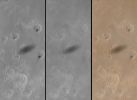
Martian_Eclipse-moc2_msss_3shadow100-01.jpgMOC Views of Martian Solar Eclipses (Original NASA/MGS/MSSS - Natural Color Frame)148 visiteThis picture shows wide angle red (left), blue (middle) and color composite (right) views of the shadow of Phobos (elliptical feature at center of each frame) as it was cast upon western Xanthe Terra on August 26, 1999, at about 2 p.m. local time on Mars. The image covers an area about 250 Km (155 miles) across and is illuminated from the left. The meandering Nanedi Valles is visible in the lower right corner of the scene. Note the dark spots on three crater floors - these appear dark in the red camera image (left) but are barely distingished in the blue image (middle), while the shadow is dark in both images. The spots on the crater floors are probably small fields of dark sand dunes.Gen 01, 2005
|
|
| 512 immagini su 43 pagina(e) |
 |
|
|
|
|
|
|
40 | |
|
|








