| Ultimi arrivi - A Tribute To Mars Global Surveyor |

Craters-Benedictus_XVI-PIA07838.jpgImpact Crater with frost deposits (Benedictus XVI Crater - Original NASA/JPL/MSSS b/w Frame)70 visiteLocation near: 37,5° South Lat. and 222,1° West Long.
Image width: ~3 Km (~1,9 mi)
Illumination from: upper left
Season: Southern Winter
Lunar Explorer Italia, in passato, ha spesso 'battezzato' crateri e rilievi Marziani i quali - ufficialmente - non hanno nome, usando un pizzico di fantasia e cercando di rimanere rispettosa della tradizione Astronomica e Scientifica in materia di nomenclatura. Oggi, 19 Aprile 2005, abbiamo pubblicato la foto di questo "frosty crater", anch'esso senza nome.
Ebbene, anche se la Scienza e la Fede sono Entità profondamente diverse (e sovente in disaccordo, come la Storia ci insegna e racconta) e sebbene Lunar Explorer Italia sia un'Associazione laica in tutto e per tutto, riteniamo giusto rendere omaggio in qualche modo al Nuovo Pontefice della Santa Romana Ecclesia e quindi battezziamo questo imponente rilievo Marziano con il nome di "Benedetto Decimo-Sesto".Apr 19, 2005
|
|

Craters-Unnamed_Crater_with_Windstreak-PIA07508-00.jpgUnnamed Crater with Windstreak (Original NASA/MGS/MSSS b/w Frame)88 visiteCaption NASA originale:"This MGS-MOC image shows a 1,2 Km North Mid-Latitude Unnamed Crater with a bright Windstreak".
Location near: 30,8° North Lat. and 131,8° West Long.
Image width: ~3 Km (~1,9 mi)
Illumination from: lower left
Season: Northern Summer
Apr 01, 2005
|
|

North_Polar_Regions-Chasma_Boreale-MGS-00.jpgBrown Dunes in Chasma Boreale (Original NASA-MSSS-MGS b/w frame)108 visiteCaption NASA originale:"This Mars Global Surveyor (MGS) Mars Orbiter Camera (MOC) image shows layers and dunes in Chasma Boreale, a large depression in the North Polar Region".
Location near: 85,2°N; 10,4°W
Image width: ~3 Km (~1.9 mi)
Illumination from: lower left
Season: Northern Summer Mar 25, 2005
|
|

Craters-Unnamed_Crater-Southern_Regions.jpgUnnamed Crater covered by Fog (Original NASA/MGS/MSSS b/w Frame)107 visiteCaption NASA originale:"Craters near the edge of the retreating South Polar Seasonal Frost Cap often have fog in them, this time of year. This MGS-MOC wide angle red image was acquired on July 13, 2003. It shows an Unnamed Crater, roughly 36 Km across, that is enveloped in Fog.
This picture was taken as a context frame for a high resolution view that was intended to show Dunes on the Floor of the Crater. That high resolution view was frustrated by thick Fog that hid the Dunes from view. This wide angle context frame shows that winds from the lower right (South/East) were blowing over the Crater, causing the Fog to bunch up in a wavy, rippled pattern. Winds streaming off the South Polar Cap toward the North create a variety of patterns in the Fogs formed by Water Ice or Vapor as the Seasonal Cap retreats during Southern Spring.
This picture shows an area located at about 66,4° South Lat. and 208,6° West Long; sunlight illuminates the scene from the upper left (North/West)". Mar 21, 2005
|
|

Craters-Kunowsky_Crater-2004_06.jpgFrost and Wavy Clouds on Kunowsky Crater (Original NASA/MGS/MSSS b/w Frame)102 visiteCaption NASA originale:"This red wide angle MGS-MOC image, acquired in March 2004, shows Kunowsky Crater ringed by seasonal Frost. Kunowsky Crater is about 67 Km (~42 mi) in diameter. Wavy Clouds form to the East of the Crater in early Spring as winds circulate from West to East. The Crater is located at about 57,1° North Lat. and 9,7° West Long.". Mar 21, 2005
|
|

North_Polar_Features-Dunes-Dark_Dunes-MGS.jpgDark Dunes in Vastitas Borealis (Original NASA/JPL/MSSS b/w Frame)93 visiteCaption NASA originale:"This MGS-MOC image shows dark North Polar Dunes overlying other materials in the North Polar Region".
Location near: 79,1° North Lat. and 228,8° West Long.
Image width: ~3 Km (~1,9 mi)
Illumination from: lower left
Season: Northern SummerMar 21, 2005
|
|

Volcanic_Features-Collapse_Pit-2003_07_12.jpgCollapse Pit in Tractus Fossae (Original NASA/MGS/MSSS b/w Frame)70 visiteCaption NASA originale:"Extensional faulting, wherein some fraction of the Martian Crust is pulled apart and Faults are formed where the Bedrock breaks, has also led to formation of Collapse Pits in the Tractus Fossae Region. This MGS-MOC image shows one such pit and the layered bedrock exposed in its walls. Dark Streaks on the Slopes of the Pit result from Avalanches of dry, fine-grained debris (probably Dust, as these streaks are only found in the dust-mantled regions of Mars).
This Pit is located near 23,5° North Lat. and 103,8° West Long. Sunlight illuminates the scene from the lower left".Mar 14, 2005
|
|

Volcanic_Features-Collapse_Pits-Pavonis_Mons_Area.jpgPit Chain on the Eastern Flank of Pavonis Mons (Original NASA/MGS/MSSS b/w Frame)90 visiteCaption NASA originale:"Pavonis Mons is the middle of the 3 large Tharsis Montes Volcanoes in the Martian Western Hemisphere.
Located on the Equator at about 113° West Longitude, Pavonis Mons stands as much as 7 Km above the surrounding Plain. The MGS-MOC recently spied the above Chain of Elliptical Pits on the lower East Flank of Pavonis Mons. The picture covers an area approx. 3 Km wide by 3,4 Km in length. The Pits are aligned down the center of a 485 meters-(approx. 530 yards)-wide, shallow Trough.
The straight Trough and the Pits were both formed by collapse associated with faulting. The Scarp on each side of the Trough is a "Fault Line" - Troughs of this type are known to geologists as "Graben". Such features are typically formed when the ground is being moved apart by tectonic forces, or when the ground is uplifted by molten rock injected into the near sub-surface from deeper underground. Both processes may be contributing to the features seen on Pavonis Mons. The Pits follow the trend of these Faults, and indicate the locus of collapse".Mar 14, 2005
|
|

Volcanoes-The_FootPrint_Volcano-D.jpgThe "Footprint" Volcano (Original NASA/MGS/MSSS b/w Frame)98 visiteCaption NASA originale:"This MGS-MOC HR image, acquired 13 July 2003, shows a small, Dust-covered Volcano on the Plains located to the East of Pavonis Mons.
The Floor of the Caldera - such as the elliptical depression at the Summit of the Volcano - has a few windblown Ripples on it. The Ripples and thick Dust Mantle, together with the small impact craters on its Surface, indicate that the Volcano erupted some time ago, but there has been no activity at this Volcano in geologically recent times. This image covers an area approx. 3 Km wide by 6,8 Km (approx. 1,9 mi by 4,2 mi). The Volcano is located near 1,6° South Lat. and 105,7° West Long.; sunlight illuminates the scene from the left".
Nota Lunexit: il nome "Footprint" è stato convenzionalmente attribuito a questo rilievo da Lunar Explorer Italia.Mar 13, 2005
|
|
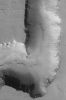
Channels-Unnamed_Channel_near_Ascraeus_Mons-2004_05.jpgA big channel on Ascraeus Mons83 visiteCaption NASA originale:"This MGS-MOC image shows a portion of a deep Channel formed on the Northern Flank of the large Volcano, Ascraeus Mons. Layers of Volcanic Rock are exposed in the Channel Walls, and the dark dots on the Valley Floor are Boulders derived from erosion of these materials.
The picture occurs near 14,5° North Lat. and 102,8° West Long. and is illuminated from the lower left. The picture covers an area about 3 Km (1,9 mi) across".Mar 13, 2005
|
|

Aeolian_Features-Dust_Storms-Mars___Earth_Comparison.jpgDust Storms on Mars and Earth92 visiteUn'interessante confronto fra una tempesta di sabbia Marziana (come vista dalla Sonda Mars Global Surveyor) ed una tempesta di sabbia che, sollevatasi con ogni probabilità dalla porzione più occidentale del deserto del Sahara, si sta ora spostando al largo dell'Oceano Atlantico.
Indubbiamente un'immagine suggestiva che evidenzia le diversità più che le similitudini esistenti fra la Terra e Marte. Inoltre, sempre secondo noi, la coloritura che è stata data alla "nube sabbiosa" terrestre è - anche in questo caso - davvero discutibile.
Chissà, forse alla NASA l'attribuzione dei colori alle immagini costituisce un problema davvero insuperabile...Mar 12, 2005
|
|

Controversial_Features-The_D_M_Pyramid-02.jpgThe D&M Pyramid (Original NASA/MGS/MSSS b/w Frame)161 visiteCaption NASA originale:"The mosaics shows a Cydonia landform popularly known as the "D&M Pyramid." It is located near 40.7°N, 9.6°W. Although it is not really shaped like a pyramid, the Cydonia landform is 1 of thousands of massifs, buttes, mesas, knobs and blocks that mark the transition from the far northwestern Arabia Terra cratered highlands down to the northeastern Acidalia Planitia lowlands. Each block, whether shaped like a face, a pyramid, or simply a mesa, massif or knob, is a remnant of the bedrock of northeastern Arabia that was left behind as erosion slowly degraded the terrain along this zone between the highlands and the lowlands. A few outcroppings of layers in this ancient bedrock can be seen in the mosaic of the pyramid-like landform shown here; much of the landform is covered with eroded mantling material that was deposited long after this highlands remnant became an isolated feature in Cydonia".
Lunar Explorer, questa volta, concorda pienamente con quanto riportato nella caption NASA.Mar 07, 2005
|
|
| 512 immagini su 43 pagina(e) |
 |
|
|
|
|
37 | |
|
|
|
|








