| Ultimi arrivi - A Tribute To Mars Global Surveyor |

North_Polar_Regions-Unusual_Landscape-MGS-1.jpgIndecipherable North Polar Landscape (Original NASA/MGS/MSSS b/w Frame)64 visiteOriginal caption:"This MGS-MOC image shows a slope on which layered materials are exposed by erosion in the North Polar Region of Mars. Wind streaks are also evident in this Summertime scene.
The layers that make up the material beneath the ice of the North Polar Residual Cap are typically considered to be a mixture of some amount of dust and ice, but the proportions of these constituents are not known".
Location near: 82,6° N; 298,1° W
Image width: ~3 Km (~1,9 mi)
Illumination from: lower left
Season: Northern SummerGen 13, 2006
|
|

Dunes-Brashear_Crater-PIA03656-00.jpgDark Dunes on Brashear Crater's Floor (Original NASA/MGS/MSSS b/w Frame)66 visiteOriginal caption:"This MGS-MOC image shows a field of Dark Sand Dunes on the North/Western side of the Floor of Brashear Crater. The Dunes formed largely from Winds that blew from the South-East (lower right)".
Location near: 253,7° South Lat. and 119,4° West Long.
Image width: ~3 Km (~1,9 mi)
Illumination from: upper left
Season: Southern SummerGen 11, 2006
|
|
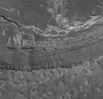
Chaotic_Terrain-Eos_Chaos-02.jpgFeatures of Eos Chaos: High Slope (Original NASA/MGS/MSSS b/w Frame - 2)69 visiteLocation near: 12,9° South Lat. and 49,5° West Long.
Image width: ~3 Km (~1,9 mi)
Illumination from: lower left
Season: Southern SummerGen 11, 2006
|
|

Chaotic_Terrain-Eos_Chaos-00.jpgFeatures of Eos Chaos: Circular Butte (Original NASA/MGS/MSSS b/w Frame - 1)68 visiteOriginal caption:"This MGS-MOC image shows light-toned, Layered Rock Outcrops in Eos Chaos, located near the East end of the Valles Marineris Trough System. The Outcrops occur in the form of a distinct, circular Butte (image 1) and a high Slope (image 2). The rocks might be sedimentary rocks, similar to those found elsewhere exposed in the Valles Marineris System and the Chaotic Terrain to the East of the Region".
Location near: 12,9° South Lat. and 49,5° West Long.
Image width: ~3 Km (~1,9 mi)
Illumination from: lower left
Season: Southern SummerGen 11, 2006
|
|

Volcanic_Features-Lava_or_Mud_Flows-00.jpgControversial Features of Zephyria Planum (Original NASA/MGS/MSSS b/w Frame)65 visiteOriginal caption:"This MGS-MOC image shows a portion of a shallow Channel carved in the Plains of the Zephyria Region of Mars. This feature might be the result of the passing of either extremely fluid Lava or, perhaps, Mud".
Location near: 5,1° North Lat. and 203,7° West Long.
Image width: ~3 Km (~1.9 mi)
Season: Northern Winter Dic 31, 2005
|
|

Craters-Airy_Crater-The_Prime_Meridian-1.JPGMars' Prime Meridian, such as: Longitude "0" (2 - Original NASA/MGS/MSSS CTX b/w Frame)95 visiteBeer and Mädler used a small circular feature, which they designated "a" as a reference point to determine the rotation period of Mars. The Italian astronomer G. V. Schiaparelli, in his 1877 map of Mars, used this feature as the 0 point of Longitude. It was subsequently named Sinus Meridiani ("Middle Bay") by Camille Flammarion.
When Mariner 9 mapped the Planet at about 1 Km (0,62 mile) resolution in 1972, an extensive control net of locations was computed by Merton Davies of the RAND Corporation. Davies designated a 0,5-Km-wide crater, subsequently named Airy-0 (within the large crater Airy in Sinus Meridiani) as the Longitude 0 point.
Airy-0 was imaged once by Mariner 9 and once by the Viking 1 orbiter in 1978, and these 2 images were the basis of the Martian Longitude System for the rest of the 20th Century. The MGS has attempted to take a picture of Airy-0 on every close overflight since the beginning of the mapping of Mars.Dic 27, 2005
|
|

Craters-Airy_Crater-The_Prime_Meridian-0.JPGMars' Prime Meridian, such as: Longitude "0" (1 - Original NASA/MGS/MSSS CTX b/w Frame)87 visiteOn Earth, the Longitude of the Royal Observatory in Greenwich, England is defined as the "Prime Meridian" or the 0 point of Longitude. Locations on Earth are measured in degrees East or West from this position.
The Prime Meridian was defined by an International Agreement in 1884 as the position of the Transit Circle: a large telescope located in the Observatory's Meridian Building. The Transit Circle was built by Sir George Biddell Airy, the 7th Astronomer Royal, in 1850. While visual observations with Transit were the basis of navigation until the space age, it is interesting to note that the current definition of the Prime Meridian is in reference to orbiting satellites and Very Long Baseline Interferometry (VLBI) measurements of distant radio sources such as quasars.
However, said "International Reference Meridian" is now about 100 mt East of the Transit Circle at Greenwich.
For Mars, the Prime Meridian was first defined by German astronomers W. Beer and J. H. Mädler in 1830-32. Dic 27, 2005
|
|

Phobos_from_MGS-003.jpgPhobos from Mars Global Surveyor (4 - HD)206 visitenessun commentoDic 27, 2005
|
|

Craters-Unnamed_Craters-Utopia_Planitia-00.jpgOld Buried Unnamed Craters in Northern Utopia Planitia (Original NASA/MGS/MSSS b/w Frame)66 visiteOriginal caption:"This MGS-MOC image shows 2 circular features on the Plains of Northern Utopia. A common sight on the Martian Northern Plains, these rings indicate the locations of Buried Impact Craters".
Location near: 65,1° North Lat. and 261,2° West Long.
Image width: ~2 Km (~1,2 mi)
Illumination from: lower left
Season: Northern SummerDic 27, 2005
|
|

Meridiani_Planum_Region-PIA03650~0.jpgUnusual Landform in Meridiani Planum (Original NASA/MGS/MSSS b/w Frame)65 visiteOriginal caption:"This MGS-MOC image shows exposures of light-toned, layered, Sedimentary Rock among dark-surfaced plains in Northern Sinus Meridiani. The circular feature in the South-East (lower right) corner of the image is a wedding-cake-like tower of Sedimentary Rocks".
Location near: 2,9° North Lat. and 359,9° West Long.
Image width: width: ~3 Km (~1,9 mi)
Illumination from: lower left
Season: Northern Winter
Nota: una "torre", piuttosto regolare nelle forme e presumibilmente costituita da rocce sedimentarie stratificate ed erose dal vento (e se ci pensate solo un attimo non Vi sarà difficile realizzare quanto rara possa essere una simile configurazione) viene liquidata come "torre-tipo-torta-matrimoniale". Non fraintendeteci: lo sappiamo che la banalizzazione fa parte del più recente stile NASA ma, alle volte, dopo gli assurdi nomi dati alle rocce Marziane, dopo la Hamburger-Nebula e dopo la torre a torta, ci domandiamo quali sìano mai le reali idee ed impressioni dei Signori che si occupano di questa Materia.Dic 20, 2005
|
|

Channels-Inverted_Channels_in_Arabia_Terra-PIA03643-02.jpgInverted channels of Arabia Terra (2 - Original NASA/MGS/MSSS b/w Frame)71 visiteOriginal caption:"This MGS-MOC image shows a somewhat sinuous, nearly flat-topped Ridge, located in Eastern Arabia Terra. The ridgetop was once the Floor of a Valley, perhaps carved by running water. The Valley Floor, or material that covered the Floor, was more resistant to erosion than the surrounding rock into which the Valley was cut. Thus, over time, the Valley disappeared and its Floor was left standing high as a Ridge. Inverted Valleys are common on Mars, but they also occur on Earth".
Location near: 10,8° North Lat. and 313,2° West Long.
Image width: width: ~3 Km (~1,9 mi)
Illumination from: lower left
Season: Northern WinterDic 17, 2005
|
|

Channels-Inverted_Channels_in_Arabia_Terra-PIA03643-00.jpgInverted channels of Arabia Terra (1 - Original NASA/MGS/MSSS b/w Frame)69 visiteOriginal caption:"This MGS-MOC image shows a somewhat sinuous, nearly flat-topped Ridge, located in Eastern Arabia Terra. The ridgetop was once the Floor of a Valley, perhaps carved by running water. The Valley Floor, or material that covered the Floor, was more resistant to erosion than the surrounding rock into which the Valley was cut. Thus, over time, the Valley disappeared and its Floor was left standing high as a Ridge. Inverted Valleys are common on Mars, but they also occur on Earth".
Location near: 10,8° North Lat. and 313,2° West Long.
Image width: width: ~3 Km (~1,9 mi)
Illumination from: lower left
Season: Northern WinterDic 17, 2005
|
|
| 512 immagini su 43 pagina(e) |
 |
|
|
|
|
29 | |
|
|
|
|








