| Ultimi arrivi - A Tribute To Mars Global Surveyor |

South_Polar_Features-Spiders-01.JPGSpiderland (Original NASA/MGS/MSSS b/w Frame)68 visiteCaption originale:"This MGS-MOC image shows Cracked Surfaces in the South Polar Layered Terrain of Mars. The Cracks in this scene have formed complex dendritic arrays. Evidence of the Fracture Networks is clear in the topmost Layer; however, close inspection reveals traces of apparently older Networks in the underlying Layers".
Location near: 79,1° South Lat. and 194,2° West Long.
Image width: ~3 Km (~1,9 mi)
Illumination from: upper left
Season: Southern SummerFeb 11, 2006
|
|

Craters-Unnamed_Crater_with_Windstreak.JPGCrater and Windstreak in Syrtis Major Planum (Original NASA/MGS/MSSS b/w Frame)71 visiteCaption originale:"This MGS-MOC image shows an Unnamed Crater that is approx. 2 Km in diameter in South Central Syrtis Major Planum. The image also captures a portion of the light-toned Windstreak formed in the Lee (---> lato sottovento) of the Unnamed Cater. The Windstreak is likely composed of a thin coating of Dust".
Location near: 1,9° North Lat. and 294,0° West Long.
Image width: ~3 Km (~1,9 mi)
Illumination from: upper left
Season: Northern SummerFeb 10, 2006
|
|
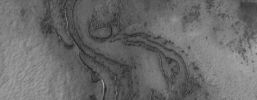
South_Polar_Features-00.JPGSouth Polar "River-like" Surface Features? (NASA-MGS/MOC RAW b/w frame)86 visiteCaption originale:"This MGS-MOC image shows layering in terrain at the high Southern Latitudes of Mars.
South Polar layers are commonly assumed to consist of varying amounts of dust and ice but there is an an alternative explanation saying that they may be exposures of ancient sedimentary rock".
Location near: 78,9° S; 10,1° W
Image width: ~3 Km (~1,9 mi)
Illumination from: upper left
Season: Southern SummerFeb 09, 2006
|
|

South_Polar_Features-Spiders-00.jpgSpiderland (Original NASA/MGS/MSSS b/w Frame)67 visiteCaption originale:"This MGS-MOC image shows an area adjacent to the South Polar Residual Cap that hosts several intricate fracture networks. Each network consists of multiple fractures radiating from a central location. Their origin is not understood - some investigators have speculated that these are sites of release of carbon dioxide from beneath the ground, but this explanation seems inadequate to explain all attributes of the features.
MOC images have shown that these features have not been changing from year to year during the course of the MGS mission".
Location near: 87,1° South Lat. and 234,1° West Long.
Image width: ~3 Km (~1,9 mi)
Illumination from: upper left
Season: Southern SummerFeb 08, 2006
|
|
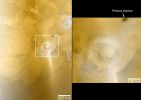
Volcanoes-Arsia_Mons.jpgArsia Mons with Water-Ice Clouds and the shadow of Phobos (credits NASA/JPL/MSSS)109 visiteCaption originale:"This pair of MGS-MOC color images shows early Autumn Clouds over the Arsia Mons Volcano, plus the shadow of the innermost of the Martain Moon Phobos. The picture on the left is taken from the MOC daily global map acquired at 7,5 km (~4,7 mi) per pixel on 28 January 2006, about a week after the start of Southern Autumn.
The picture on the right was taken at the same time, but at a higher resolution of 489 mt (~1604 ft) per pixel.
Both pictures are composites of MOC red and blue wide angle images, and both are oriented such that North is up and East is to the right. Arsia Mons and the other large Tharsis volcanoes commonly develop afternoon orographic (i.e., topographically-controlled) water ice clouds at this time of year. The equatorial Tharsis volcano, Pavonis Mons, is also under a deck of Water-Ice Clouds; it is located toward the upper right corner of the left, lower-resolution image.
Sunlight glints off the dusty Surface and the Clouds and Aerosols in the Atmosphere, producing the bright diagonal Streak located just South/East (lower right) of Arsia Mons. A Water-Ice Haze is seen on the left side of the lower-resolution image. The dark oval to the North-East of Arsia Mons, as noted above, is the shadow of Phobos".Feb 06, 2006
|
|
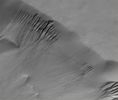
Craters-Lyell_Crater-00.jpgLyell Crater's Gullies (Original NASA/MGS/MSSS b/w Frame)74 visiteCaption originale:"This MGS-MOC image shows a suite of Gullies on a Scarp in Lyell Crater".
Location near: 69,7° South Lat. and 14,0° West Long.
Image width: ~3 Km (~1,9 mi)
Illumination from: upper left
Season: Southern SummerFeb 01, 2006
|
|

Controversial_Features-The_D_M_Pyramid-01.gifThe D&M Pyramid (High-Def-3D)133 visiteSe i 3D relativi alla "Faccia di Marte" hanno demolito - a nostro parere - le speculazioni relative ad una possibile artificialità del rilievo, altrettanto non si può dire per la "Piramide D&M". Anche in questo caso la tecnica del 3D ci dà un aiuto per muoverci verso la comprensione, ma si tratta di un aiuto davvero modesto.
La Piramide D&M "sembra" - ripetiamo "sembra" - se si guarda alla sua base (versante Nord-Ovest) avere una qualche sorta di squadratura, ma questo indizio è davvero troppo precario ed inconcludente per spingerci verso una congettura di artificialità. Precarietà ed inconcludenza che si palesano molto chiaramente quando andiamo a verificare i lati Nord-Est epoi l'intero versante Sud, laddove la presunta "squadratura" cede il posto ad un diegno del tutto irregolare ed indefinibile.
Comunque, proprio in virtù di quanto appare nella porzione Nord-Ovest della pseudo-collina, lasciamo la porta aperta a qualche ulteriore analisi speculativa e, nel frattempo, aspettiamo nuove immagini...Gen 28, 2006
|
|

South_Polar_Regions-Hills_and_Knobs.jpgHills, Knobs and Buried Craters in the South Polar Region (Original NASA/MGS/MSSS b/w Frame)71 visiteOriginal caption:"This MGS-MOC image shows a Summer scene from the South Polar Region of Mars. The circular feature in the North-East (upper right) corner of the image is an old meteor impact crater that has been partially filled and buried. The cone-shaped hill that occurs within the crater on its East (right) side is a remnant of material that once covered and completely buried the crater. Perhaps beneath the surfaces in the rest of the image there are other craters that have been filled and buried such that we cannot know, from an image, that they ever existed. The theme of filled, buried, and exhumed craters is one that repeats itself —over and over again — all over Mars".
Location near: 80,3° South Lat. and 286,1° West Long.
Image width: ~3 Km (~1,9 mi)
Illumination from: upper left
Season: Southern SummerGen 28, 2006
|
|

Craters-Terby_Crater-02.jpgThe Sedimentary Layers of Terby Crater (2 - Original NASA/MGS/MSSS b/w Frame)71 visitenessun commentoGen 27, 2006
|
|

Craters-Terby_Crater-01.jpgThe Sedimentary Layers of Terby Crater (1 - Original NASA/MGS/MSSS b/w Frame)74 visiteOriginal caption:"This MGS-MOC image shows some of the light-toned, layered, Sedimentary Rock Outcrops in Northern Terby Crater. Terby is located along the North edge of Hellas Planitia. The Sedimentary Rocks might have been deposited in a greater, Hellas-filling sea — or not. Today, the rocks are partly covered by dark-toned Sediment and Debris".
Location near: 27,2° South Lat. and 285,3° West Long.
Image width: ~3 km (~1,9 mi)
Illumination from: upper left
Season: Southern SummerGen 27, 2006
|
|

Craters-Unnamed_Crater_Field_in_Ares_Vallis-MGS.JPGSecondary Craters' Field in Ares Vallis (Original NASA/MGS/MSSS b/w Frame)70 visiteOriginal caption:"This MGS-MOC image shows a Field of Secondary Craters located on the Plains located North of Ares Vallis, roughly 30 or 35 Km (such as about 19–22 miles) North-East of the Mars Pathfinder LS. These Craters did not form directly by individual meteor impacts: they resulted from the impact of material ejected from a much larger meteor impact that might have occurred somewhere to the South of the Region".
Nota: per i professionisti di Scienze Planetarie, suggeriamo di portare il frame sino al full-size e quindi esaminare, campionando, almeno 10/12 crateri secondari agendo sull'intera area ripresa. Noi lo abbiamo fatto e le forme che abbiamo individuate NON supportano - a nostro parere - la caption NASA. In particolare: se questa zona è effettivamente ricoperta da crateri secondari, allora dovremmo ipotizzare, dopo aver valutato le diverse angolazioni dei rilievi, che questi ejecta sono arrivati da almeno 2 (se non 3) impatti diversi e sensibilmente distanziati nel tempo.
L.N.: 19.9° N and 33,3° WGen 26, 2006
|
|

Craters-Becquerel_Crater-Layers-00.jpgBeautiful Layers inside Becquerel Crater (Original NASA/MGS/MSSS b/w Frame)71 visiteOriginal caption:"This MGS-MOC image shows light-toned, layered, Sedimentary Rock Outcrops in Becquerel Crater , located in the Western Arabia Terra Region. The Crater may once have hosted a lake, into which these sediments were deposited. Although the fine, detailed layering in Becquerel was not known until the MGS-MOC first began to image these materials in 1999, the presence of a grossly-layered, light-toned feature was known from Viking orbiter images and was speculated from those data to possibly represent evidence for the presence of a former lake".
Location near: 21,5° North Lat. and 8,2° West Long.
Image width: ~3 Km (~1,9 mi)
Season: Northern WinterGen 14, 2006
|
|
| 512 immagini su 43 pagina(e) |
 |
|
|
|
|
28 | |
|
|
|
|








