| Ultimi arrivi - A Tribute To Mars Global Surveyor |

Craters-Unnamed_Crater-Terra_Cimmeria.JPGUnnamed Crater with Gullies in Terra Cimmeria (Original NASA/MGS/MSSS b/w Frame)69 visiteCaption NASA originale:"This MGS-MOC image shows an array of gullies in the North-NorthWest wall of a crater in Terra Cimmeria. These features may have been formed through the interaction of several processes including, but not limited to, mass wasting and/or seepage and runoff of groundwater".
Location near: 33,5° South Lat. and 207,2° West Long.
Image width: ~3 Km (~1,9 mi)
Illumination from: upper left
Season: Southern SummerApr 27, 2006
|
|

South_Polar_Features-Swiss_Cheese_Terrain-00.JPGEarly Fall at the South Pole69 visiteCaption NASA originale:"This MGS-MOC image shows a portion of the South Polar Residual Cap. The darkened edges of the pits and mesas are evidence of the removal — by sublimation — of frozen CO2 during the recent Martian Summer.
Summer ended and Autumn began in January 2006, shortly before this image was acquired".
Location near: 86,8° South; 90,5° West
Image width: ~3 Km (~1,9 mi)
Illumination from: upper left
Season: Southern SummerApr 22, 2006
|
|
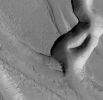
Troughs-Olympica_Fossae-MGS-3.jpgThe Troughs of Olympica Fossae (2 - Original NASA/MGS/MSSS b/w Frame)68 visitenessun commentoApr 20, 2006
|
|

Troughs-Olympica_Fossae-MGS-02.jpgThe Troughs of Olympica Fossae (2 - Original NASA/MGS/MSSS b/w Frame)79 visiteCaption originale:"This MGS-MOC image shows a complex pattern of intersecting and overlapping Troughs in the Olympica Fossae Region of Northern Tharsis. Some combination of Floods, Lava Flows and faulting/tectonic activity contributed to this scene, followed by mantling by dust. Dark Streaks on Slopes in the Troughs were formed by Dust Avalanches".
Location near: 24,8° North Lat. and 114,8° West Long.
Image width: ~3 Km (~1,9 mi)
Illumination from: lower left
Season: Northern Winter
Apr 20, 2006
|
|

Craters-Unnamed_Crater-Layered_Outcrop-Thaumasia_Region-00.jpgLayered Rocky Outcrops (Original NASA/MGS/MSSS b/w Frame)70 visiteCaption NASA originale:"This MGS-MOC image shows light-toned, layered rock outcrops in the central pit of an impact crater in the Thaumasia Planum Region of Mars. The outcrops were tilted and broken-up by the extreme energy of the impact that formed the crater in which they occur. These are layers of rock that were brought up by the impact from horizontal beds that lie below the floor of the crater".
Location near: 21,7° South Lat. and 69,4° West Long.
Image width: ~3 Km (~1,9 mi)
Illumination from: upper left
Season: Southern Summer
Nota: difficile pensare, per spiegare i rilievi catturati in questo frame, ad una costruzione logica più improbabile di quella proposta dalla NASA...Apr 14, 2006
|
|

Craters-Unnamed_South_Polar_Crater-2.jpgBuried and frozen (2)68 visitenessun commentoApr 10, 2006
|
|

Craters-Unnamed_South_Polar_Crater-1.jpgBuried and Frozen (1)68 visiteCaption originale:"This MGS-MOC image shows an eroded stack of layered material in a crater of the South Polar Region of Mars.
The composition of the layers is not known; some speculate that they may contain a combination of dust and ice, or possibly ancient sedimentary rock".
Location near: 80,6° South; 230,4° West
Image width: ~3 Km (~1,9 mi)
Illumination from: upper left
Season: Southern SummerApr 10, 2006
|
|

Craters-Unnamed_Crater_in_Terra_Tyrrhena-MGS-03.jpgUnnamed Crater and Dunes in Terra Tyrrhena (Original NASA/MGS/MSSS b/w Frame)73 visitenessun commentoApr 08, 2006
|
|

Craters-Unnamed_Crater_in_Terra_Tyrrhena-01.jpgUnnamed Crater and Dunes in Terra Tyrrhena (Original NASA/MGS/MSSS b/w Frame)72 visiteCaption originale:"This MGS-MOC image shows a portion of a Field of Dark Sand Dunes superposed on the light-toned Floor of an Unnamed Crater located in Eastern Tyrrhena Terra. The orientation of the Dunes — with the steep faces toward the South (right) — suggests that winds generally blew from North to South at the time the dunes were formed".
Location near: 14,6° South Lat and 262,3° West Long.
Image width: ~3 Km (~1,9 mi)
Illumination from: lower left
Season: Southern Summer
Nota: la caption originale, come spesso sta accadendo, esprimendosi sulla direzione dei venti che avrebbero scolpito le dune della Terra Tirrena è - scusateci - così stupida che meriterebbe la censura (faremmo solo un favore alla NASA). Tuttavia, dato che il servizio che noi cerchiamo di rendere vuole coprire anche alcuni lati "curiosi" (sic!) della Divulgazione Scientifica, abbiamo pensato di lasciare il commentino ufficiale integro, così che qualsiasi Lettore, leggendolo, possa rendersi conto di che cosa significa "parlare (rectius: scrivere) quando non si ha proprio nulla da dire (scrivere)".Apr 08, 2006
|
|

Noachis_Terra-00.JPGFeatures of Noachis Terra (Original NASA/MGS/MSSS b/w Frame)70 visiteCaption NASA Originale:"This MGS-MOC image shows the edge of a trough, which is part of a large pit crater complex in Noachis Terra. This type of trough forms through the collapse of surface materials into the subsurface and often begins as a series of individual pit craters. Over time, continued collapse increases the diameter of individual pits until finally, adjacent pits merge to form a trough such as the one captured in this image. The deep shadowed area is caused in part by an overhang; layered rock beneath this overhang is less resistant to erosion, and thus has retreated tens of meters backward, beneath the overhang. A person could walk up inside this "cave" formed by the overhanging layered material".
Location near: 47,0° South; 355,7° West
Image width: ~3 Km (~1,9 mi)
Illumination from: upper left
Season: Southern SummerApr 06, 2006
|
|

Craters-Unnamed_Crater_with_Pedestal-PIA08029.jpgUnnamed Pedestal Crater in Promethei Terra (Original NASA/MGS/MSSS b/w Frame)69 visiteCaption NASA originale:"This MGS-MOC image shows a Pedestal Crater in the Promethei Terra Region. The Ejecta from an impact crater is usually rocky. The rocks in the Ejecta help shield the Terrain beneath the Ejecta from being eroded away by Wind. Thus, over time, some Craters appear to be raised on Pedestals defined by their Ejecta Blankets, because Wind has stripped away tons and tons of surrounding material".
Location near: 65,4° South Lat. and 264,7° West Long.
Image width: ~3 Km (~1,9 mi)
Illumination from: upper left
Season: Southern Autumn
Nota: un altro (relativamente) famoso cratere con (o su) piedistallo si trova su Venere ed è conosciuto con il nome di Cratere Adivar.Apr 05, 2006
|
|

Aeolian_Features-Windstreaks-Chrise_Planitia-MGS-00.jpgSigns of the wind in Chryse Planitia (Original NASA/MGS/MSSS b/w Frame)71 visiteCaption NASA originale:"This MGS-MOC image shows two Unnamed Impact Craters of nearly equal size, plus their associated Windstreaks. These occur in far Eastern Chryse Planitia. The Wind streaks point toward the South-West, indicating that the responsible Winds blew from the North-East. One of the two craters is shallower than the other and has a suite of large, windblown Ripples on its Floor. The shallower Unnamed Crater with the Ripples is probably older than the other, deeper Unnamed Crater".
Location near: 20,6° North Lat. and 30,1° West Long.
Image width: ~3 Km (~1,9 mi)
Illumination from: lower left
Season: Northern WinterApr 01, 2006
|
|
| 512 immagini su 43 pagina(e) |
 |
|
|
|
|
24 | |
|
|
|
|








