| Ultimi arrivi - A Tribute To Mars Global Surveyor |

Dunes-Ogygis_Region-MGS.jpgThe Dunes of Ogygis (Original NASA/MGS/MSSS b/w Frame)67 visiteCaption NASA originale:"This MGS-MOC image shows dark Sand Dunes, with a thin coating of Autumn Frost, in the Ogygis Regio, West of the Argyre Basin. The steepest Slopes on the Dunes (such as their "Slip Faces"), point toward the North-North/East (lower left), indicating that the Dominant Winds in the Region blow from the South-South/West (upper right)".
Location near: 50,4° South Lat. and 66,6° West Long.
Image width: ~3 Km (~1,9 mi)
Illumination from: upper left
Season: Southern AutumnSet 14, 2006
|
|
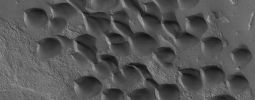
Craters-Wirtz_Crater-Dunes-MGS.jpgThe Dunes of Wirtz Crater (Original NASA/MGS/MSSS b/w Frame)84 visiteCaption NASA originale:"This MGS-MOC image shows dark Sand Dunes, formed by winds blowing from the South-West (upper right), in Wirtz Crater. The Crater is named for Carl Wilhelm Wirtz (1876–1939), a German astronomer".
Location near: 49,0° South Lat. and 25,5° West Long.
Image width: ~3 Km (~1,9 mi)
Illumination from: upper left
Season: Southern AutumnSet 10, 2006
|
|

Channels-Unnamed_Channel_with_White_Ripples-MGS-01.jpgWhite Ripples and Landslide (2 - Original NASA/MGS/MSSS b/w Frame)70 visiteAlla NASA non hanno dubbi: le "creste" di color chiaro che coprono il fondo della quasi totalità dei letti degli antichi fiumi e torrenti Marziani, non sono altro che dune di sabbia "indurita" e levigata dal vento il quale, attraverso refoli e correnti ascendenti e discendenti - ed a prescindere dalla direzione principale dalla quale soffia - modella con maestria il fondo dei letti asciutti di questi canali.
Che dire? La risoluzione di questa immagine - come di tante altre che potrebbero essere di aiuto ai Ricercatori - è pessima e quindi...
Dobbiamo aspettare ancora ma, nel frattempo, guardate bene questo dettaglio del frame: il punto di incrocio fra i due maggiori "troughs" (in basso a Dx) non Vi sembra che abbia qualche "lacuna prospettica"? Come si incrociano, di fatto ed in relazione alla piana alla quale accedono, i due letti asciutti? C'è qualcosa che non va?!?...Set 08, 2006
|
|

Channels-Unnamed_Channel_with_White_Ripples-MGS-00.jpgWhite Ripples and Landslide (1 - Original NASA/MGS/MSSS b/w Frame)67 visiteCaption NASA originale:"This MGS-MOC image shows light-toned Ripples covering the Floors of Troughs in the Adamas Labyrinthus Region of Northern Elysium Planitia. The Ripple Crests generally run perpendicular to the trend of each Trough, indicating that the Dominant Winds involved in shaping these Ripples blow up and down, through the Troughs, independently from the direction of the Winds that blow across the Plains outside the Troughs themselves".
Location near: 32,7° North Lat. and 251,1° West Long.
Image width: ~3 Km (~1,9 mi)
Illumination from: lower left
Season: Northern SpringSet 08, 2006
|
|

North_Polar_Features-Dunes-MGS-07.jpgNorth Polar Dunes (Original NASA/MGS/MSSS b/w Frame)69 visiteCaption NASA originale:"This MGS-MOC image shows dunes in the Martian North Polar Region. The dunes are composed of dark,
coarse (--> ruvido, di tessitura grossolana) sand.
The white areas around the dunes are the last remaining areas of seasonal CO2 frost cover.
The solid CO2 accumulates during the Autumn and Winter and sublimes (goes from solid to gas) away in the Spring.
This image was taken near the end of the Northern Spring".
Location near: 78,0° North; 244,5° West
Image width: ~3 Km (~1,9 mi)
Illumination from: lower left
Season: Northern SpringSet 01, 2006
|
|

North_Polar_Features-Unconformity-02.jpgNorth Polar "Minor Unconformity" (Original NASA/MGS/MSSS b/w Frame)68 visiteCaption NASA originale:"This MGS-MOC image shows Layers exposed in a Trough in the Martian North Polar Region. At the time the picture was acquired, the entire scene was covered by seasonal Carbon Dioxide Frost. By late Spring and into Summer, these Layers would appear darker, once the CO2 Frost sublimes away".
Location near: 84,9° North Lat. and 263,3° West Long.
Image width: ~3 Km (~1,9 mi)
Illumination from: lower left
Season: Northern SpringAgo 28, 2006
|
|

North_Polar_Features-Unconformity-MGS-01.jpgNorth Polar "Unconformity" (Original NASA/MGS/MSSS b/w Frame)68 visiteCaption NASA originale:"This MGS-MOC image shows layered material exposed on a slope in the North Polar Region.
An "unconformity" is visible in the middle/lower left of the image, where layers are abruptly truncated. Unconformities are indicators of drastic change in the Region — the lower layers were deposited first, then eroded, then the upper layers were deposited".
Location near: 81,1° North Lat. and 75,2° West Long.
Image width: ~3 Km (~1,9 mi)
Illumination from: lower left
Season: Northern SpringAgo 26, 2006
|
|

Dunes-S20-00165d-_acquired_july_2006-_11-8-06-A.jpgDark Dunefield? (Original NASA/MGS/MSSS b/w Frame)81 visiteA nostro parere la "chiazza scura" che ci è stata segnalata dal Dr Barca e che caratterizza un'ampia porzione di questo frame non è un'ombra, bensì - dopo aver operato alcune comparazioni visive con altri frames similari - un "affioramento" di un qualche tipo (una "macchia" della superficie - simile ai "seeps" - che può essere indice della presenza di idrocarburi affioranti o, più spesso, dell'esposizione del suolo post evaporazione di ghiacci superfciali o sublimazione di ghiacci di CO2); da non escludersi la possibilità che si tratti di un reticolato - non risolvibile con questa bassa definizione - di Dark Dunes (insomma: un Dunefield a bassa albedo).
Le uniche ombre significative ed oggettivamente visibili dalle varie Sonde che orbitano attorno a Marte sono quelle di Deimos e Phobos, quando producono una Eclissi Solare. Tuttavia, esaminando qualche frames relativo ad Eclissi viste dall'orbita, si può notare che quando le lune di Marte proiettano ombra sulla Superficie del Pianeta, l'effetto visivo è molto diverso da quello che vediamo in questo frame.Ago 24, 2006
|
|

North_Polar_Features-Unconformities-00.jpgNorth Polar "Unconformity" (Original NASA/MGS/MSSS b/w Frame)76 visiteCaption NASA originale:"This MGS-MOC image shows an Unconformity in an exposure of North Polar Layered Material, at which older Layers were cut-off and eroded before a new suite of Layers was deposited above them.
The Terrain in the entire scene was covered by a thin layer of CO2 Frost at the time this picture was acquired in June 2006".
Location near: 86,1° North Lat. and 208,5° West Long.
Image width: ~4 Km (~2,5 mi)
Illumination from: lower left
Season: Northern SpringAgo 21, 2006
|
|

South_Polar_Features-Fans-PIA08658.jpgSouth Polar Fans (Original NASA/MGS/MSSS b/w Frames)70 visiteCaption NASA originale:"Dark spots (left) and 'Fans' appear to scribble dusty hieroglyphics on top of the Martian South Polar Cap in two High-Resolution MGS-MOC images taken in Southern Spring. Each image is about 3-Km wide".Ago 17, 2006
|
|

Northern_Regions-Mesas-MGS.jpgMesas in Vastitas Borealis (Original NASA/MGS/MSSS b/w frame)64 visiteCaption NASA originale:"This MGS-MOC image shows two mesas on the Northern Plains of Mars. "Mesa" is the Spanish word for "table" and that is a very good description of the two elliptical features captured in this MOC image. In both cases, the Mesa tops and the material beneath them, down to the level of the surrounding, rugged Plain, are remnants of a once more extensive layer (or layers) of material that has been largely eroded away. The circular feature near the center of the larger Mesa is the site of a filled and buried Impact Crater".
Location near: 53,5° North Lat. and 153,5° West Long.
Image width: ~3 Km (~1,9 mi)
Illumination from: lower left
Season: Northern SpringAgo 10, 2006
|
|

Volcanic_Features-Pits-A.jpgUnusually-looking Collapse Pits (Original NASA/MGS/MSSS b/w CTX Frame)67 visiteLocation near: 22,1° North Lat. and 53,2° East Long.
Image width: ~3 Km (~1,9 mi)
Season: Northern Spring
Resolution: 18 mt/pixel
Ago 06, 2006
|
|
| 512 immagini su 43 pagina(e) |
 |
|
|
|
|
20 | |
|
|
|
|








