| Ultimi arrivi - A Tribute To Mars Global Surveyor |

North_Polar_Features-Dunes-MGS-01.jpgNorth Polar Dunes (Natural Colors; credits for the additional process. and color.: Dr Paolo C. Fienga - Lunexit Team)65 visiteCaption NASA originale:"This MGS-MOC image shows dunes in the North Polar Region of Mars. In this Springtime view, the dunes are largely covered by frozen Carbon Dioxide (CO2) that was deposited during the Winter months in the Northern Hemisphere. Dark spots indicate areas where the frost has begun to either sublime away, acquire a roughened texture, or both".
Location near: 77,3° North; 95,4° West
Image width: ~3 Km (~1,9 mi)
Illumination from: lower left
Season: Northern SpringMareKromiumAgo 06, 2007
|
|

North_Polar_Features-Chasma_Boreale-PIA07195-01-PCF-LXTT.jpgFeatures of Chasma Boreale (Natural Colors; credits for the additional process. and color.: Dr Paolo C. Fienga - Lunexit Team) 77 visitenessun commentoMareKromiumAgo 05, 2007
|
|
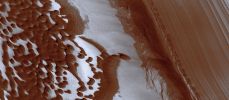
North_Polar_Regions-Chasma_Boreale-MGS-01.jpgBrown Dunes in Chasma Boreale (Enhanced Natural Colors; credits for the additional process. and color.: Dr Paolo C. Fienga - Lunexit Team)68 visitenessun commentoMareKromiumAgo 05, 2007
|
|

North_Polar_Features-Dunes-MGS-09.jpgNorth Polar Dunes (Natural Colors; credits for the additional process. and color.: Dr Paolo C. Fienga - Lunexit Team)66 visiteCaption NASA:"What causes the black dots on dunes on Mars? As spring dawned on the Northern Hemisphere of Mars in 2004, dunes of sand near the Poles begin to defrost. Thinner regions of ice typically thaw first revealing sand whose darkness soaks in sunlight and accelerates the thaw.
The process might involve sandy jets exploding through the thinning ice. By Summer, the spots expanded to encompass the entire dunes that were then completely thawed and dark. The carbon dioxide and water ice actually sublime in the thin atmosphere directly to gas. Taken in mid-July, the above image shows a field of spotted polar dunes spanning about 3 Km near the Martian North Pole.
Today, the future of Mars Rovers Spirit and Opportunity remains unknown windy dust storms continue to starve them of needed sunlight".MareKromiumAgo 05, 2007
|
|

South_Polar_Features-Defrosting_Dunes-2005_06-PCF-LXTT.jpgDefrosting Dunes (Natural Colors; credits for the additional process. and color.: Dr Paolo C. Fienga - Lunexit Team)82 visitenessun commentoMareKromiumLug 22, 2007
|
|

Craters-Unnamed_Crater-South_Polar_Regions-PIA03921-PCF-LXTT.jpgUnnamed South Polar Defrosting Crater (Absolute Natural Colors; credits for the additional process. and color.: Dr Paolo C. Fienga - Lunar Explorer Italia)75 visitenessun commentoMareKromiumLug 17, 2007
|
|

South_Polar_Features-01.jpgSouth Polar "River-like" Surface Features? (RAW Natural Colors; credits for the additional process. and color.: Dr Paolo C. Fienga - Lunexit Team)80 visitenessun commentoMareKromiumLug 16, 2007
|
|

Craters-Unnamed_Crater_with_Pedestal-MGS.jpgAnother "Pedestal Crater" (Enhanced Natural Colors; credits for the additioanl process. and color.: Dr Paolo C. Fienga - Lunexit Team)76 visitenessun commentoMareKromiumLug 15, 2007
|
|
North_Polar_Features-Dunes-PCF-LXTT.jpgThe Frozen Dunes of the North in early Spring (Natural Colors; credits for the additional process. and color.: Dr Paolo C. Fienga - Lunexit Team)68 visiteCaption NASA originale:"This MGS-MOC image shows a group of sand dunes, covered by seasonal Carbon Dioxide frost, in the Martian North Polar Region. Over the course of Northern Hemisphere Spring, the CO2 frost sublimes away, slowly revealing the dark sand that makes up the dunes.
The dark spots in this image may be patches of freshly-exposed sand, or they could be places where the CO2 frost has changed, either becoming rougher, coarser-grained (larger crystals), or both.
A rougher or coarser-grained surface will appear darker because of an increase in shadowing of the surface by the small-scale roughness elements".
Location near: 75,2° North Lat.and 51,3° West Long.
Image width: ~3 Km (~1,9 mi)
Illumination from: lower left
Season: Northern SpringMareKromiumLug 15, 2007
|
|

South_Polar_Features-Swiss_Cheese-PCF-LXTT.jpgSouth Polar Features: Swiss-Cheese Terrain (Natural Colors; credits for the additional process. and color.: Dr Paolo C. Fienga - Lunexit Team)105 visitenessun commentoMareKromiumLug 15, 2007
|
|

Inca-City-AB107908.jpgA true "South Polar Oddity": Inca City (1)66 visiteDati contestuali di riferimento:
Longitude of image center: 64,63° West
Latitude of image center: 81,48° South
Scaled pixel width: 15,47 mt
Scaled image width: 31,88 Km
Scaled image height: 32,87 Km
Solar longitude (Ls): 246,89°
Local True Solar Time (M.L.T.): 12,90 (decimal hours) such as --> 12:54
Emission angle: 58,14°
Incidence angle: 58,59°
Phase angle: 25,53°
North azimuth: 250,10°
Sun azimuth: 238,48°
Spacecraft altitude: 3222,87 Km
Slant distance: 4167,30 KmApr 10, 2007
|
|

Inca-City-M0306902-00.jpgA true "South Polar Oddity": Inca City (2 - False Colors)70 visite"Inca City" is the informal name given by Mariner 9 Scientists in 1972 to a set of intersecting, rectilinear ridges that are located among the layered materials of the South Polar Region of Mars. Their origin has never been understood; most investigators thought they might be sand dunes, either modern dunes or, more likely, dunes that were buried, hardened, then exhumed. Others considered them to be dikes formed by injection of molten rock (magma) or soft sediment into subsurface cracks that subsequently hardened and then were exposed at the surface by wind erosion.Apr 10, 2007
|
|
| 512 immagini su 43 pagina(e) |
 |
|
|
|
|
16 | |
|
|
|
|








