| Ultimi arrivi - A Tribute To Mars Global Surveyor |
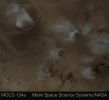
Tharsis_Montes-MGS1.jpgJust clouds and fogs over Tharsis?74 visiteUno spettacolare frame Mars Global Surveyor, inviatoci dall'Amico e Partner, Dr Alessio Feltri, ci offre una spettacolare visione di "fumi" che sovrastano la Provincia Vulcanica di Tharsis.
Secondo la NASA si tratta di nuvole (prevalentemente costituite da vapore acqueo) e nebbie. E noi diciamo che "può darsi", anzi: è molto probabile che sia così.
Ma ora osservate questa immagine e mettetela in correlazione al recente frame Mars Express che sembrava rappresentare uno spettacolare pennacchio sollevatosi da una delle caldere del vulcano Arsia Mons (diciamo "sembrava" poichè, a parte il Gruppo Lunexit, NESSUN ALTRO si è pronunciato sull'evento!).
Siamo davvero certi che quanto si vede in questo frame sìano solo nuvole e nebbie?
Siamo davvero certi che la Provincia Vulcanica di Tharsis sia "inerte"?
Osservate attentamente la forma delle "nebbie" che sovrastano e circondano i diversi camini vulcanici ripresi e poi provate a rispondere a questa "semplice" domanda: che cosa stiamo guardando?...MareKromiumSet 23, 2009
|
|
![South_Polar_Regions-South_Pole-MGS-mg90s000[1]-PCF-LXTT-1.jpg](albums/userpics/10060/small_South_Polar_Regions-South_Pole-MGS-mg90s000%5B1%5D-PCF-LXTT-1.jpg "Nome del file=South_Polar_Regions-South_Pole-MGS-mg90s000[1]-PCF-LXTT-1.jpg
Dimensione del file=48KiB
Dimensioni=1062x1000
Aggiunta il=Ago 09, 2009")
South_Polar_Regions-South_Pole-MGS-mg90s000[1]-PCF-LXTT-1.jpgMartian South Pole and South Polar Regions, from MGS (Darkened Natural Colors; credits for the additional process. and color.: Dr Paolo C. Fienga - Lunexit Team)65 visitenessun commentoMareKromiumAgo 09, 2009
|
|

Volcanoes-Olympus_Mons-PCF-LXTT-2.jpgOlympus Mons, from MGS (Natural Colors; credits: NASA & Lunar Explorer Italia)148 visitenessun commentoMareKromiumLug 23, 2009
|
|

Phobos-Phobos_Monolith-06.jpgThe "Phobos' Monolith", like you've never seen it before! (an Image- composite by Dr Marco Faccin)1685 visiteDal nostro grandissimo Marco Faccin, una spettacolare ricostruzione in Alta definizione del famoso "Monolito di Phobos" il quale, finalmente, sembra risolversi davanti ai nostri occhi per ciò che esso realmente è: un macigno (boulder) a pianta triangolare, curiosamente caratterizzato da un'albedo di gran lunga superiore a quella dell'intero paesaggio al quale accede.
Il giorno in cui "2001 - A Space Odyssey" diventerà realtà, purtroppo, deve ancora attendere la sua alba...MareKromiumLug 11, 2009
|
|

South_Polar_Storm-PIA11982.jpgSouth Polar Dust Storm75 visiteCaption NASA:"This nearly global mosaic of observations made by the Mars Color Imager on NASA's Mars Reconnaissance Orbiter on April 2, 2009, shows billowing clouds of dust being lifted into the Atmosphere by a storm near the edge of the Seasonal Polar Cap of Southern Mars.
The season on Southern Mars is late Spring. Late Southern Spring and early Southern Summer are a peak time of the Martian year for major Dust Storms.
Atmospheric haze due to suspended dust from recent storm activity is evident elsewhere on the Planet, including the Skies over Mars rovers Opportunity (MER-B) and Spirit (MER-A).
Black areas in the mosaic are the result of data drops or high angle roll maneuvers by the Orbiter that limit the camera's view of the Planet.
Equally-spaced blurry areas that run from South-to-North (bottom-to-top) result from the high off-nadir viewing geometry, a product of the spacecraft's low-orbit.
Malin Space Science Systems, San Diego, provided and operates the Mars Color Imager. NASA's Jet Propulsion Laboratory, a division of the California Institute of Technology in Pasadena, manages the Mars Reconnaissance Orbiter for NASA's Science Mission Directorate, Washington. Lockheed Martin Space Systems, Denver, is the prime contractor for the project and built the Spacecraft".MareKromiumApr 16, 2009
|
|

Channels-Auqakuh_Vallis-MGS-PCF-LXTT.jpgAuqakuh Vallis: "Old Riverbed" or "Windblown Ripples"? (Natural Colors; credits for the additional process. and color.: Dr Paolo C. Fienga - Lunar Explorer Italia)70 visiteCaption NASA originale:"This MGS-MOC image shows windblown ripples on the floor of Auqakuh Vallis.
The light-toned area, running diagonally across the scene from South-West to North-East, may be dust that has accumulated in the bottom of the valley and on top of the ripples".
Location near: 31,3° North; 299,3° West
Image width: ~3 Km (~1,9 mi)
Illumination from: lower left
Season: Northern SpringMareKromiumApr 04, 2009
|
|

Craters-Wirtz_Crater-MGS~0.jpgThe Dunes of Wirtz Crater (Natural Colors; credits for the additioonal process. and color.: Dr Paolo C. Fienga - Lunexit Team)63 visitenessun commentoMareKromiumApr 03, 2009
|
|

Hellas_Planitia-MGS~0.jpgFeatures of Hellas Planitia: the "Martian Freeways" (Saturated Absolute Natural Colors; credits for the additional process. and color: Dr Paolo C. Fienga - Lunexit Team)64 visiteCaption NASA originale:"This MGS-MOC image shows an example of the extremely odd, seemingly scrambled layered rocks exposed by erosion near the deepest part of the deepest basin on Mars: Hellas. This pattern of eroded, and perhaps deformed layers was once exposed to the martian surface, then buried, and more recently exposed again. The story behind these layers is not really understood; some members of the MOC team have — for nearly 9 years now —taken to calling these features, "taffy-pull terrain".
Location near: 43,1° South; 307,3° West
Image width: ~3 Km (~1,9 mi)
Illumination from: upper left
Season: Southern Spring
Nota Lunexit: immagini come questa, a parte la loro intrinseca bellezza e la grande suggestione che riescono ad infondere in chi le guarda, hanno un Valore immenso.
Tuttavia, di quando in quando, qualche pseudo-scienziato dice che le immagini in arrivo dallo Spazio (TUTTE le immagini, senza eccezioni) sono "sostanzialmente inutili a fini di ricerca scientifica".
Noi non comprendiamo la ratio di questa frase che - onestamente - è tanto "ad effetto", quanto vuota e stupida; però una cosa ci va di dirla: forse le immagini in arrivo dallo Spazio "non servono" alla Ricerca Scientifica. Forse.
Ma CERTAMENTE non servono alla predetta Ricerca degli pseudo-scienziati (probabilmente dei ricercatori universitari falliti o fallendi) che, quando gli "gira", proferiscono impunemente (dall'alto della loro stratosferica ignoranza) simili assurdità.
Vere e proprie bestemmie, insomma, specie se si pensa a QUANTE VITE e QUANTI SOLDI sono costate e costano le "scientificamente inutili" immagini che ci arrivano dal resto del Sistema Solare.
Morale: certa gente dovrebbe solo tacere, rivoltarsi nel proprio guano e vergognarsi.MareKromiumApr 03, 2009
|
|
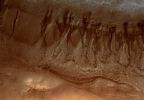
Terra_Cimmeria-Gullies-PIA02919-3.jpgGullies in Terra Cimmeria (Natural Colors; credits for the additional process. and color.: Dr Paolo C. Fienga - Lunar Explorer Italia)72 visiteCaption originale NASA:"This MGS-MOC image shows two suites of gullies within a single impact crater in the Terra Cimmeria Region. The gullies near the top of the image are located on the northern wall of the crater, while the lower suite resides on a lower bench in the crater's northern wall complex. Gully erosion has cut into the layered rock exposed on the crater wall. Water may have been involved in their formation".
Location near: 38,2° South; 190,6° West
Image width: ~3 Km (~1,9 mi)
Illumination from: upper left
Season: Southern SummerMareKromiumApr 03, 2009
|
|

Gullies-Hellas_Planitia-MGS~2.jpgGullies in Hellas Planitia (Absolute Natural Colors; credits for the additional process. and color.: Dr G. Barca - Lunexit Team)65 visiteCaption NASA originale:"This MGS-MOC image shows neighboring networks of gullies in the NorthWestern wall of a South, middle-latitude, crater West of Hellas Planitia. The faint crisscrossing streaks, also observed on the wall of the crater, are evidence of passing Dust Devils, a common phenomena in this Region.
The gullies might have formed by erosion caused by running water, mixed with debris".
Location near: 54,0° South; 337,1° West
Image width: ~3 Km (~1,9 mi)
Illumination from: upper left
Season: Southern SummerMareKromiumApr 03, 2009
|
|
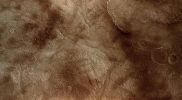
Hellas_Planitia-MGS~1.jpgValley in Hellas Planitia (Absolute Natural Colors; credits for the additional process. and color.: Dr Paolo C. Fienga - Lunexit Team) 63 visiteCaption originale:"This MGS-MOC image shows a valley which has become partially-filled with material. It is located West of Hellas Planitia. The valley, entering the scene from the East (lower side), turns toward the South-West (upper right) and splits to form a "V". Partially-filled depressions are common throughout the scene, including the circular feature near the top of the image.
In each such case, the filling material is probably the remains of a material that once covered the entire scene".
Location near: 48,4° South; 318,1° West
Image width: ~3 Km (~1,9 mi)
Illumination from: upper left
Season: Southern SummerMareKromiumApr 03, 2009
|
|
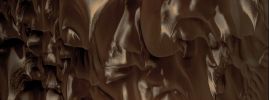
Craters-Hellespontus_Crater-1-M0201817Det.jpgFrost on the dunes of Hellespontus Crater (Natural Colors; credits for the additional process. and color.: Dr Paolo C. Fienga - Lunar Explorer Italia)67 visitenessun commentoMareKromiumApr 02, 2009
|
|
| 512 immagini su 43 pagina(e) |
 |
|
|
|
|
13 | |
|
|
|
|








