| Ultimi arrivi - NASA Original Files - The "Ranger" Programme |

ra9_a001.jpgThe Moon from Ranger-9: Alphonsus Crater (1)54 visiteCaption NASA:"The first Ranger 9 image of the Moon, taken with the A camera from a distance of 2378 Km. The image is centered on the Mare Nubium Region of the Moon, which extends to the bottom of the image. At upper left is South-Eastern Oceanus Procellarum. The two craters with the central peaks at right are Alphonsus, diameter 108 Km and below it Arzachel, diameter 96 Km. The crater near the center at about 8:00 is 60 Km Bullialdus. The frame is approximately 1050 Km across and North is at 12:30. The final impact point of Ranger 9 is in the Alphonsus Crater, midway between the central peak and rim at about 1:30 (Ranger 9, A001)".MareKromiumNov 12, 2006
|
|

ra8_a030.jpgThe Moon from Ranger-8: Mare Tranquillitatis (2) - HR56 visitenessun commentoMareKromiumNov 12, 2006
|
|
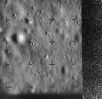
ra8_a060.jpgThe Moon from Ranger-8: Mare Tranquillitatis (3)57 visiteCaption NASA:"Last image taken by Ranger 8 camera-A from a distance of 4,2 Km, 2" before impact on 20 February 1965. The area shown is at 2,7° North Lat. and 24,55° East Long.; the image is about 1,4 Km across. The right side of the image is missing because Ranger 8 crashed before completing transmission. This area is about 60 Km away from the Apollo 11 Landing Site in the Sea of Tranquillity. These Ranger close-ups showed for the first time that even areas on the Moon which looked smooth from Earth were peppered with small impact craters. North is up (Ranger 8, A060)".MareKromiumNov 12, 2006
|
|

ra8_b001.jpgThe Moon from Ranger-8: Mare Tranquillitatis (4)55 visiteCaption NASA:"The first image taken by the Ranger 8 camera B on 20 February 1965 shows the 164 Km diameter Ptolemaeus Crater, top center, and below it Alphonsus Crater (diameter 108 Km). The Davy Crater Chain can be seen immediately to the right of the left-middle reticle mark as a dotted white line extending S-WW to N-EE. The picture was taken 23 minutes before impact from a range of 2545 Km.
The image is about 360 Km across and North is up. Ranger 8 was the second successful lunar impact mission in the series (Ranger 8, B001)".MareKromiumNov 12, 2006
|
|
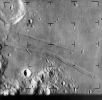
ra8_b045.jpgThe Moon from Ranger-8: Mare Tranquillitatis (5)55 visiteCaption NASA:"Ranger 8 image of the Mare Tranquillitatis (Sea of Tranquillity) area of the Moon taken from 511 Km about 4 minutes before surface impact. The 30 Km diameter Sabine crater is at upper left. Note the two linear features at the center of the frame and rugged region at the bottom.
The frame is about 95 Km across and North is up.
The Apollo 11 Landing Site is about 30 Km to the right of this area (Ranger 8, B045)".MareKromiumNov 12, 2006
|
|

ra7_b200.jpgThe Moon from Ranger-7: Mare Cognitum (6)56 visiteMareKromiumNov 12, 2006
|
|

ra7_p001.jpgThe Moon from Ranger-7: Mare Cognitum (7)57 visiteCaption NASA:"First P-camera images taken by Ranger 7. The images are numbered by camera (clockwise from upper left) P3, P4, P2, P1. All images were taken from a distance of about 1870 Km about 13,5' before impact. Frame P3 shows Guericke crater (diameter 63 Km) at the upper right.
P4 also shows Guericke at right center. Image P1 is 41 Km across and shows the floor of Mare Nubium north of Opelt crater. The bottom of frame P2 overlaps the upper right corner of P1. P2 is about 40 Km across. North is at 12:30 in all four images (Ranger 7, P001)".MareKromiumNov 12, 2006
|
|

ra7_p100.jpgThe Moon from Ranger-7: Mare Cognitum (8)57 visitenessun commentoMareKromiumNov 12, 2006
|
|

ra7_p200.jpgThe Moon from Ranger-7: Mare Cognitum (9)55 visiteCaption NASA:"The final two images taken by Ranger 7 before its impact on the Moon's surface.
These image were taken by the number 1 and 3 P-channel cameras at 0,39 and 0,19" before impact from an altitude of 1070 and 519 mt, respectively. The pictures are cut off because the spacecraft impacted the surface before completing the transmission. The top image was taken by the P3 camera and the bottom image by P1. The P3 image is about 25 mt across. North is at 12:30 for both images.
The impact occurred on 31 July 1964 at 13:25:48.82 UT (Ranger 7, CP1002)".MareKromiumNov 12, 2006
|
|

ra8_a001.jpgThe Moon from Ranger-8: Mare Tranquillitatis (1)56 visiteCaption NASA:"First full-frame image of the Moon taken by the Ranger 8 camera A from a distance of 2573 Km. The image was taken on 20 Feb. 1965 at 09:34 UT with the spacecraft at an altitude of 2510 Km. The central reticle is at 10,65° South Latitude, 22,4° West Longitude, in the Mare Cognitum area of the Moon. North is up, and the picture extends 1200 Km across, from about 5° North to 30° South Lat. and from 5° West to 45° West Longitude. The craters Campanus and Mercator are visible at the bottom center. Gassandi crater (101 Km diameter) is the bright circle near the edge of the frame at 8:00. The Apollo 12 Landing Site is near top center and Apollo 14 slightly to the right of that (Ranger 8, A001)".MareKromiumNov 12, 2006
|
|

ra7_a001.jpgThe Moon from Ranger-7: Mare Cognitum (1)55 visiteLa Storia del Programma di Ricognizione Lunare "Ranger" (il quale ebbe luogo negli Anni 1961-1965) è una storia fatta da 9 Missioni: sei di esse (i "Ranger" da 1 a 6) costiturono dei fiaschi clamorosi - che poi Vi proporremo in scaletta); le ultime tre, invece (I "Ranger" 7, 8 e 9), furono uno storico successo. Attenzione però: noi parliamo di successo "storico" ma, in fondo, si trattava "solo" di spedire un veicolo verso la Luna il cui unico scopo era quello di "scattare delle fotografie" (quante più possibili) e quindi di schiantarsi sulla superficie del nostro Satellite (proprio come ha fatto la Sonda ESA "SMART-1" lo scorso mese di Settembre - 2006). Questa maniera - veramente "pionieristica" - di approcciare la Luna, oggi, ci fa sorridere ma, 45 anni fa, quello che i Ranger-7, 8 e 9 ottennero fu, in fondo, il vero "viatico" per la nascita del Programma Apollo: l'individuazione di uno "spot for a - relatively -safe landing".
Missione Compiuta, ovviamente.MareKromiumNov 12, 2006
|
|

ra7_a100.jpgThe Moon from Ranger-7: Mare Cognitum (2)55 visiteThe Ranger series was the first U.S. attempt to obtain close-up images of the Lunar Surface.
The Ranger spacecraft were designed to fly straight down towards the Moon and send images back until the moment of impact.
Ranger 7 impacted in a "mare terrain", modified by crater rays. Ranger 8 also impacted in mare terrain, but this area contained a complex system of ridges.
Ranger 9 impacted in a large crater located in the Lunar Highlands.MareKromiumNov 12, 2006
|
|
| 27 immagini su 3 pagina(e) |
2 |
|





