| |

| Ultimi arrivi - The Universe in Super Definition |

BHR71-PIA09338.jpgProtostellar Jet in BHR 71 Dark Cloud65 visiteTwo rambunctious young stars are destroying their natal dust cloud with powerful jets of radiation, in an infrared image from NASA's Spitzer Space Telescope.
The stars are located approximately 600 light-years away in a cosmic cloud called BHR 71. In visible light (left panel), BHR 71 is just a large black structure. The burst of yellow light toward the bottom of the cloud is the only indication that stars might be forming inside. In infrared light (center panel), the baby stars are shown as the bright yellow smudges toward the center. Both of these yellow spots have wisps of green shooting out of them. The green wisps reveal the beginning of a jet. Like a rainbow, the jet begins as green, then transitions to orange, and red toward the end. The combined visible-light and infrared composite (right panel) shows that a young star's powerful jet is responsible for the rupture at the bottom of the dense cloud in the visible-light image. Astronomers know this because burst of light in the visible-light image overlaps exactly with a jet spouting-out of the left star, in the infrared image.
The jets' changing colors reveal a cooling effect, and may suggest that the young stars are spouting out radiation in regular bursts. The green tints at the beginning of the jet reveal really hot hydrogen gas, the orange shows warm gas, and the reddish wisps at the end represent the coolest gas. The fact that gas toward the beginning of the jet is hotter than gas near the middle suggests that the stars must give off regular bursts of energy -- and the material closest to the star is being heated by shockwaves from a recent stellar outburst. Meanwhile, the tints of orange reveal gas that is currently being heated by shockwaves from a previous stellar outburst. By the time these shockwaves reach the end of the jet, they have slowed down so significantly that the gas is only heated a little, and looks red. The combination of views also brings out some striking details that evaded visible-light detection. For example, the yellow dots scattered throughout the image are actually young stars forming inside BHR 71. Spitzer also uncovered another young star with jets, located to the right of the powerful jet seen in the visible-light image. Spitzer can see details that visible-light telescopes don't, because its infrared instruments are sensitive to "heat."
The infrared image is made up of data from Spitzer's infrared array camera. Blue shows infrared light at 3.6 microns, green is light at 4.5 microns, and red is light at 8.0 microns.
MareKromiumMag 04, 2007
|
|

NGC-2808-0.jpgNGC 2808 - Globular Star Cluster62 visiteAstronomers have long thought that globular star clusters had a single "baby boom" of stars early in their lives and then settled into a quiet existence.
New observations by NASA's Hubble Space Telescope, however, are showing that this idea may be too simple. The Hubble analysis of the massive globular cluster NGC 2808 provides evidence that star birth went "boom, boom, boom," with three generations of stars forming very early in the cluster's life.
"We had never imagined that anything like this could happen," said Giampaolo Piotto of the University of Padova in Italy and leader of the team that made the discovery. "This is a complete shock."
Globular clusters are the homesteaders of our Milky Way Galaxy, born during our galaxy's formation. They are compact swarms of typically hundreds of thousands of stars held together by gravity.
"The standard picture of a globular cluster is that all of its stars formed at the same time, in the same place, and from the same material, and they have co-evolved for billions of years," said team member Luigi Bedin of the European Space Agency, the European Organization for Astronomical Research in the Southern Hemisphere (ESO), in Garching, Germany, and the Space Telescope Science Institute in Baltimore, Md. "This is the cornerstone on which much of the study of stellar populations has been built. So we were very surprised to find several distinct populations of stars in NGC 2808. All of the stars were born within 200 million years very early in the life of the 12.5-billion-year-old massive cluster."
Finding multiple stellar populations in a globular cluster so close to home has deep cosmological implications, the researchers said.
"We need to do our best to solve the enigma of these multiple generations of stars found in these Hubble observations so that we can understand how stars formed in distant galaxies in our early universe," Piotto explained.
The astronomers used Hubble's Advanced Camera for Surveys to measure the brightness and color of the cluster stars. Hubble's exquisite resolution allowed the astronomers to sort out the different stellar populations. The Hubble measurements showed three distinct populations, with each successive generation appearing slightly bluer. This color difference suggests that successive generations contain a slightly different mix of some chemical elements.
"One assumption, although we have no direct proof," said team member Ivan King of the University of Washington in Seattle, "is that the successively bluer color of the stellar populations indicates that the amount of helium increases with each generation of stars. Perhaps massive star clusters like NGC 2808 hold onto enough gas to ignite a rapid succession of stars."
The star birth would be driven by shock waves from supernovae and stellar winds from giant stars, which compress the gas and make new stars, King explained. The gas would be increasingly enriched in helium from previous generations of stars more massive than the Sun.
Astronomers commonly assume that globular clusters produce only one stellar generation, because the energy radiating from the first batch of stars would clear out most of the residual gas needed to make more stars. But a hefty cluster like NGC 2808, which is two to three times more massive than a typical globular cluster, may have enough gravity to hang onto that gas, which has been enriched by helium from the first stars. Of the about 150 known globular clusters in our Milky Way Galaxy, NGC 2808 is one of the most massive, containing more than 1 million stars.
Another possible explanation for the multiple stellar populations is that NGC 2808 may only be masquerading as a globular cluster. The stellar grouping may have been a dwarf galaxy that was stripped of most of its material due to gravitational capture by our galaxy.
Omega Centauri, the only other stellar system Piotto's group found to have multiple generations of stars, is suspected to be the remnant core of a dwarf galaxy, Bedin said.
Although the astronomers' search is only in its infancy, they say multiple stellar populations may be a typical occurrence in other massive clusters.
"No one would make the radical step of suggesting that previous work on other clusters is no longer valid," King said. "But this discovery shows that the study of stellar populations in globular clusters now opens up in a new direction."
The team plans to use ESO's Very Large Telescope in Chile to make spectroscopic observations of the chemical abundances in NGC 2808, which may offer further evidence that the stars were born at different times and yield clues to how they formed. They also will use Hubble to hunt for multiple generations of stars in about 10 more hefty globular clusters.
The team's results have been accepted for publication in the Astrophysical Journal Letters.
MareKromiumMag 04, 2007
|
|

NGC-2237-PIA09267.jpgNGC 2237 - The "Rosette Nebula", and Globular Star Cluster NGC 224461 visiteThis infrared image from NASA's Spitzer Space Telescope shows the Rosette nebula, a pretty star-forming region more than 5,000 light-years away in the constellation Monoceros. In optical light, the nebula looks like a rosebud, or the "rosette" adornments that date back to antiquity.
But lurking inside this delicate cosmic rosebud are so-called planetary "danger zones" (see spheres illustrations in figure 1). These zones surround super hot stars, called O-stars (blue stars inside spheres), which give off intense winds and radiation. Young, cooler stars that just happen to reside within one of these zones are in danger of having their dusty planet-forming materials stripped away.
While O-star danger zones were known about before, their parameters were not. Astronomers used Spitzer's infrared vision to survey the extent of the five danger zones shown here. The results showed that young stars lying beyond 1.6 light-years, or 10 trillion miles, of any O-stars are safe, while young stars within this zone are likely to have their potential planets blasted into space.
Radiation and winds from the super hot stars have collectively blown layers of dust (green) and gas away, revealing the cavity of cooler dust (red). The largest two blue stars in this picture are in the foreground, and not in the nebula itself.
This image shows infrared light captured by Spitzer's infrared array camera. Light with wavelengths of 24 microns is red; light of 8 microns is green; and light of 4.5 microns is blue.
MareKromiumApr 20, 2007
|
|

YoungStar-PIA09266.jpgThe "O"-Star76 visite"The further on the edge, the hotter the intensity," sings Kenny Loggins in "Danger Zone," a song made famous by the movie "Top Gun." The same words ring true for young, cooler stars like our sun that live in the danger zones around scorching hot stars, called O-stars. The closer a young, maverick star happens to be to a super hot O-star, the more likely its burgeoning planets will be blasted into space.
This artist's animation illustrates how this process works. The movie begins by showing an O-star in a murky star-forming region. It then pans out to show a young, cooler star and its swirling disk of planet-forming material. Disks like this one, called protoplanetary disks, are where planets are born. Gas and dust in a disk clumps together into tiny balls that sweep through the material, growing in size to eventually become full-grown planets.
The young star happens to lie within the "danger zone" around the O-star, which means that it is too close to the hot star to keep its disk. Radiation and winds from the O-star boil and blow away the material, respectively. This process, called photoevaporation, is sped up here but takes anywhere from 100,000 to about 1,000,000 years. Without a disk, the young star will not be able to produce planets.
Our own sun and its suite of planets might have grown up on the edge of an O-star's danger zone before migrating to its current, spacious home. However, we know that our young sun didn't linger for too long in any hazardous territory, or our planets, and life, wouldn't be here today.
NASA's Spitzer Space Telescope surveyed the danger zones around five O-stars in the Rosette nebula. It was able to determine that the zones are spheres with a radius of approximately 1.6 light-years, or 10 trillion miles.
MareKromiumApr 20, 2007
|
|

The_Evaporating_Planet.jpgWater Claimed in Evaporating Planet HD 209458b66 visitePlanet HD 209458b is evaporating. It is so close to its parent star that its heated atmosphere is simply expanding away into space. Some astronomers studying this distant planetary system now believe they have detected water vapor among the gases being liberated. This controversial claim, if true, would mark the first instance of planetary water beyond our Solar System, and indicate anew that life might be sustainable elsewhere in the universe. HD 209458b is known as a hot Jupiter type system because it involves a Jupiter-type planet in a Mercury-type orbit. Although spectroscopic observations from the Hubble Space Telescope are the basis for the water detection claim, the planetary system is too small and faint to image. Therefore, an artist's impression of the HD 209458b system is shown above. Research into the atmospheric composition of HD 209458b and other extrasolar planets is continuing.MareKromiumApr 17, 2007
|
|

AlienWorld-PIA09228.jpgTwin Suns' Sunset68 visiteOur solitary sunsets here on Earth might not be all that common in the grand scheme of things. New observations from NASA's Spitzer Space Telescope have revealed that mature planetary systems -- dusty disks of asteroids, comets and possibly planets -- are more frequent around close-knit twin, or binary, stars than single stars like our sun. That means sunsets like the one portrayed in this artist's photo concept, and more famously in the movie "Star Wars," might be quite commonplace in the universe.
Binary and multiple-star systems are about twice as abundant as single-star systems in our galaxy, and, in theory, other galaxies. In a typical binary system, two stars of roughly similar masses twirl around each other like pair-figure skaters. In some systems, the two stars are very far apart and barely interact with each other. In other cases, the stellar twins are intricately linked, whipping around each other quickly due to the force of gravity.
Astronomers have discovered dozens of planets that orbit around a single member of a very wide stellar duo. Sunsets from these worlds would look like our own, and the second sun would just look like a bright star in the night sky.
But do planets exist in the tighter systems, where two suns would dip below a planet's horizon one by one? Unveiling planets in these systems is tricky, so astronomers used Spitzer to look for disks of swirling planetary debris instead. These disks are made of asteroids, comets and possibly planets. The rocky material in them bangs together and kicks up dust that Spitzer's infrared eyes can see. Our own solar system is swaddled in a similar type of disk.
Surprisingly, Spitzer found more debris disks around the tightest binaries it studied (about 20 stars) than in a comparable sample of single stars. About 60 percent of the tight binaries had disks, while the single stars only had about 20 percent. These snug binary systems are as close or closer than just three times the distance between Earth and the sun. And the disks in these systems were found to circumnavigate both members of the star pair, rather than just one.
Though follow-up studies are needed, the results could mean that planet formation is more common around extra-tight binary stars than single stars. Since these types of systems would experience double sunsets, the artistic view portrayed here might not be fiction.
The original sunset photo used in this artist's concept was taken by Robert Hurt of the Spitzer Science Center at the California Institute of Technology, Pasadena, Calif.
Mar 29, 2007
|
|

TwoSuns-PIA09227.jpgTwin Suns61 visiteThis diagram illustrates that mature planetary systems like our own might be more common around twin, or binary, stars that are either really close together, or really far apart.
NASA's Spitzer Space Telescope observed that debris disks, which are signposts of mature planetary systems, are more abundant around the tightest and widest of binary stars it studied. Specifically, the infrared telescope found significantly more debris disks around binary stars that are 0 to 3 Astronomical Units (AU) apart (top panel) and 50 to 500 AU apart (bottom panel) than binary stars that are 3 to 50 AU apart (middle panel). An astronomical unit is the distance between Earth and the Sun.
In other words, if 2 stars are as far apart from each other as the Sun is from Jupiter (5 AU) or Pluto (40 AU), they would be unlikely to host a family of planetary bodies.
The Spitzer data also revealed that debris disks circle all the way around both members of a close-knit binary (top panel), but only a single member of a wide duo (bottom panel). This could explain why the intermediately spaced binary systems (middle panel) can be inhospitable to planetary disks: they are too far apart to support one big disk around both stars, and they are too close together to have enough room for a disk around just one star.Mar 29, 2007
|
|

TwoSuns-PIA09229.jpgTwin Suns, Planets and Asteroids68 visiteThis artist's image depicts a faraway Solar System like our own -- except for one big difference: planets and asteroids circle around not one, but two Suns. NASA's Spitzer Space Telescope found evidence that such Solar Systems might be common in the Universe. Spitzer did not see any planets directly, but it detected dust that is kicked up from disks like this one. The disks were spotted circling all the way around several double, or binary, stars, some of which were closer together than Earth is to our sun. In fact, Spitzer found more disks in orbit around close-knit binary stars than single stars. This could mean that planets prefer two parent stars to one, but more research is needed to figure out exactly what's going on.Mar 29, 2007
|
|
Z-Camelopardalis-PIA09219.jpgZ-Camelopardalis65 visiteThis composite image shows Z Camelopardalis, or Z Cam, a double-star system featuring a collapsed, dead star, called a white dwarf, and a companion star, as well as a ghostly shell around the system. The massive shell provides evidence of lingering material ejected during and swept up by a powerful classical nova explosion that occurred probably a few thousand years ago.
The image combines data gathered from the far-ultraviolet and near-ultraviolet detectors on NASA's Galaxy Evolution Explorer on Jan. 25, 2004. The orbiting observatory first began imaging Z Cam in 2003.
Z Cam is the largest white object in the image, located near the center. Parts of the shell are seen as a lobe-like, wispy, yellowish feature below and to the right of Z Cam, and as two large, whitish, perpendicular lines on the left.
Z Cam was one of the first known recurrent dwarf nova, meaning it erupts in a series of small, "hiccup-like" blasts, unlike classical novae, which undergo a massive explosion. That's why the huge shell around Z Cam caught the eye of astronomer Dr. Mark Seibert of Carnegie Institution of Washington in Pasadena, Calif. - it could only be explained as the remnant of a full-blown classical nova explosion. This finding provides the first evidence that some binary systems undergo both types of explosions. Previously, a link between the two types of novae had been predicted, but there was no evidence to support the theory.
The faint bluish streak in the bottom right corner of the image is ultraviolet light reflected by dust that may or may not be related to Z Cam. Numerous foreground and background stars and galaxies are visible as yellow and white spots. The yellow objects are strong near-ultraviolet emitters; blue features have strong far-ultraviolet emission; and white objects have nearly equal amounts of near-ultraviolet and far-ultraviolet emission.
Mar 10, 2007
|
|
![SN-1987A-PIA09119_fig1[1].jpg](albums/userpics/10060/small_SN-1987A-PIA09119_fig1%5B1%5D.jpg "Nome del file=SN-1987A-PIA09119_fig1[1].jpg
Dimensione del file=576KiB
Dimensioni=3000x2400
Aggiunta il=Mar 06, 2007")
SN-1987A-PIA09119_fig1[1].jpgSupernova 1987A and the Bipolar Nebula around HD16862562 visitenessun commentoMareKromiumMar 06, 2007
|
|
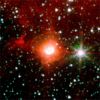
Supernova-PIA09119.jpgBipolar Nebula63 visiteCaption NASA:"A luminous blue variable star in our galaxy, named HD168625, surrounded by a bipolar nebula that is similar to the one around SN1987A.
SN1987A was a supernova that exploded in 1987 in the Large Magellanic Cloud, and was the nearest supernova in about 400 years.
Rings near the equator are sometimes seen around stars that shed mass from their surfaces, but the larger rings above the poles are very rare. Tipped toward Earth and illuminated by the star, the rings look like ellipses in images taken with NASA's Spitzer Space Telescope.
The image was taken in 2004 by the infrared array camera on Spitzer at wavelengths between 3,6 and 8 microns. The massive star at the center, which lies within the constellation Sagittarius, is about 7.200 Light-Years from Earth". MareKromiumMar 06, 2007
|
|

GasGiant-PIA09117.jpgA "young" Gas-Giant71 visiteCaption NASA:"This is an artist's concept of a hypothetical 10-million-year-old star system. The bright blur at the center is a star much like our Sun. The other orb in the image is a gas-giant planet like Jupiter. Wisps of white throughout the image represent traces of gas.
Astronomers using NASA's Spitzer Space Telescope have found evidence showing that gas-giant planets either form within the first 10 million years of a Sun-like star's life, or not at all. The lifespan for sun-like stars is about 10 billion years.
The scientists came to this conclusion after searching for traces of gas around 15 different Sun-like stars, most with ages ranging from 3 to 30 million years. With the help of Spitzer's Infrared Spectrometer Instrument, they were able to search for relatively warm gas in the inner regions of these star systems, an area comparable to the zone between Earth and Jupiter in our own solar system. They also used ground-based radio telescopes to search for cooler gas in the outer regions of these systems, an area comparable to the zone around Saturn and beyond".MareKromiumMar 06, 2007
|
|
| 157 immagini su 14 pagina(e) |
|
|
|
|
|
9 | |
|
|
|
|
|
|





