| |

| Ultimi arrivi - The Universe in Super Definition |
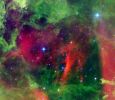
NGC-2237_and_NGC-2244.jpgHot Stars in the Rosette Nebula61 visiteWinds and radiation from massive hot stars in the Rosette Nebula have cleared the natal gas and dust from the center of the nearby star-forming region. They also pose a danger to planet forming disks around young, cooler stars in the neighborhood. This Spitzer Space Telescope (SST) infrared image of dust clouds near the Rosette's central region, shows the cleared-out cavity.
The view spans about 45 LY at the the nebula's estimated distance of 5.200 LY. MareKromiumLug 26, 2007
|
|
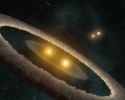
HD98800-PIA09939.jpgEvidence for Strange Stellar Family74 visiteThis artist concept depicts a Quadruple-Star System called HD 98800. The System is approx. 10 MY old, and is located 150 LY away in the constellation TW Hydrae.
HD 98800 contains four stars, which are paired off into doublets, or binaries.
The stars in the binary pairs orbit around each other, and the two pairs also circle each other like choreographed ballerinas. One of the stellar pairs, called HD 98800B, has a disk of dust around it, while the other pair does not.
Although the four stars are gravitationally bound, the distance separating the two binary pairs is about 50 astronomical units (AU) -- slightly more than the average distance between our sun and Pluto.
Using NASA's Spitzer Space Telescope, scientists finally have a detailed view of HD 98800B's potential planet-forming disk. Astronomers used the telescope's infrared spectrometer to detect the presence of two belts in the disk made of large dust grains. One belt sits approx. 5.9 AU away from the central binary, or about the distance from the sun to Jupiter, and is likely made up of asteroids and comets. The other belt sits at 1.5 to 2 AU, comparable to the area where Mars and the asteroid belt sit, and is made up of sand-sized dust grains.
MareKromiumLug 25, 2007
|
|
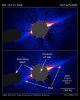
HD-15115.jpgLopsided debris disk around the young star HD 1511563 visiteThe disk, seen edge-on, is the dense blue line extending from the star to the upper right and lower left of the image. As seen from Earth, the edge-on disk resembles a needle sticking out from the star. The disk appears thicker and longer at upper right than at lower left, evidence of the disk's lopsided structure.
Astronomers think the disk's odd imbalanced look is caused by dust particles following a highly elliptical orbit around the star, which is slightly brighter than the Sun. The lopsidedness may have been caused by planets sweeping up debris in the disk or by the gravity of a nearby star.
Astronomers used an occulting mask on Hubble's Advanced Camera for Surveys to block out the bright starlight so they could see the dim disk. The occulting masks can be seen in the image as the dark circle in the center and the dark bar on the left. The star is behind the central mask.
HD 15115 is among nearly 30 stars that belong to the Beta Pictoris Moving Group. Moving groups are expanded clusters of stars believed to have a common birthplace and age, in this case about 12 million years, that are traveling together loosely through space. HD 15115 is 150 light-years from Earth.
Dusty disks are known to exist around at least 100 stars, but because of the difficulty in observing material close to the brightness of a star, less than a dozen have been studied closely.
Astronomers described the disk as one of the most peculiar debris disks that Hubble has ever imaged. They in fact made follow-up observations with the W.M. Keck Observatory in Hawaii to confirm the disk's presence.
Hubble's Advanced Camera for Surveys snapped the image on July 17, 2006.
MareKromiumLug 19, 2007
|
|

HD_189733b-PIA09715_01.jpgExoplanet HD 189733b61 visiteCaption NASA:"This plot of data from NASA's Spitzer Space Telescope (SST) tells astronomers that a toasty gas exoplanet, or a planet beyond our Solar System, contains water vapor.
Spitzer observed the Planet, called HD 189733b, cross in front of its star at three different infrared wavelengths: 3,6; 4,5 and 8 microns (see lime-colored dots). For each wavelength, the Planet's Atmosphere absorbed different amounts of the starlight that passed through it. The pattern by which this absorption varies with wavelength matches known signatures of water, as shown by the theoretical model in blue".MareKromiumLug 16, 2007
|
|
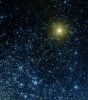
NGC-0362-PIA09653.jpgNGC 362 - Globular Star Cluster62 visiteThe Galaxy Evolution Explorer's ultraviolet eyes have captured a globular star cluster, called NGC 362, in our own Milky Way galaxy. In this new image, the cluster appears next to stars from a more distant neighboring galaxy, known as the Small Magellanic Cloud.
Globular clusters are densely packed bunches of old stars scattered in galaxies throughout the universe. NGC 362, located 30,000 light-years away, can be spotted as the dense collection of mostly yellow-tinted stars surrounding a large white-yellow spot toward the top-right of this image. The white spot is actually the core of the cluster, which is made up of stars so closely packed together that the Galaxy Evolution Explorer cannot see them individually.
The light blue dots surrounding the cluster core are called extreme horizontal branch stars. These stars used to be very similar to our sun and are nearing the end of their lives. They are very hot, with temperatures reaching up to about four times that of the surface of our sun (25,000 Kelvin or 45,500 degrees Fahrenheit).
A star like our sun spends most of its life fusing hydrogen atoms in its core into helium. When the star runs out of hydrogen in its core, its outer envelope will expand. The star then becomes a red giant, which burns hydrogen in a shell surrounding its inner core. Throughout its life as a red giant, the star loses a lot of mass, then begins to burn helium at its core. Some stars will have lost so much mass at the end of this process, up to 85 percent of their envelopes, that most of the envelope is gone. What is left is a very hot ultraviolet-bright core, or extreme horizontal branch star.
Blue dots scattered throughout the image are hot, young stars in the Small Magellanic Cloud, a satellite galaxy of the Milky Way located approximately 200,000 light-years away. The stars in this galaxy are much brighter intrinsically than extreme horizontal branch stars, but they appear just as bright because they are farther away. The blue stars in the Small Magellanic Cloud are only about a few tens of millions of years old, much younger than the approximately 10-million-year-old stars in NGC 362.
Because NGC 362 sits on the northern edge of the Small Magellanic Cloud galaxy, the blue stars are denser toward the south, or bottom, of the image.
Some of the yellow spots in this image are stars in the Milky Way galaxy that are along this line of sight. Astronomers believe that some of the other spots, particularly those closer to NGC 362, might actually be a relatively ultraviolet-dim family of stars called "blue stragglers." These stars are formed from collisions or close encounters between two closely orbiting stars in a globular cluster.
This image is a false-color composite, where light detected by the Galaxy Evolution Explorer's far-ultraviolet detector is colored blue, and light from the telescope's near-ultraviolet detector is red.
MareKromiumLug 01, 2007
|
|
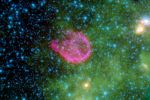
SNR-N132D-PIA09604.jpgThe "Shock-Waves" of N132D61 visiteSupernovae are the explosive deaths of the universe's most massive stars. In death, these volatile creatures blast tons of energetic waves into the cosmos, destroying much of the dust surrounding them.
This false-color composite from NASA's Spitzer Space Telescope and NASA's Chandra X-ray Observatory shows the remnant of one such explosion. The remnant, called N132D, is the wispy pink shell of gas at the center of this image. The pinkish color reveals a clash between the explosion's high-energy shockwaves and surrounding dust grains.
In the background, small organic molecules called polycyclic aromatic hydrocarbons are shown as tints of green. The blue spots represent stars in our galaxy along this line of sight.
N132D is located 163.000 LY away in the Large Magellanic Cloud.
In this image, infrared light at 4,5 microns is mapped to blue, 8,0 microns to green and 24 microns to red. Broadband X-ray light is mapped purple. The infrared data were taken by Spitzer's infrared array camera and multiband imaging photometer, while the X-ray data were captured by Chandra.
MareKromiumGiu 19, 2007
|
|
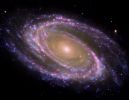
M-081-PIA09579.jpgThe M 81 Galaxy is "Pretty in Pink"62 visiteThe perfectly picturesque Spiral Galaxy known as Messier 81, or M81, looks sharp in this new composite from NASA's Spitzer (SST) and Hubble Space Telescopes (HST) and NASA's Galaxy Evolution Explorer.
M81 is a "grand design" spiral galaxy, which means its elegant arms curl all the way down into its center. It is located about 12 MLY away in the Ursa Major Constellation and is one of the brightest galaxies that can be seen from Earth through telescopes.
The colors in this picture represent a trio of light wavelengths: blue is ultraviolet light captured by the Galaxy Evolution Explorer; yellowish white is visible light seen by Hubble; and red is infrared light detected by Spitzer.
The blue areas show the hottest, youngest stars, while the reddish-pink denotes lanes of dust that line the spiral arms. The orange center is made up of older stars. MareKromiumGiu 06, 2007
|
|

M-042-PIA09411.jpgOut of Orion's Head (1)61 visiteThis image from NASA's SST shows infant stars "hatching" in the Head of the Hunter constellation, Orion. Astronomers suspect that shockwaves from a supernova explosion in Orion's head, nearly 3 MY ago, may have initiated this newfound birth
The Region featured in this Spitzer image is called Barnard 30.
It is located approx. 1,300 LY away and sits on the right side of Orion's "Head" just North of the massive star Lambda Orionis.
Wisps of green in the cloud are organic molecules called polycyclic aromatic hydrocarbons. These molecules are formed anytime carbon-based materials are burned incompletely. On Earth, they can be found in the sooty exhaust from automobile and airplane engines. They also coat the grills where charcoal-broiled meats are cooked.
Tints of orange-red in the cloud are dust particles warmed by the newly forming stars. The reddish-pink dots at the top of the cloud are very young stars embedded in a cocoon of cosmic gas and dust. Blue spots throughout the image are background Milky Way along this line of sight.
This composite includes data from Spitzer's infrared array camera instrument, and multiband imaging photometer instrument. Light at 4.5 microns is shown as blue, 8.0 microns is green, and 24 microns is red.
MareKromiumMag 18, 2007
|
|
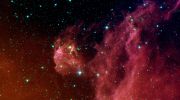
M-042-PIA09412.jpgOut of Orion's Head (2)61 visiteThis image from NASA's SST shows infant stars "hatching" in the Head of the Hunter constellation, Orion. Astronomers suspect that shockwaves from a supernova explosion in Orion's head, nearly 3 MY ago, may have initiated this newfound birth
The Region featured in this Spitzer image is called Barnard 30.
It is located approximately 1300 LY away and sits on the right side of Orion's "Head" just North of the massive star Lambda Orionis. Wisps of red in the cloud are organic molecules called polycyclic aromatic hydrocarbons. These molecules are formed anytime carbon-based materials are burned incompletely. On Earth, they can be found in the sooty exhaust from automobile and airplane engines. They also coat the grills where charcoal-broiled meats are cooked.
This image shows infrared light captured by Spitzer's infrared array camera. Light with wavelengths of 8 and 5.8 microns (red and orange) comes mainly from dust that has been heated by starlight.
Light of 4.5 microns (green) shows hot gas and dust; and light of 3.6 microns (blue) is from starlight.
MareKromiumMag 18, 2007
|
|
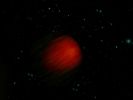
HD149026b_-PIA09378.jpgHot, Black and (relatively) Close...63 visiteThis artist's concept illustrates the hottest planet yet observed in the universe.
The scorching ball of gas, a "Hot Jupiter" called HD 149026b, is a sweltering 3700° Fahrenheit (2040° Celsius) -- about 3 times hotter than the rocky surface of Venus, the hottest planet in our Solar System. The Planet is so hot that astronomers believe it is absorbing almost all of the heat from its star and reflecting very little to no light. Objects that reflect no sunlight are black. Consequently, HD 149026b might be the blackest known planet in the universe, in addition to the hottest.
The temperature of this dark and balmy planet was taken with NASA's SST. While the planet reflects no visible light, its heat causes it to radiate a little visible and a lot of infrared light. Spitzer, an infrared observatory, was able to measure this infrared light through a technique called secondary eclipse. HD 149026b is what is known as a transiting planet, which means that it crosses in front of in front of and passes behind its star -- the secondary eclipse -- when viewed from Earth. By determining the drop in total infrared light that occurs when the planet disappears, astronomers can figure out how much infrared light is coming from the planet alone.
The Spitzer observations of HD 149026b also suggest a hot spot in the middle of the side of the planet that always faces its star. Even though the planet is black, the spot would glow like a black lump of charcoal. HD 149026b is thought to be tidally locked, just as our moon is to Earth, such that one side of the planet is perpetually baked under the heat of its sun.
Astronomers think that HD 149026b is probably blazing hot on its sunlit side, and much cooler on its dark side. A similar phenomenon was observed previously by Spitzer for the planet Upsilon Andromedae b.
In the case of both planets, heat is not being evenly distributed across their surfaces. This is the opposite of what happens on Jupiter, where temperature differences are minimal all around.
HD 149026b is located 256 light-years away in the constellation Hercules. It is the smallest known transiting planet, with a size similar to Saturn's and a suspected dense core 70 to 90 times the mass of Earth. It speeds around its star every 2.9 days.
MareKromiumMag 18, 2007
|
|
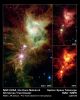
NGC-2264.jpgNGC 2264 - The "Snowflake Cluster" versus the "Cone Nebula"62 visiteCaption NASA:"Strange shapes and textures can be found in the neighborhood of the Cone Nebula.
These patterns result from the tumultuous unrest that accompanies the formation of the open cluster of stars known as NGC 2264, the Snowflake Cluster. To better understand this process, a detailed image of this Region was taken in two colors of infrared light by the orbiting Spitzer Space Telescope (SST). Bright stars from the Snowflake cluster dot the field. These stars soon heat up and destroy the gas and dust mountains in which they formed. One such dust mountain is the famous Cone Nebula, visible in the above image on the left, pointing toward a bright star near the center of the field.
The entire NGC 2264 Region is located about 2500 LY away toward the constellation of the Unicorn (Monoceros)".MareKromiumMag 09, 2007
|
|
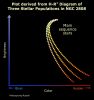
NGC-2808-2.jpgTriple Stellar Evolution Epochs in NGC 280862 visiteLike a simplified version of the Hertzsprung-Russell (HR) Diagram and by using the original HST data, this graph schematically plots the brightness of the stars in Globular Cluster NGC 2808 (along the vertical axis) against stellar color and temperature (along the horizontal axis).
The cooler a star is, the redder it appears, and it diminishes in brightness.
The bluer stars are to the left; redder stars are to the right.
The brightest stars are near the top.
The 3 curves represent the 3 different populations of stars that are present in NGC 2808.MareKromiumMag 04, 2007
|
|
| 157 immagini su 14 pagina(e) |
|
|
|
|
|
8 | |
|
|
|
|
|
|





