| |

| Ultimi arrivi - The Universe in Super Definition |
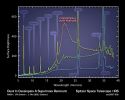
SN-Cassiopeia_A_-PIA10207.jpgCassiopeia "A": Dissecting the Wake of a Supernova Explosion61 visiteThe elements and molecules that flew out of the Cassiopeia A star when it exploded about 300 years ago can be seen clearly for the first time in this plot of data, called a Spectrum, taken by NASA's SST.
The Spectrum, which was created by splitting light into its basic components, reveals the composition of gas and dust that were synthesized in the explosion. It also provides some of the best evidence yet that stellar explosions, called Supernovae, were a significant source of fresh dust in the very young universe.
Prior to these observations, nobody was certain where this early dust — the same dust that ultimately made its way into future stars, planets and people — came from.
One of the most interesting features of the plot is a bump labeled Cassiopeia A Dust Feature. This bump is actually the signature of a collection of dust composed of proto-silicates, Silicon Dioxide and Iron Oxide. The Spectrum reveals that the brightness of the dust feature is correlated to that of Argon gas (yellow vertical line at left), known to have been expelled and synthesized during the star's explosion. The fact that the dust is associated with the expelled gas, or ejecta, tells astronomers that this Supernova manufactured new dust.
Each of the 3 lines of this plot represents a different layer of the Supernova remnant, with the top yellow and red line being the outermost layer.
Similar correlations between gas and dust are also seen in the middle layer (green line). For example, neon gas correlates with dust composed of Carbon and Aluminum Oxide.MareKromiumDic 28, 2007
|
|
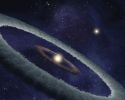
HD-113766-PIA09931.jpgHD 11376675 visiteThis artist's conception shows a binary-star, or two-star, system, called HD 113766, where astronomers suspect a rocky Earth-like planet is forming around one of the stars. At approximately 10 to 16 MY old, astronomers suspect this star is at just the right age for forming rocky planets. The System is located approx. 424 LY away from Earth.
The two yellow spots in the image represent the System's two stars. The brown ring of material circling closest to the central star depicts a huge belt of dusty material, more than 100 times as much as in our asteroid belt, or enough to build a Mars-size planet or larger. The rocky material in the belt represents the early stages of planet formation, when dust grains clump together to form rocks, and rocks collide to form even more massive rocky bodies called planetesimals. The belt is located in the middle of the system's terrestrial Habitable Zone, or the region around a star where liquid water could exist on any rocky planets that might form.
Earth is located in the middle of our sun's terrestrial habitable zone.
Using NASA's Spitzer Space Telescope, astronomers learned that the belt material in HD 113766 is more processed than the snowball-like stuff that makes up infant solar systems and comets, which contain pristine ingredients from the early solar system. However, it is not as processed as the stuff found in mature planets and asteroids. This means that the dust belt is made out of just the right mix of materials to be forming an Earth-like planet. It is composed mainly of rocky silicates and metal sulfides (like fool's gold), similar to the material found in lava flows.
The white outer ring shows a concentration of icy dust also detected in the system. This material is at the equivalent position of the asteroid belt in our solar system, but only contains about one-sixth as much material as the inner ring. Astronomers say it is not clear from the Spitzer observations if anything is occurring in the icy belt, but they believe it could be a source of water later on for the planet that grows from the inner warm ring.
MareKromiumOtt 06, 2007
|
|
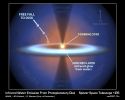
NGC-1333-PIA09966.jpgWater Vapor inside NGC 133362 visiteThis diagram illustrates the earliest journeys of water in a young, forming Star System. Stars are born out of icy cocoons of gas and dust. As the cocoon collapses under its own weight in an inside-out fashion, a stellar embryo forms at the center surrounded by a dense, dusty disk.
The stellar embryo "feeds" from the disk for a few million years, while material in the disk begins to clump together to form planets.
NASA's Spitzer Space Telescope was able to probe a crucial phase of this stellar evolution - a time when the cocoon is vigorously falling onto the pre-planetary disk. The infrared telescope detected water vapor as it smacks down on a disk circling a forming star called NGC 1333-IRAS 4B.
This vapor started out as ice in the outer envelope, but vaporized upon its arrival at the disk.
By analyzing the water in the system, astronomers were also able learn about other characteristics of the disk, such as its size, density and temperature.
How did Spitzer see the water vapor deep in the NGC 1333-IRAS 4B system?
This is most likely because the system is oriented in just the right way, such that its thicker disk is seen face-on from our Earthly perspective. In this "face-on" orientation, Spitzer can peer through a window carved by an outflow of material from the embryonic star. This system in this drawing is shown in the opposite "edge-on" configuration.MareKromiumSet 04, 2007
|
|
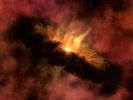
NGC-1333-PIA09967.jpgNGC 133364 visiteNASA's Spitzer Space Telescope observed a fledgling Solar System like the one depicted in this artist's concept, and discovered deep within it enough water vapor to fill the oceans on Earth five times. This water vapor starts out in the form of ice in a cloudy cocoon (not pictured) that surrounds the embryonic star, called NGC 1333-IRAS 4B (buried in center of image).
Material from the cocoon, including ice, falls toward the center of the cloud. The ice then smacks down onto a dusty pre-planetary disk circling the stellar embryo (doughnut-shaped cloud) and vaporizes.
Eventually, this water might make its way into developing planets.MareKromiumSet 04, 2007
|
|

NGC-1333-PIA09965.jpgWater Vapor inside NGC 133365 visiteThis plot of infrared data, called a Spectrum, shows the strong signature of water vapor deep within the core of an Embryonic Star System called NGC 1333-IRAS 4B.
The data were captured by NASA's SST using an instrument called Spectrograph.
A spectrograph collects light and sorts it according to color, or wavelength. In this case, infrared light from NGC 1333-IRAS 4B was broken up into the wavelengths listed on the horizontal axis of the plot. The sharp spikes, called spectral lines, occur at wavelengths at which the stellar object is particularly bright. The signature of water vapor is revealed in the pattern of wavelengths at which the spikes appear.
By comparing the observed data to a model (lower curve), astronomers can also determine the physical and chemical details of the region.
F.e.: Astronomers say these data suggest that ice in a cocoon surrounding the forming star is falling inward. The ice then smacks supersonically into a dusty planet-forming disk surrounding the stellar embryo, heats up and vaporizes quickly, releasing the infrared light that Spitzer collected.
MareKromiumSet 04, 2007
|
|
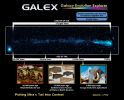
Mira-PIA09958-0.jpgMira soars through the Sky!64 visiteNew ultraviolet images from NASA's Galaxy Evolution Explorer shows a speeding star that is leaving an enormous trail of "seeds" for new solar systems. The star, named Mira (pronounced my-rah) after the latin word for "wonderful," is shedding material that will be recycled into new stars, planets and possibly even life as it hurls through our galaxy.
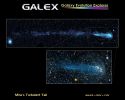
In figure 1, the upper panel shows Mira's full, comet-like tail as seen only in shorter, or "far" ultraviolet wavelengths, while the lower panel is a combined view showing both far and longer, or "near" ultraviolet wavelengths. The close-up picture at bottom gives a better look at Mira itself, which appears as a pinkish dot, and is moving from left to right in this view. Shed material appears in light blue. The dots in the picture are stars and distant galaxies. The large blue dot on the left side of the upper panel, and the large yellow dot in the lower panel, are both stars that are closer to us than Mira.
The Galaxy Evolution Explorer discovered the strange tail during part of its routine survey of the entire sky at ultraviolet wavelengths. When astronomers first saw the picture, they were shocked because Mira has been studied for over 400 years yet nothing like this has ever been documented before.
Mira's comet-like tail stretches a startling 13 light-years across the sky. For comparison, the nearest star to our sun, Proxima Centauri, is only about 4 light-years away. Mira's tail also tells a tale of its history -- the material making it up has been slowly blown off over time, with the oldest material at the end of the tail being released about 30,000 years ago (figure 2).
Mira is a highly evolved, "red giant" star near the end of its life. Technically, it is called an asymptotic giant branch star. It is red in color and bloated; for example, if a red giant were to replace our sun, it would engulf everything out to the orbit of Mars. Our sun will mature into a red giant in about 5 billion years.
Like other red giants, Mira will lose a large fraction of its mass in the form of gas and dust. In fact, Mira ejects the equivalent of the Earth's mass every 10 years. It has released enough material over the past 30,000 years to seed at least 3,000 Earth-sized planets or 9 Jupiter-sized ones.
While most stars travel along together around the disk of our Milky Way, Mira is charging through it. Because Mira is not moving with the "pack," it is moving much faster relative to the ambient gas in our section of the Milky Way. It is zipping along at 130 kilometers per second, or 291,000 miles per hour, relative to this gas.
Mira's breakneck speed together with its outflow of material are responsible for its unique glowing tail. Images from the Galaxy Evolution Explorer show a large build-up of gas, or bow shock, in front of the star, similar to water piling up in front of a speeding boat. Scientists now know that hot gas in this bow shock mixes with the cooler, hydrogen gas being shed from Mira, causing it to heat up as it swirls back into a turbulent wake. As the hydrogen gas loses energy, it fluoresces with ultraviolet light, which the Galaxy Evolution Explorer can detect.
Mira, also known as Mira A, is not alone in its travels through space. It has a distant companion star called Mira B that is thought to be the burnt-out, dead core of a star, called a white dwarf. Mira A and B circle around each other slowly, making one orbit about every 500 years. Astronomers believe that Mira B has no effect on Mira's tail.
Mira is also what's called a pulsating variable star. It dims and brightens by a factor of 1,500 every 332 days, and will become bright enough to see with the naked eye in mid-November 2007. Because it was the first variable star with a regular period ever discovered, other stars of this type are often referred to as "Miras."
Mira is located 350 light-years from Earth in the constellation Cetus, otherwise known as the whale. Coincidentally, Mira and its "whale of a tail" can be found in the tail of the whale constellation.
These images were between November 18 and December 15, 2006.
MareKromiumAgo 16, 2007
|
|
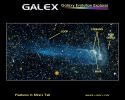
Mira-PIA09958-1.jpgMira: anatomy of a "Celestial Shooting Star"...64 visiteA close-up view of a star racing through space faster than a speeding bullet can be seen in this image from NASA's Galaxy Evolution Explorer. The star, called Mira (pronounced My-rah), is traveling at 130 kilometers per second, or 291,000 miles per hour. As it hurls along, it sheds material that will be recycled into new stars, planets and possibly even life.
In this image, Mira is moving from left to right. It is visible as the pinkish dot in the bulb shape at right. The yellow dot below is a foreground star. Mira is traveling so fast that it's creating a bow shock, or build-up of gas, in front of it, as can be seen here at right.
Like a boat traveling through water, a bow shock forms ahead of the star in the direction of its motion. Gas in the bow shock is heated and then mixes with the cool hydrogen gas in the wind that is blowing off Mira. This heated hydrogen gas then flows around behind the star, forming a wake.
Why is the wake of material glowing? When the hydrogen gas is heated, it transitions into a higher-energy state, which then loses energy by emitting ultraviolet light - a process called fluorescence. The Galaxy Evolution Explorer has special instruments that can detect this ultraviolet light.
A similar fluorescence process is responsible for the Northern Lights -- a glowing, green aurora that can be seen from northern latitudes. However, in that case nitrogen and oxygen gas are fluorescing with visible light.
Streams and a loop of material can also be seen coming off Mira. Astronomers are still investigating what these streams are, but they suspect that they are denser parts of Mira's wind perhaps flowing out of the star's poles.
This image consists of data captured by both the far- and near-ultraviolet detectors on the Galaxy Evolution Explorer between November 18 and December 15, 2006. It has a total exposure time of about 3 hours.
MareKromiumAgo 16, 2007
|
|
Mira-PIA09959.jpgMira: anatomy of a "Celestial Shooting Star"...64 visiteA close-up view of a star racing through space faster than a speeding bullet can be seen in this image from NASA's Galaxy Evolution Explorer. The star, called Mira (pronounced My-rah), is traveling at 130 kilometers per second, or 291,000 miles per hour. As it hurls along, it sheds material that will be recycled into new stars, planets and possibly even life.
In this image, Mira is moving from left to right. It is visible as the pinkish dot in the bulb shape at right. The yellow dot below is a foreground star. Mira is traveling so fast that it's creating a bow shock, or build-up of gas, in front of it, as can be seen here at right.
Like a boat traveling through water, a bow shock forms ahead of the star in the direction of its motion. Gas in the bow shock is heated and then mixes with the cool hydrogen gas in the wind that is blowing off Mira. This heated hydrogen gas then flows around behind the star, forming a wake.
Why is the wake of material glowing? When the hydrogen gas is heated, it transitions into a higher-energy state, which then loses energy by emitting ultraviolet light - a process called fluorescence. The Galaxy Evolution Explorer has special instruments that can detect this ultraviolet light.
A similar fluorescence process is responsible for the Northern Lights -- a glowing, green aurora that can be seen from northern latitudes. However, in that case nitrogen and oxygen gas are fluorescing with visible light.
Streams and a loop of material can also be seen coming off Mira. Astronomers are still investigating what these streams are, but they suspect that they are denser parts of Mira's wind perhaps flowing out of the star's poles.
This image consists of data captured by both the far- and near-ultraviolet detectors on the Galaxy Evolution Explorer between November 18 and December 15, 2006. It has a total exposure time of about 3 hours.
MareKromiumAgo 16, 2007
|
|
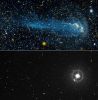
Mira-PIA09961.jpgMira's Tail62 visiteCaption NASA:"NASA's Galaxy Evolution Explorer discovered an exceptionally long comet-like tail of material trailing behind Mira -- a star that has been studied thoroughly for about 400 years.
So, why had this tail gone unnoticed for so long? The answer is that nobody had scanned the extended region around Mira in ultraviolet light until now.
As this composite demonstrates, the tail is only visible in ultraviolet light (top), and does not show up in visible light (bottom). Incidentally, Mira is much brighter in visible than ultraviolet light due to its low surface temperature of about 3000 Kelvin (about 5000° Fahrenheit)".MareKromiumAgo 16, 2007
|
|
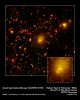
PIA09955_fig1.jpgFearsome Foursome (Figure 1)62 visiteOne of the biggest galaxy collisions ever observed is taking place at the center of this image. The four yellow blobs in the middle are large galaxies that have begun to tangle and ultimately merge into a single gargantuan galaxy. The yellowish cloud around the colliding galaxies contains billions of stars tossed out during the messy encounter. Other galaxies and stars appear in yellow and orange hues.
NASA's Spitzer Space Telescope spotted the four-way collision, or merger, in a giant cluster of galaxies, called CL0958+4702, located nearly 5 BLY away.
The dots in the picture are a combination of galaxies in the cluster; background galaxies located behind the cluster; and foreground stars in our own Milky Way galaxy.
Infrared data from Spitzer are colored red in this picture, while visible-light data from a telescope known as WIYN are green. Areas where green and red overlap appear orange or yellow.
Since most galaxies in the cluster contain old stars that are visible to Spitzer and WIYN, those galaxies appear orange.
MareKromiumAgo 07, 2007
|
|
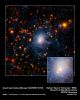
PIA09955_fig2.jpgFearsome Foursome (Figure 2)63 visiteFigure 2 is similar to figure 1 except the color blue represents X-ray light captured by NASA's Chandra X-ray Observatory. The colliding galaxies appear white in this picture because they are in areas where all the colors overlap.
The WIYN telescope, located near Tucson, Ariz., is owned and operated by the WIYN Consortium, which consists of the University of Wisconsin, Indiana University, Yale University, and the National Optical Astronomy Observatory.MareKromiumAgo 07, 2007
|
|

NGC-2237_and_NGC-2244-SST.jpgThe "O" Stars inside the Rosette Nebula111 visiteIn this sub-frame are highlighted 5 dangerous hot stars that can be found inside the Rosette Nebula; these stars are classified as "O" Stars (meaning stars with a surface temperatures of 25.000 Kelvins - such as 24.726,85° Celsius - or higher).
Astronomers calculate that cool stars wandering within about 1,6 Light-Years of the Rosette's "O" Stars are in danger of having their planet forming disks destroyed.
MareKromiumLug 26, 2007
|
|
| 157 immagini su 14 pagina(e) |
|
|
|
|
|
7 | |
|
|
|
|
|
|





