| |

| Ultimi arrivi - The Universe in Super Definition |
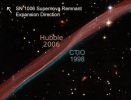
SN-1006-PIA10926.jpgStars and a Stripe in Celestial Fireworks63 visiteA delicate ribbon of gas floats eerily in our galaxy. A contrail from an alien spaceship? A jet from a black-hole? Actually this image, taken by NASA's Hubble Space Telescope, is a very thin section of a supernova remnant caused by a stellar explosion that occurred more than 1,000 years ago.
On or around May 1, 1006 A.D., observers from Africa to Europe to the Far East witnessed and recorded the arrival of light from what is now called SN 1006, a tremendous supernova explosion caused by the final death throes of a white dwarf star nearly 7,000 light-years away. The supernova was probably the brightest star ever seen by humans, and surpassed Venus as the brightest object in the night time sky, only to be surpassed by the moon. It was visible even during the day for weeks, and remained visible to the naked eye for at least two and a half years before fading away.
It wasn't until the mid-1960s that radio astronomers first detected a nearly circular ring of material at the recorded position of the supernova. The ring was almost 30 arcminutes across, the same angular diameter as the full moon. The size of the remnant implied that the blast wave from the supernova had expanded at nearly 20 million miles per hour over the nearly 1,000 years since the explosion occurred.
In 1976, the first detection of exceedingly faint optical emission of the supernova remnant was reported, but only for a filament located on the northwest edge of the radio ring. A tiny portion of this filament is revealed in detail by the Hubble observation. The twisting ribbon of light seen by Hubble corresponds to locations where the expanding blast wave from the supernova is now sweeping into very tenuous surrounding gas.
The hydrogen gas heated by this fast shock wave emits radiation in visible light. Hence, the optical emission provides astronomers with a detailed "snapshot" of the actual position and geometry of the shock front at any given time. Bright edges within the ribbon correspond to places where the shock wave is seen exactly edge on to our line of sight.
Today we know that SN 1006 has a diameter of nearly 60 light-years, and it is still expanding at roughly 6 million miles per hour. Even at this tremendous speed, however, it takes observations typically separated by years to see significant outward motion of the shock wave against the grid of background stars. In the Hubble image as displayed, the supernova would have occurred far off the lower right corner of the image, and the motion would be toward the upper left.
SN 1006 resides within our Milky Way Galaxy. Located more than 14 degrees off the plane of the galaxy's disk, there is relatively little confusion with other foreground and background objects in the field when trying to study this object. In the Hubble image, many background galaxies (orange extended objects) far off in the distant universe can be seen dotting the image. Most of the white dots are foreground or background stars in our Milky Way galaxy.
This image is a composite of hydrogen-light observations taken with Hubble's Advanced Camera for Surveys in February 2006 and Wide Field Planetary Camera 2 observations in blue, yellow-green, and near-infrared light taken in April 2008. The supernova remnant, visible only in the hydrogen-light filter was assigned a red hue in the Heritage color image.
For images and more information about SN 1006, visit:
http://hubblesite.org/news/2008/22
http://heritage.stsci.edu/2008/22
For additional information, contact:
Ray Villard Space Telescope Science Institute, Baltimore, Md. 410-338-4514 villard@stsci.edu
William Blair Johns Hopkins University, Baltimore, Md. 410-516-8447 wpb@pha.jhu.edu
MareKromiumLug 02, 2008
|
|

The_Missing_Matter.jpgWhat is "missing" in the Universe?66 visiteIn the May 20, 2008, issue of The Astrophysical Journal, Charles Danforth and Mike Shull (University of Colorado, Boulder) report on NASA's Hubble Space Telescope and NASA's Far Ultraviolet Spectroscopic Explorer (FUSE) observations taken along sight-lines to 28 quasars. Their analysis represents the most detailed observations to date of how the intergalactic medium looks within about 4 Billion Light-Years of Earth.
The astronomers say they have definitively found about half of the missing normal matter, called "Baryons", in the space between the galaxies.
This illustration shows how the Hubble Space Telescope searches for missing Baryons, by looking at the light from quasars several Billion Light-Years away. Imprinted on that light are the spectral fingerprints of the missing ordinary matter that absorbs the light at specific frequencies (shown in the colorful spectra at right).
The missing Baryonic Matter helps trace out the structure of intergalactic space, called the "Cosmic Web".MareKromiumGiu 20, 2008
|
|

GRB-080319B.jpgSpace "Flash"! GRB-080319B64 visiteCaption NASA:"Peering across 7,5 BLY (Billion Light-Years) and halfway back to the Big Bang, NASA's Hubble Space Telescope has photographed the fading optical counterpart of a powerful Gamma Ray Burst (GRB) that holds the record for being the intrinsically brightest naked-eye object ever seen from Earth. For nearly a minute this single star was as bright as 10 million galaxies.
Hubble Wide Field and Planetary Camera 2 (WFPC2) images of GRB 080319B, taken on Monday, April 7, 2008, show the fading optical counterpart of the titanic blast. The object erupted in a brilliant flash of Gamma Rays and other electromagnetic radiation at 2:12 a.m. EDT on March 19, and was detected by Swift, NASA's Gamma Ray Burst "Watchdog Satellite". Immediately after the explosion, the Gamma Ray Burst glowed as a dim 5th magnitude "star" in the spring constellation Bootes.
Designated GRB 080319B, the intergalactic firework has been fading away ever since then. Hubble astronomers had hoped to see the host galaxy where the burst presumably originated, but were taken aback that the light from the GRB is still drowning out the galaxy's light even three weeks after the explosion.
This is particularly surprising because it was such a bright GRB initially. Previously, bright bursts have tended to fade more rapidly, which fits in to the theory that brighter GRBs emit their energy in a more tightly confined beam. The slow fading leaves astronomers puzzling about just where the energy came from to power this GRB, and makes Hubble's next observations of this object in May 2008 all the more crucial.
Called a Long-Duration GRB, such events are theorized to be caused by the death of a very massive star, perhaps weighing as much as 50 times our Sun. Such explosions, sometimes dubbed "hypernovae", are more powerful than ordinary supernova explosions and are far more luminous, in part because their energy seems to be concentrated into a blowtorch-like beam that, in this case, was aimed directly at Earth. The Hubble exposure also shows field galaxies around the fading optical component of the gamma ray burst, which are probably unrelated to the burst itself".MareKromiumApr 11, 2008
|
|
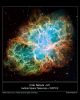
M-001.jpgM 1 - The "Crab Nebula"62 visitenessun commentoMareKromiumFeb 25, 2008
|
|

BLG-109.jpgBLG-109: A Distant Version of our own Solar System67 visiteCaption NASA:"How common are planetary systems like our own?
Perhaps quite common, as the first system of planets like our own Solar System has been discovered using a newly adapted technique that, so far, has probed only six planetary systems.
The technique, called "Gravitational Microlensing", looks for telling brightness changes in measured starlight when a foreground star with planets chances almost directly in front of a more distant star. The distant star's light is slightly deflected in predictable ways by the gravity of the closer system.
Recently a detailed analysis of Microlensing System OGLE-2006-BLG-109 has related brightness variations to two planets that are similar to Jupiter and Saturn of our own Solar System. This discovery carries the tantalizing implication that interior planets, possibly including Earth-like planets, might also be common.
Pictured above is an artistic conception of how the BLG-109 planetary system might look".MareKromiumFeb 18, 2008
|
|
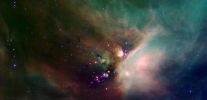
Rho_Ophiuci-PIA10181.jpgRho Ophiuci68 visiteNewborn stars peek out from beneath their natal blanket of dust in this dynamic image of the Rho Ophiuchi dark cloud from NASA's Spitzer Space Telescope. Called "Rho Oph" by astronomers, it's one of the closest star-forming regions to our own solar system. Located near the constellations Scorpius and Ophiuchus, the nebula is about 407 light years away from Earth.
Rho Oph is a complex made up of a large main cloud of molecular hydrogen, a key molecule allowing new stars to form from cold cosmic gas, with two long streamers trailing off in different directions. Recent studies using the latest X-ray and infrared observations reveal more than 300 young stellar objects within the large central cloud. Their median age is only 300,000 years, very young compared to some of the universe's oldest stars, which are more than 12 billion years old.
This false-color image of Rho Oph's main cloud, Lynds 1688, was created with data from Spitzer's infrared array camera, which has the highest spatial resolution of Spitzer's three imaging instruments, and its multiband imaging photometer, best for detecting cooler materials. Blue represents 3.6-micron light; green shows light of 8 microns; and red is 24-micron light. The multiple wavelengths reveal different aspects of the dust surrounding and between the embedded stars, yielding information about the stars and their birthplace.
The colors in this image reflect the relative temperatures and evolutionary states of the various stars. The youngest stars are surrounded by dusty disks of gas from which they, and their potential planetary systems, are forming. These young disk systems show up as red in this image. Some of these young stellar objects are surrounded by their own compact nebulae. More evolved stars, which have shed their natal material, are blue.
The extended white nebula in the center right of the image is a region of the cloud which is glowing in infrared light due to the heating of dust by bright young stars near the right edge of the cloud. Fainter multi-hued diffuse emission fills the image. The color of the nebulosity depends on the temperature, composition and size of the dust grains. Most of the stars forming now are concentrated in a filament of cold, dense gas that shows up as a dark cloud in the lower center and left side of the image against the bright background of the warm dust. Although infrared radiation at 24 microns pierces through dust easily, this dark filament is incredibly opaque, appearing dark even at the longest wavelengths in the image.
MareKromiumFeb 13, 2008
|
|
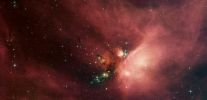
Rho_Ophiuci-PIA10182.jpgRho Ophiuci63 visiteNewborn stars peek out from beneath their natal blanket of dust in this dynamic image of the Rho Ophiuchi dark cloud from NASA's Spitzer Space Telescope. Called "Rho Oph" by astronomers, it's one of the closest star-forming regions to our own solar system. Located near the constellations Scorpius and Ophiuchus, the nebula is about 407 light years away from Earth.
Rho Oph is a complex made up of a large main cloud of molecular hydrogen, a key molecule allowing new stars to form from cold cosmic gas, with two long streamers trailing off in different directions. Recent studies using the latest X-ray and infrared observations reveal more than 300 young stellar objects within the large central cloud. Their median age is only 300,000 years, very young compared to some of the universe's oldest stars, which are more than 12 billion years old.
This false-color image of Rho Oph's main cloud, Lynds 1688, was created with data from Spitzer's infrared array camera, which has the highest spatial resolution of Spitzer's three imaging instruments. Blue represents 3.6 micron light, green is 4.5 micron light, orange is 5.8, and red is 8.0. The multiple wavelengths reveal different aspects of the dust surrounding and between the embedded stars, yielding information about the stars and their birthplace.
The colors in this image reflect the relative temperatures and evolutionary states of the various stars. The youngest stars are surrounded by dusty disks of gas from which they, and their potential planetary systems, are forming. These young disk systems show up as yellow-green tinted stars in this image. Some of these young stellar objects are surrounded by their own compact nebulae. More evolved stars, which have shed their natal material, are blue-white.
The extended white nebula in the center right of the image is a region of the cloud which is glowing in infrared light due to the illumination of dust by bright young stars near the right edge of the cloud. Red and pink diffuse emission from carbon-rich dust molecules fills the image. Most of the stars forming now are concentrated in a filament of cold, dense gas that shows up as a dark cloud in the lower center and left side of the image against the bright background of the warm dust. Although infrared radiation at 8 microns pierces through dust easily, this dark filament is incredibly opaque, appearing dark even at the longest wavelengths in the image.
MareKromiumFeb 13, 2008
|
|

Abell-1689.jpgGravitational "Lensing" for Abell 168966 visiteA massive cluster of yellowish galaxies is seemingly caught in a spider web of eerily distorted background galaxies in the left-hand image, taken with the Advanced Camera for Surveys (ACS) aboard NASA's Hubble Space Telescope.
The gravity of the cluster's trillion stars acts as a cosmic "zoom lens," bending and magnifying the light of the galaxies located far behind it, a technique called gravitational lensing. The faraway galaxies appear in the Hubble image as arc-shaped objects around the cluster, named Abell 1689. The increased magnification allows astronomers to study remote galaxies in greater detail.
One galaxy is so far away, however, it does not show up in the visible-light image taken with ACS [top, right], because its light is stretched to invisible infrared wavelengths by the universe's expansion.
Astronomers used Hubble's Near Infrared Camera and Multi-Object Spectrometer (NICMOS) and NASA's Spitzer Space Telescope with its Infrared Array Camera (IRAC)—with help from the gravitational lensing cluster—to see the faraway galaxy.
The distant galaxy, dubbed A1689-zD1, appears as a grayish-white smudge in the close-up view taken with Hubble's NICMOS [center, right], and as a whitish blob in the Spitzer IRAC close-up view [bottom, right]. The galaxy is brimming with star birth. Hubble and Spitzer worked together to show that it is one of the youngest galaxies ever discovered. Astronomers estimate that the galaxy is 12.8 billion light-years away. Abell 1689 is 2.2 billion light-years away.
A1689-zD1 was born during the middle of the "dark ages," a period in the early universe when the first stars and galaxies were just beginning to burst to life. The dark ages lasted from about 400,000 to roughly a billion years after the Big Bang. Astronomers think that A1689-zD1 was one of the galaxies that helped end the dark ages.
The ACS images were taken in 2002, the NICMOS images in 2005 and 2007, and the Spitzer IRAC images in 2006.
MareKromiumFeb 13, 2008
|
|

Abell-1763-PIA10227.jpgCelestial Cities and the Roads that connect Them69 visiteThis is a representation of galaxies in and surrounding a galaxy cluster called Abell 1763. The placement of each dot is based on the actual coordinates of galaxies in the region. Blue dots are active star-forming galaxies; red dots show galaxies that are not actively forming stars.
Galaxies across the universe reside in cosmic communities big and small. Large, densely populated galactic communities are called galaxy clusters (highlighted in the orange circle). Like cities on Earth, galaxy clusters are scattered throughout the universe and are connected by a web of dusty highways called filaments (highlighted in purple). Smaller galactic communities are sprinkled along the filaments, creating celestial suburbs.
Over time, astronomers suspect that all galactic suburbanites make their way to a galaxy cluster by way of filaments. Observations from NASA's Spitzer Space Telescope show that filamentary galaxies form stars at twice the rate of their densely clustered counterparts.
NASA's Jet Propulsion Laboratory, Pasadena, Calif., manages the Spitzer Space Telescope mission for NASA's Science Mission Directorate, Washington. Science operations are conducted at the Spitzer Science Center at the California Institute of Technology, also in Pasadena. Caltech manages JPL for NASA.
MareKromiumFeb 13, 2008
|
|

GLS-SDSSJ0946+1006.jpgHubble Finds Double "Einstein Ring"75 visiteNASA's Hubble Space Telescope has revealed a never-before-seen optical alignment in space: a pair of glowing rings, one nestled inside the other like a bull's-eye pattern. The double-ring pattern is caused by the complex bending of light from two distant galaxies strung directly behind a foreground massive galaxy, like three beads on a string.
More than just a novelty, this very rare phenomenon can offer insight into dark matter, dark energy, the nature of distant galaxies, and even the curvature of the universe.
The ring was found by an international team of astronomers led by Raphael Gavazzi and Tommaso Treu of the University of California, Santa Barbara. The discovery is part of the ongoing Sloan Lens Advanced Camera for Surveys (SLACS) program. The team is reporting its results at the 211th meeting of the American Astronomical Society in Austin, Texas. A paper has been submitted to The Astrophysical Journal.
The phenomenon, called gravitational lensing, occurs when a massive galaxy in the foreground bends the light rays from a distant galaxy behind it, in much the same way as a magnifying glass would. When both galaxies are exactly lined up, the light forms a circle, called an "Einstein ring," around the foreground galaxy. If another background galaxy lies precisely on the same sightline, a second, larger ring will appear.
Because the odds of seeing such a special alignment are estimated to be 1 in 10,000, Tommaso says that they "hit the jackpot." The odds of seeing this phenomenon are less than winning two consecutive bets on a single number at Roulette.
"Such stunning cosmic coincidences reveal so much about nature. Dark matter is not hidden to lensing," added Leonidas Moustakas of the Jet Propulsion Laboratory in Pasadena, Calif. "The elegance of this lens is trumped only by the secrets of nature that it reveals."
The massive foreground galaxy is almost perfectly aligned in the sky with two background galaxies at different distances. The foreground galaxy is 3 billion light-years away. The inner ring and outer ring are comprised of multiple images of two galaxies at a distance of 6 billion and approximately 11 billion light-years.
SLACS team member Adam Bolton of the University of Hawaii's Institute for Astronomy in Honolulu first identified the lens in the Sloan Digital Sky Survey (SDSS). "The original signature that led us to this discovery was a mere 500 photons (particles of light) hidden among 500,000 other photons in the SDSS spectrum of the foreground galaxy," commented Bolton.
"The twin rings were clearly visible in the Hubble image, added Tommaso. "When I first saw it I said 'wow, this is insane!' I could not believe it!"
The distribution of dark matter in the foreground galaxies that is warping space to create the gravitational lens can be precisely mapped. Tommaso finds that the fall-off in density of the dark matter is similar to what is seen in spiral galaxies (as measured by the speed of a galaxy's rotation, which yields a value for the amount of dark matter pulling on it), though he emphasizes there is no physical reason to explain this relationship.
In addition, the geometry of the two Einstein rings allowed the team to measure the mass of the middle galaxy precisely to be a value of 1 billion solar masses. The team reports that this is the first measurement of the mass of a dwarf galaxy at cosmological distance (redshift of z=0.6).
A sample of several dozen double rings such as this one would offer a purely independent measure. The comparative radius of the rings could also be used to provide an independent measure of the curvature of space by gravity. This would help in determining the matter content of the universe and the properties of dark energy.
Observations of the cosmic microwave background (a relic from the Big Bang) favor flat geometry. A sample of 50 suitable double Einstein rings would be sufficient to measure the dark matter content of the universe and the equation of state of the dark energy (a measure of its pressure) to 10 percent precision. Other double Einstein rings could be found with wide-field space telescope sky surveys that are being proposed for the Joint Dark Energy Mission (JDEM) and recently recommended by the National Research Council.
MareKromiumGen 21, 2008
|
|
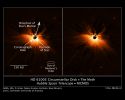
HD_61005.jpgCircumstellar Dust Takes Flight in 'The Moth'61 visiteWhat superficially resembles a giant moth floating in space is giving astronomers new insight into the formation and evolution of planetary systems.
This is not your typical flying insect. It has a wingspan of about 22 billion miles. The wing- like structure is actually a dust disk encircling the nearby, young star HD 61005, dubbed "The Moth." Its shape is produced by starlight scattering off dust.
Dust disks around roughly 100-million-year-old stars like HD 61005 are typically flat, pancake-shaped structures where planets can form. But images taken with NASA's Hubble Space Telescope of "The Moth" are showing that some disks sport surprising shapes.
"It is completely unexpected to find a dust disk with this unusual shape," said senior research scientist Dean Hines of the Space Science Institute, New Mexico Office in Corrales, New Mexico, and a member of the Hubble team that discovered the disk. "We think HD 61005 is plowing through a local patch of higher-density gas in the interstellar medium, causing material within HD 61005's disk to be swept behind the star. What effect this might have on the disk, and any planets forming within it, is unknown."
Hines called this possible collision "unusual, because we don't expect very much interstellar material to be in the solar neighborhood. That's because the area through which our Sun is moving was evacuated within the past few million years by at least one supernova, the explosion of a massive star. Yet, here's evidence of dense material that's very close, only 100 light-years away."
Astronomers have found evidence that the environment in which a star forms influences its prospects for planet formation. Hubble has actually seen that young planet-forming disks can be affected directly by their environment. The harsh stellar radiation from the Trapezium stars in the Orion Nebula has altered some disks. It is unclear, however, what effect passage through a cloud similar to the one in which HD 61005 finds itself would have on planet formation. Researchers have speculated that passage through dense regions of the interstellar medium could impact the atmospheres of evolving planets.
The Moth is part of a survey of Sun-like stars that Hines and collaborators observed with Hubble's Near-Infrared Camera and Multi-Object Spectrometer (NICMOS) and NASA's Spitzer Space Telescope to study the formation and evolution of planetary systems. Under the lead of Michael Meyer of the University of Arizona in Tucson, the team initially used Spitzer to look for heat radiation—the tell-tale sign of dust warmed by the star—to identify interesting star systems.
Hines then teamed with Glenn Schneider of the University of Arizona to use Hubble's high- contrast imaging capability of the NICMOS coronagraph to image these disks and reveal where the dust detected by Spitzer resides. The NICMOS coronagraph blocked out the starlight so that astronomers could see details in the surrounding disk.
"These symbiotic capabilities, uniquely implemented in NASA's Great Observatories, provide astronomers with the powerful observational tools to study the circumstellar environments of potentially planet-forming systems," Schneider said.
Added Meyer: "Combining observations from these two spacecraft gives us information about the composition of the dust grains, whether they're icy or sandy, or whether they're like the sooty smoke particles rising from a chimney. The composition and sizes of the dust can tell us a lot about the dynamics and evolution of a solar system. In our solar system, for example, astronomers have evidence of rocks smashing into each other and generating dust, as in the asteroid and Kuiper belts. We're seeing these same processes unfold in other planetary systems."
MareKromiumGen 21, 2008
|
|
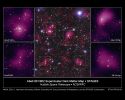
Abell-901_and_902-PM.jpgAbell 901 and 902 Supercluster65 visiteAstronomers are using NASA's Hubble Space Telescope to dissect one of the largest structures in the universe as part of a quest to understand the violent lives of galaxies. Hubble is providing indirect evidence of unseen dark matter tugging on galaxies in the crowded, rough-and-tumble environment of a massive supercluster of hundreds of galaxies.
Dark matter is an invisible form of matter that accounts for most of the universe's mass. Hubble's Advanced Camera for Surveys has mapped the invisible dark matter scaffolding of the supercluster Abell 901/902, as well as the detailed structure of individual galaxies embedded in it.
The images are part of the Space Telescope Abell 901/902 Galaxy Evolution Survey (STAGES), which covers one of the largest patches of sky ever observed by the Hubble telescope. The area surveyed is so wide that it took 80 Hubble images to cover the entire STAGES field. The new work is led by Meghan Gray of the University of Nottingham in the United Kingdom and Catherine Heymans of the University of British Columbia in Vancouver, along with an international team of scientists.
The Hubble study pinpointed four main areas in the supercluster where dark matter has pooled into dense clumps, totaling 100 trillion times the Sun's mass. These areas match the location of hundreds of old galaxies that have experienced a violent history in their passage from the outskirts of the supercluster into these dense regions. These galaxies make up four separate galaxy clusters.
"Thanks to Hubble's Advanced Camera for Surveys, we are detecting for the first time the irregular clumps of dark matter in this supercluster," Heymans said. "We can even see an extension of the dark matter toward a very hot group of galaxies that are emitting X-rays as they fall into the densest cluster core."
The dark matter map was constructed by measuring the distorted shapes of over 60,000 faraway galaxies. To reach Earth, the galaxies' light traveled through the dark matter that surrounds the supercluster galaxies and was bent by the massive gravitational field. Heymans used the observed, subtle distortion of the galaxies' shapes to reconstruct the dark matter distribution in the supercluster using a method called weak gravitational lensing. The dark matter map is 2.5 times sharper than a previous ground-based survey of the supercluster.
"The new map of the underlying dark matter in the supercluster is one key piece of this puzzle," Gray explained. "At the same time we're looking in detail at the galaxies themselves." The survey's broader goal is to understand how galaxies are influenced by the environment in which they live.
On Earth, the pace of quiet country life is vastly different from the hustle of the big city. In the same way, galaxies living lonely isolated lives look very different from those found in the most crowded regions of the universe, like a supercluster. "We've known for a long time that galaxies in crowded environments tend to be older, redder, and rounder than those in the field," Gray said. "Galaxies are continually drawn into larger and larger groups and clusters by the inevitable force of gravity as the universe evolves."
In such busy environments galaxies are subject to a life of violence: high-speed collisions with other galaxies; the stripping away of gas, the fuel supply they use to form new stars; and distortion due to the strong gravitational pull of the underlying invisible dark matter. "Any or all of these effects may play a role in the transformation of galaxies, which is what we're trying to determine," Gray said.
The STAGES survey's simultaneous focus on both the big picture and the details can be likened to studying a big city. "It's as if we're trying to learn everything we can about New York City and New Yorkers," Gray explained. "We're examining large-scale features, like mapping the roads, counting skyscrapers, monitoring traffic. At the same time we're also studying the residents to figure out how the lifestyles of people living downtown differ from those out in the suburbs. But in our case the city is a supercluster, the roads are dark matter, and the people are galaxies."
Further results by other team members support this view. "In the STAGES supercluster we clearly see that transformations are happening in the outskirts of the supercluster, where galaxies are still moving relatively slowly and first feel the influence of the cluster environment," said Christian Wolf, an Advanced Research Fellow at the University of Oxford in the U.K.
Assistant professor Shardha Jogee and graduate student Amanda Heiderman, both of the University of Texas in Austin, concur. "We see more collisions between galaxies in the regions toward which the galaxies are flowing than in the centers of the clusters," Jogee said. "By the time they reach the center, they are moving too fast to collide and merge, but in the outskirts their pace is more leisurely, and they still have time to interact."
The STAGES team also finds that the outer parts of the clusters are where star formation in the galaxies is slowly switching off and where the supermassive black holes at the hearts of the galaxies are most active.
Added Heiderman: "The galaxies at the centers of the clusters may have been there for a long time and have probably finished their transformation. They are now old, round, red, and dead."
The team plans more studies to understand how the supercluster environment is responsible for producing these changes.
Abell 901/902 resides 2.6 billion light-years from Earth and measures more than 16 million light-years across.
MareKromiumGen 21, 2008
|
|
| 157 immagini su 14 pagina(e) |
|
|
|
|
6 | |
|
|
|
|
|
|
|





