| |

| Ultimi arrivi - The Universe in Super Definition |
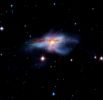
NGC-6240-PIA11828.jpgNGC 6240 - Colliding Galaxies64 visiteThis image of a pair of colliding galaxies called NGC 6240 shows them in a rare, short-lived phase of their evolution just before they merge into a single, larger galaxy. The prolonged, violent collision has drastically altered the appearance of both galaxies and created huge amounts of heat turning NGC 6240 into an "InfraRed Luminous" Active Galaxy.
A rich variety of active galaxies, with different shapes, luminosities and radiation profiles exist. These galaxies may be related astronomers have suspected that they may represent an evolutionary sequence. By catching different galaxies in different stages of merging, a story emerges as one type of active galaxy changes into another. NGC 6240 provides an important "missing link" in this process.
This image was created from combined data from the infrared array camera of NASA's Spitzer Space Telescope at 3.6 and 8.0 microns (red) and Visible Light from NASA's Hubble Space Telescope (green and blue).MareKromiumApr 05, 2009
|
|

ARP_274-HST-2009-14-a-print.jpgGalaxy Triplet Arp 27464 visiteArp 274, also known as NGC 5679, is a system of 3 galaxies that appear to be partially overlapping in the image, although they may be at somewhat different distances. The spiral shapes of 2 of these galaxies appear mostly intact. The third galaxy (to the far left) is more compact, but shows evidence of star formation.
Two of the three galaxies are forming new stars at a high rate. This is evident in the bright blue knots of star formation that are strung along the arms of the galaxy on the right and along the small galaxy on the left.
The largest component is located in the middle of the triplet. It appears as a Spiral Galaxy, which may be barred. The entire system resides at about 400 Million Light-Years away from Earth in the Virgo constellation.
Hubble's Wide Field Planetary Camera 2 was used to image Arp 274. Blue, visible, and infrared filters were combined with a filter that isolates hydrogen emission. The colors in this image reflect the intrinsic color of the different stellar populations that make up the galaxies. Yellowish older stars can be seen in the central bulge of each galaxy.
A bright central cluster of stars pinpoint each nucleus. Younger blue stars trace the spiral arms, along with pinkish nebulae that are illuminated by new star formation. Interstellar dust is silhouetted against the starry population. A pair of foreground stars inside our own Milky Way are at far right.MareKromiumApr 05, 2009
|
|
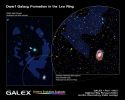
PIA11805.JPGBaby Dwarf Galaxies63 visiteThe unique Ultraviolet (UV) Vision of NASA's Galaxy Evolution Explorer reveals, for the first time, dwarf galaxies forming out of nothing more than pristine gas likely leftover from the early universe. Dwarf galaxies are relatively small collections of stars that often orbit around larger galaxies like our Milky Way.
The forming dwarf galaxies shine in the far UV Spectrum, rendered as blue in the call-out on the right hand side of this image. Near UV Light, also obtained by the Galaxy Evolution Explorer, is displayed in green, and Visible Light from the blue part of the spectrum here is represented by red. The clumps (in circles) are distinctively blue, indicating they are primarily detected in far UV Light.
The faint blue overlay traces the outline of the Leo Ring, a huge cloud of Hydrogen and helium that orbits around two massive galaxies in the constellation Leo (left panel). The cloud is thought likely to be a primordial object, an ancient remnant of material that has remained relatively unchanged since the very earliest days of the universe. Identified about 25 years ago by radio waves, the ring cannot be seen in Visible Light.
Only a portion of the Leo Ring has been imaged in the UV, but this section contains the telltale UV signature of recent massive star formation within this ring of pristine gas. Astronomers have previously only seen dwarf galaxies form out of gas that has already been cycled through a galaxy and enriched with metals — elements heavier than Helium — produced as stars evolve.
The visible data come from the Digitized Sky Survey of the Space Telescope Science Institute in Baltimore, Md. The Leo Ring visible image (left) represents the survey's blue, red, and infrared bands with the colors blue, green, and red. The overlay indicating the location of Hydrogen gas in the Leo Ring is based on observations made at the Arecibo Observatory in Puerto Rico.MareKromiumFeb 20, 2009
|
|
M-101-PIA11797.jpgM 10162 visiteIn 1609, Galileo improved the newly invented telescope, turned it toward the heavens, and revolutionized our view of the universe. In celebration of the 400th anniversary of this milestone, 2009 has been designated as the International Year of Astronomy.
Today, NASA's Great Observatories are continuing Galileo's legacy with stunning images and breakthrough science from the Hubble Space Telescope, the Spitzer Space Telescope, and the Chandra X-ray Observatory.
While Galileo observed the sky using visible light seen by the human eye, technology now allows us to observe in many wavelengths, including Spitzer's infrared view and Chandra's view in X-rays. Each wavelength region shows different aspects of celestial objects and often reveals new objects that could not otherwise be studied.
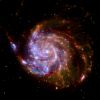
This image of the spiral galaxy Messier 101 is a composite of views from Spitzer, Hubble, and Chandra.
The red color shows Spitzer's view in infrared light. It highlights the heat emitted by dust lanes in the galaxy where stars can form.
The yellow color is Hubble's view in visible light. Most of this light comes from stars, and they trace the same spiral structure as the dust lanes.
The blue color shows Chandra's view in X-ray light. Sources of X-rays include million-degree gas, exploded stars, and material colliding around black holes.
Such composite images allow astronomers to see how features seen in one wavelength match up with those seen in another wavelength. It's like seeing with a camera, night vision goggles, and X-ray vision all at once.
In the four centuries since Galileo, astronomy has changed dramatically. Yet our curiosity and quest for knowledge remain the same. So, too, does our wonder at the splendor of the universe.
The International Year of Astronomy Great Observatories Image Unveiling is supported by the NASA Science Mission Directorate Astrophysics Division. The project is a collaboration between the Space Telescope Science Institute, the Spitzer Science Center, and the Chandra X-ray Center.
MareKromiumFeb 11, 2009
|
|

HD-80606b.jpgA Dangerous Summer on HD 80606b76 visiteOn the distant planet HD 80606b, Summers might be dangerous.
Hypothetic life forms floating in HD 080606b's Atmosphere or lurking on one of its (presently hypothetical) moons might fear the 1500 Kelvin Summer heat, which is hot enough not only to melt Lead but also Nickel. Although Summers are defined for Earth by the daily amount of Sunlight, Summers on HD 80606b are more greatly influenced by how close the Planet gets to its Parent Star.
HD 80606b, about 200 LY distant, has the most elliptical orbit of any planet yet discovered. In comparison to the Solar System, the distance to its Parent Star would range from outside the orbit of Venus to well inside the orbit of Mercury.
In this sequence, the night side of HD 80606b is computer simulated as it might glow in infrared light in nearly daily intervals as it passed the closest point in its 111-day orbit around its Parent Star.
The simulation is based on infrared data taken in late 2007 by the Spitzer Space Telescope.
Nota Lunexit (a chi interessa): la Formula di Conversione per le Temperature espresse in Kelvin in Temperature espresse in Celsius è la seguente: T° Celsius = T Kelvin - 273,15
Nel nostro caso di specie, quindi, la temperatura diurna media Estiva di HD 80606b dovrebbe essere pari a circa 1227° C.
Un bel "tepore", davvero...MareKromiumFeb 04, 2009
|
|

Cassiopeia_A-PIA11748.jpgSNR Cassiopeia "A"68 visiteFor the first time, a multiwavelength three-dimensional reconstruction of a SuperNova Remnant has been created. This stunning visualization of Cassiopeia A, or Cas A, the result of an explosion approximately 330 years ago, uses data from several telescopes: X-ray data from NASA's Chandra X-ray Observatory, InfraRed data from NASA's Spitzer Space Telescope and optical data from the National Optical Astronomy Observatory 4-meter telescope at Kitt Peak, Ariz., and the Michigan-Dartmouth-MIT 2.4-meter telescope, also at Kitt Peak. In this visualization, the green region is mostly Iron observed in X-rays. The yellow region is a combination of Argon and Silicon seen in X-rays, optical, and infrared — including jets of Silicon — plus outer debris seen in the optical. The red region is cold debris seen in the infrared. Finally, the blue reveals the outer blast wave, most prominently detected in X-rays.
Most of the material shown in this visualization is debris from the explosion that has been heated by a shock moving inwards. The red material interior to the yellow/orange ring has not yet encountered the inward moving shock and so has not yet been heated. These unshocked debris were known to exist because they absorb background radio light, but they were only recently discovered in infrared emission with Spitzer. The blue region is composed of gas surrounding the explosion that was heated when it was struck by the outgoing blast wave, as clearly seen in Chandra images.
To create this visualization, scientists took advantage of both a previously known phenomenon — the Doppler effect — and a new technology that bridges astronomy and medicine. When elements created inside a supernova, such as Iron, Silicon and Argon, are heated they emit light at certain wavelengths. Material moving towards the observer will have shorter wavelengths and material moving away will have longer wavelengths. Since the amount of the wavelength shift is related to the speed of motion, one can determine how fast the debris are moving in either direction.
Because Cas A is the result of an explosion, the stellar debris is expanding radially outwards from the explosion center. Using simple geometry, the scientists were able to construct a 3-D model using all of this information. A program called 3-D Slicer — modified for astronomical use by the Astronomical Medicine Project at Harvard University in Cambridge, Mass. — was used to display and manipulate the 3-D model. Commercial software was then used to create the 3-D fly-through.
The blue filaments defining the blast wave were not mapped using the Doppler Effect because they emit a different kind of light —synchrotron radiation — that does not emit light at discrete wavelengths, but rather in a broad continuum. The blue filaments are only a representation of the actual filaments observed at the blast wave.
This visualization shows that there are two main components to this supernova remnant: a spherical component in the outer parts of the remnant and a flattened (disk-like) component in the inner region. The spherical component consists of the outer layer of the star that exploded, probably made of helium and carbon. These layers drove a spherical blast wave into the diffuse gas surrounding the star.
The flattened component — that astronomers were unable to map into 3-D prior to these Spitzer observations — consists of the inner layers of the star. It is made from various heavier elements, not all shown in the visualization, such as Oxygen, Neon, Silicon, Sulphur, Argon and Iron.
High-velocity plumes, or jets, of this material are shooting out from the explosion in the plane of the disk-like component mentioned above. Plumes of Silicon appear in the North/East and South/West, while those of Iron are seen in the South/East and North. These jets were already known and Doppler velocity measurements have been made for these structures, but their orientation and position with respect to the rest of the debris field had never been mapped before now.
This new insight into the structure of Cas A gained from this 3-D visualization is important for astronomers who build models of supernova explosions. Now, they must consider that the outer layers of the star come off spherically, but the inner layers come out more disk-like with high-velocity jets in multiple directions.MareKromiumGen 16, 2009
|
|

Asteroid-PIA11735.jpgUnsuccesful crossing of the Roche Limit72 visiteIl Limite di Roche è la distanza minima dal centro di un Pianeta o di una Stella (qui di seguito definiti "Corpo Maggiore"), al di sotto della quale un satellite, o un pianeta (qui di seguito definito "Corpo Minore"), si può frammentare a causa delle Onde Gravitazionali Mareali (o "Forze di Marea"). Se si suppone che entrambi i Corpi (Maggiore e Minore) considerati abbiano la medesima densità, il Limite di Roche viene fatto pari a circa 2,5 volte il raggio del Corpo Maggiore (Pianeta o Stella che sia).
È possibile che all'interno di tale Limite esistano dei satelliti, ma essi devono essere sufficientemente piccoli e leggeri, così che le tensioni ad essi interne gli impediscano la frammentazione.
In un disco di frammenti che avvolge un pianeta appena formato (cd. "Protoplanetary Cloud Remainders" o anche "Accretion Disk"), la materia esistente oltre il Limite di Roche può assemblarsi in uno o più satelliti di modeste dimensioni, poichè all'interno di tale Limite le Forze di Marea impediscono la formazione di satelliti grandi.
Un buon esempio di questo tipo di fenomeno è negli anelli che vediamo intorno a Giove, Saturno, Urano e Nettuno: tutti questi anelli, infatti e ad esempio, si trovano all'interno del Limite di Roche.
Nel Sistema Solare sono quattro i pianeti che presentano anelli e per ciascuno di essi è stato calcolato il relativo Limite di Roche:
Giove = 175.000 Km
Saturno = 147.000 Km
Urano = 62.000 Km
Nettuno = 59.000 Km
Édouard Albert Roche, nel 1850, studiò in particolare gli Anelli di Saturno e giunse a dimostrare che il valore di 2,44 Raggi Planetari Saturniani si posizionava leggermente al di fuori dell'Anello più esterno, dentro il quale effettivamente non esistevano corpi di rilevanza.
Dalle riprese effettuate durante i Programmi Voyager e CASSINI-Huygens, si è potuto notare che gli Anelli di Saturno (al pari di quelli di tutti i Giganti Gassosi) non sono "unitari e compatti", bensì composti da aggregazioni promiscue di rocce di modeste dimensioni e ghiaccio: tutti elementi, questi, che - come detto - trovandosi all'interno del Limite di Roche ed avendo resistito alle Onde Gravitazionali emanate da Saturno, ci dimostrano una scarsissima densità intrinseca (e dunque una evidente idoneità alla "sopravvivenza" verso le Onde Gravitazionali Mareali).MareKromiumGen 11, 2009
|
|

W-5_Star_Forming_Region-PIA11726.jpgIn the Cosmic Hurricane...75 visiteThis image from NASA's Spitzer Space Telescope shows the nasty effects of living near a group of massive stars: radiation and winds from the massive stars (white spot in center) are blasting planet-making material away from stars like our sun. The planetary material can be seen as comet-like tails behind three stars near the center of the picture. The tails are pointing away from the massive stellar furnaces that are blowing them outward. The picture is the best example yet of multiple sun-like stars being stripped of their planet-making dust by massive stars.
The sun-like stars are about 2 three 3 million years old, an age when planets are thought to be growing out of surrounding disks of dust and gas. Astronomers say the dust being blown from the stars is from their outer disks. This means that any Earth-like planets forming around the sun-like stars would be safe, while outer planets like Uranus might be nothing more than dust in the wind.
This image shows a portion of the W5 star-forming region, located 6,500 light-years away in the constellation Cassiopeia. It is a composite of infrared data from Spitzer's infrared array camera and multiband imaging photometer. Light with a wavelength of 3.5 microns is blue, while light from the dust of 24 microns is orange-red.MareKromiumDic 31, 2008
|
|
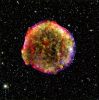
SNR-Tycho-SR-PIA11435.jpgTycho: the most colourful Supernova Remnant78 visiteThis composite image of the Tycho Supernova Remnant combines InfraRed and X-Ray observations obtained with NASA's Spitzer and Chandra space observatories, respectively, and the Calar Alto observatory, Spain.
It shows the scene more than four centuries after the brilliant star explosion witnessed by Tycho Brahe and other astronomers of that era.
The explosion has left a blazing hot cloud of expanding debris (green and yellow). The location of the blast's outer shock wave can be seen as a blue sphere of ultra-energetic electrons. Newly synthesized dust in the ejected material and heated pre-existing dust from the area around the supernova radiate at infrared wavelengths of 24 microns (red).
Foreground and background stars in the image are white.MareKromiumDic 09, 2008
|
|
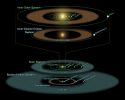
Epsilon_Eridani-PIA11376.JPGSolar Systems63 visiteThis artist's diagram compares the Epsilon Eridani System to our own Solar System. The two systems are structured similarly, and both host asteroids (brown), comets (blue) and planets (white dots).
Epsilon Eridani is our closest known planetary system, located about 10 LY away in the constellation Eridanus. Its central star is a younger, fainter version of our Sun, and is about 800 million years old — about the same age of our Solar System when life first took root on Earth.
Observations from NASA's Spitzer Space Telescope show that the System hosts two Asteroid Belts, in addition to previously identified candidate planets and an Outer Comet Ring.
Epsilon Eridani's inner Asteroid Belt is located at about the same position as ours, approximately 3 AU from its star (aone AU is the distance between Earth and Sun). The system's second, denser Belt lies at about the same place where Uranus orbits in our Solar System, or 20 AU from the star.
In the same way that Jupiter lies just outside our Asteroid Belt, shepherding its rocky debris into a ring, Epsilon Eridani is thought to have planets orbiting near the rims of its two Belts. The first of these planets was identified in 2000 via the Radial Velocity Technique.
Called "Epsilon Eridani b", it orbits at an average distance of 3,4 AU — placing it just outside the System's inner Asteroid Belt.
The second planet orbiting near the rim of the outer Asteroid Belt at 20 AU was inferred when Spitzer discovered the belt.
A third planet might orbit in Epsilon Eridani at the inner edge of its outermost Comet Ring, which lies between 35 and 90 AU. This planet was first hinted at in 1998 due to observed lumpiness in the Comet Ring.
The outer Comet Ring around Epsilon Eridani is denser than our Comet Ring, called Kuiper Belt, because the system is younger.
Over time, Epsilon Eridani's ring will become wispier like the Kuiper Belt. Its comets will collide with each other and break up, or get pushed out of the ring by the gravitational influences of the planets. MareKromiumNov 30, 2008
|
|

PIA11417.jpgQuartz-like Crystals found in Planetary Disks62 visiteNASA's Spitzer Space Telescope has, for the first time, detected tiny quartz-like crystals sprinkled in young planetary systems. The crystals, which are types of silica minerals called Cristobalite and Tridymite, can be seen close-up in the black-and-white insets (Cristobalite is on the left, and Tridymite on the right). The main picture is an artist's concept of a young star and its swirling disk of planet-forming materials.
Cristobalite and Tridymite are thought to be two of many planet ingredients. On Earth, they are normally found as tiny crystals in volcanic lava flows and meteorites from space. These minerals are both related to quartz. For example, if you were to heat the familiar quartz crystals often sold as mystical tokens, the quartz would transform into Cristobalite and Tridymite.
Because Cristobalite and Tridymite require rapid heating and cooling to form, astronomers say they were most likely generated by shock waves traveling through the planetary disks.
The insets are Scanning Electron Microscope pictures courtesy of George Rossman of the California Institute of Technology, Pasadena, Calif.MareKromiumNov 23, 2008
|
|
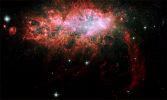
NGC-1569.jpgStarburst Galaxy NGC 156962 visiteThis image taken by NASA's Hubble Space Telescope showcases the brilliant core of one of the most active galaxies in our local neighborhood. The entire core is 5,000 light-years wide.
The galaxy, called NGC 1569, sparkles with the light from millions of newly formed young stars. NGC 1569 is pumping out stars at a rate that is 100 times faster than the rate observed in our Milky Way Galaxy. This frenzied pace has been almost continuous for the past 100 million years.
The core's centerpiece is a grouping of three giant star clusters, each containing more than a million stars. (Two of the clusters are so close they appear as one grouping.) The clusters reside in a large, central cavity. The gas in the cavity has been blown out by the multitude of massive, young stars that already exploded as supernovae. These explosions also triggered a violent flow of gas and particles that is sculpting giant gaseous structures. The sculpted structure at lower right is about 3,700 light-years long.
Huge bubbles of gas, such as the two at left, appear like floating islands. The largest bubble is about 378 light-years wide and the smallest 119 light-years wide. They are being illuminated by the radiation from the bright, young stars within them. Some of those stars are peaking through their gaseous cocoons.
The biggest and brightest objects surrounding the core are stars scattered throughout our Milky Way Galaxy. In contrast, the thousands of tiny white dots in the image are stars in the halo of NGC 1569. The galaxy is 11 million light-years from Earth.
A new analysis of NGC 1569 shows that it is one and a half times farther from Earth than astronomers previously thought. The extra distance places the galaxy in the middle of a group of about 10 galaxies centered on the spiral galaxy IC 342. Gravitational interactions among the group's galaxies may be compressing gas in NGC 1569 and igniting the star-birthing frenzy.
MareKromiumNov 21, 2008
|
|
| 157 immagini su 14 pagina(e) |
|
|
4 | |
|
|
|
|
|
|
|
|
|





