| |

| Ultimi arrivi - The Universe in Super Definition |
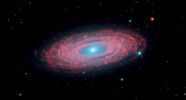
NGC-2841-PIA12001.jpgNGC 2841 - Spiral Galaxy63 visiteThis image from NASA's Spitzer Space Telescope shows the Spiral Galaxy NGC 2841, located about 46 MLY from Earth in the constellation Ursa Major. The galaxy is helping astronomers solve one of the oldest puzzles in astronomy: Why do galaxies look so smooth, with stars sprinkled evenly throughout?
An international team of astronomers has discovered that rivers of young stars flow from their hot, dense stellar nurseries, dispersing out to form large, smooth distributions.
This image is a composite of three different wavelengths from Spitzer's InfraRed Array Camera. The shortest wavelengths are displayed in blue, and mostly show the older stars in NGC 2841, as well as foreground stars in our own Milky Way galaxy. The cooler areas are highlighted in red, and show the dusty, gaseous regions of the galaxy.
Blue shows InfraRed Light of 3,6 microns, green represents 4,5-micron light and red, 8,0-micron light. The contribution from starlight measured at 3,6 microns has been subtracted from the 8,0-micron data to enhance the visibility of the dust features. The shortest wavelengths are displayed in blue, and mostly show the older stars in NGC 2841, as well as foreground stars in our own Milky Way Galaxy.MareKromiumMag 24, 2009
|
|

K4-55-HST.jpgK4-55 Planetary Nebula63 visiteThe Hubble Community bids farewell to the soon-to-be decommissioned Wide Field Planetary Camera 2 (WFPC2) onboard the Hubble Space Telescope.
In tribute to Hubble's longest-running optical camera, Planetary Nebula K 4-55 has been imaged as WFPC2's final "pretty picture".MareKromiumMag 13, 2009
|
|

Cepheid-HST-2009-08-a-print.jpgRefined Hubble Constant narrows possible explanations for Dark Energy80 visiteWhatever Dark Energy is, explanations for it have less wiggle room following a Hubble Space Telescope observation that has refined the measurement of the Universe's present Expansion Rate to a precision where the error is smaller than 5%. The new value for the Expansion Rate, known as the "Hubble Constant", or "H0" (after Edwin Hubble who first measured the expansion of the universe nearly a century ago), is 74,2 Km-per-second-per-megaparsec (with an error margin of ± 3,6).
The results agree closely with an earlier measurement gleaned from Hubble of 72 ± 8 km/sec/megaparsec, but are now more than twice as precise.
The Hubble measurement, conducted by the SHOES (Supernova H0 for the Equation of State) Team and led by Adam Riess, of the Space Telescope Science Institute and the Johns Hopkins University, uses a number of refinements to streamline and strengthen the construction of a cosmic "Distance Ladder", a Billion LY in length, that astronomers use to determine the Universe's Expansion Rate.
Hubble observations of pulsating stars called "Cepheid Variables" in a nearby cosmic mile marker, the galaxy NGC 4258, and in the host galaxies of recent supernovae, directly link these distance indicators. The use of Hubble to bridge these rungs in the ladder eliminated the systematic errors that are almost unavoidably introduced by comparing measurements from different telescopes.
Riess explains the new technique: "It's like measuring a building with a long tape measure instead of moving a yard stick end over end. You avoid compounding the little errors you make every time you move the yardstick. The higher the building, the greater the error".
Lucas Macri, professor of physics and astronomy at Texas A&M, and a significant contributor to the results, said, "Cepheids are the backbone of the distance ladder because their pulsation periods, which are easily observed, correlate directly with their luminosities. Another refinement of our ladder is the fact that we have observed the Cepheids in the Near-InfraRed parts of the electromagnetic spectrum where these variable stars are better distance indicators than at optical wavelengths."
This new, more precise value of the Hubble Constant was used to test and constrain the properties of Dark Energy, the form of energy that produces a repulsive force in space, which is causing the expansion rate of the Universe to accelerate.
By bracketing the expansion history of the universe between today and when the universe was only approx. 380.000 years old, the astronomers were able to place limits on the nature of the Dark Energy that is causing the expansion to speed up.
(The measurement for the far, early universe is derived from fluctuations in the Cosmic Microwave Background (---> Radiazione di Fondo), as resolved by NASA's Wilkinson Microwave Anisotropy Probe, WMAP, in 2003.)
Their result is consistent with the simplest interpretation of Dark Energy: that it is mathematically equivalent to Albert Einstein's hypothesized Cosmological Constant, introduced a century ago to push on the fabric of space and prevent the Universe from collapsing under the pull of gravity. (Einstein, however, removed the Constant once the expansion of the universe was discovered by Edwin Hubble.)
"If you put in a box all the ways that Dark Energy might differ from the Cosmological Constant, that box would now be 3 times smaller", says Riess. "That's progress, but we still have a long way to go to pin down the nature of Dark Energy".
Though the cosmological constant was conceived of long ago, observational evidence for Dark Energy didn't come along until 11 years ago, when two studies, one led by Riess and Brian Schmidt of Mount Stromlo Observatory, and the other by Saul Perlmutter of Lawrence Berkeley National Laboratory, discovered Dark Energy independently, in part with Hubble observations. Since then astronomers have been pursuing observations to better characterize Dark Energy.
Riess's approach to narrowing alternative explanations for Dark Energy — whether it is a static Cosmological Constant or a dynamical field (like the repulsive force that drove inflation after the Big Bang) — is to further refine measurements of the Universe's expansion history.
Before Hubble was launched in 1990, the estimates of the Hubble Constant varied by a factor of two. In the late 1990s the Hubble Space Telescope Key Project on the Extragalactic Distance Scale refined the value of the Hubble constant to an error of only about 10%. This was accomplished by observing Cepheid variables at optical wavelengths out to greater distances than obtained previously and comparing those to similar measurements from ground-based telescopes.
The SHOES team used Hubble's Near Infrared Camera and Multi-Object Spectrometer (NICMOS) and the Advanced Camera for Surveys (ACS) to observe 240 Cepheid variable stars across 7 galaxies. One of these galaxies was NGC 4258, whose distance was very accurately determined through observations with radio telescopes. The other 6 galaxies recently hosted Type Ia Supernovae that are reliable distance indicators for even farther measurements in the Universe.
Type Ia Supernovae all explode with nearly the same amount of energy and therefore have almost the same intrinsic brightness.
By observing Cepheids with very similar properties at Near-InfraRed wavelengths in all 7 galaxies and using the same telescope and instrument, the team was able to more precisely calibrate the luminosity of Supernovae.
With Hubble's powerful capabilities, the team was able to sidestep some of the shakiest rungs along the previous Distance Ladder involving uncertainties in the behavior of Cepheids. Riess would eventually like to see the Hubble constant refined to a value with an error of no more than 1%, to put even tighter constraints on solutions to Dark Energy.MareKromiumMag 10, 2009
|
|

From_HST-2009-19-a-print.jpgStarbursts in Dwarf Galaxies are a Global Affair63 visiteBursts of star making in a galaxy have been compared to a Fourth of July fireworks display: They occur at a fast and furious pace, lighting up a region for a short time before winking out.
But these fleeting starbursts are only pieces of the story, astronomers say. An analysis of archival images of small, or dwarf, galaxies taken by NASA's Hubble Space Telescope suggests that starbursts, intense regions of star formation, sweep across the whole galaxy and last 100 times longer than astronomers thought. The longer duration may affect how dwarf galaxies change over time, and therefore may shed light on galaxy evolution.
"Our analysis shows that starburst activity in a dwarf galaxy happens on a global scale", explains Kristen McQuinn of the University of Minnesota in Minneapolis and leader of the study. "There are pockets of intense star formation that propagate throughout the galaxy, like a string of firecrackers going off". According to McQuinn, the duration of all the starburst events in a single dwarf galaxy would total 200 to 400 MYs.
These longer timescales are vastly more than the 5 to 10 MYs proposed by astronomers who have studied star formation in dwarf galaxies. "They were only looking at individual clusters and not the whole galaxy, so they assumed starbursts in galaxies lasted for a short time".
Dwarf galaxies are considered by many astronomers to be the building blocks of the large galaxies seen today, so the length of starbursts is important for understanding how galaxies evolve.
"Astronomers are really interested to find out the steps of galaxy evolution", McQuinn says. "Exploring these smaller galaxies is important because, according to popular theory, large galaxies are created from the merger of smaller, dwarf galaxies. So understanding these smaller pieces is an important part of filling in that scenario".
McQuinn's team analyzed archival Advanced Camera for Surveys data of three dwarf galaxies, NGC 4163, NGC 4068 and IC 4662. Their distances range from 8 to 14 MLYs away. The trio is part of a survey of starbursts in 18 nearby dwarf galaxies. Hubble's superb resolution allowed McQuinn's team to pick out individual stars in the galaxies and measure their brightness and color, two important characteristics astronomers use to determine stellar ages.
By determining the ages of the stars, the astronomers could reconstruct the starburst history in each galaxy.
Two of the galaxies, NGC 4068 and IC 4662, show active, brilliant starburst regions in the Hubble images. The most recent starburst in the third galaxy, NGC 4163, occurred 200 MYs ago and has faded from view. The team looked at regions of high and low densities of stars, piecing together a picture of the starbursts. The galaxies were making a few stars, when something, perhaps an encounter with another galaxy, pushed them into high star-making mode. Instead of forming eight stars every thousand years, the galaxies started making 40 stars every thousand years, which is a lot for a small galaxy, McQuinn says. The typical dwarf is 10 to 30.000 LYs wide. By comparison, a normal-sized galaxy such as our Milky Way is about 100.000 LYs wide.
About 300 to 400 MYs ago star formation occurred in the outer areas of the galaxies. Then it began migrating inward as explosions of massive stars triggered new star formation in adjoining regions. Starbursts are still occurring in the inner parts of NGC 4068 and IC 4662.
The total duration of starburst activity depends on many factors, including the amount of gas in a galaxy, the distribution and density of the gas, and the event that triggered the starburst. A merger or an interaction with a large galaxy, for example, could create a longer starburst event than an interaction with a smaller system.
McQuinn plans to expand her study to a larger sample of more than 20 galaxies. "Studying nearby dwarf galaxies, where we can see the stars in great detail, will help us interpret observations of galaxies in the distant universe, where starbursts were much more common because galaxies had more gas with which to make stars".
McQuinn's results appeared in the April 10 issue of The Astrophysical Journal.MareKromiumMag 02, 2009
|
|

Sharpless308-Goldman.jpgSharpless 30863 visiteCaption NASA:"Blown by fast winds from a hot, massive star, this cosmic bubble is huge. Cataloged as Sharpless 308 it lies some 5200 LY away in the constellation Canis Major and covers over 2/3° on the sky (compared with 0,5° for the Full Moon). That corresponds to a diameter of 60 LY at its estimated distance. The massive star itself, a Wolf-Rayet Star, is the bright blue one near the center of the Nebula.
Wolf-Rayet Stars have over 20 times the mass of the Sun and are thought to be in a brief, pre-supernova phase of massive star evolution. Fast winds from this Wolf-Rayet Star create the bubble-shaped nebula as they sweep up slower moving material from an earlier phase of evolution.
The windblown nebula has an age of about 70.000 years. Relatively faint emission captured in the expansive image is dominated by the glow of Ionized Oxygen atoms mapped to bluish hues".MareKromiumApr 23, 2009
|
|

ARP194-HST-2009-18-a-full_jpg.jpgArp 194 (Galaxy Cluster)65 visiteTo commemorate the Hubble Space Telescope's 19 years of historic, trailblazing science, the orbiting telescope has photographed a peculiar system of galaxies known as Arp 194. This interacting group contains several galaxies, along with a "cosmic fountain" of stars, gas, and dust that stretches over 100.000 LY.
The Northern (upper) component of Arp 194 appears as a haphazard collection of dusty spiral arms, bright blue star-forming regions, and at least two Galaxy Nuclei that appear to be connected and in the early stages of merging. A third, relatively normal, spiral galaxy appears off to the right.
The Southern (lower) component of the galaxy group contains a single large spiral galaxy with its own blue star-forming regions.
However, the most striking feature of this galaxy troupe is the impressive blue stream of material extending from the Northern Component. This "fountain" contains complexes of "Super Star Clusters", each one of which may contain dozens of individual young Star Clusters. The blue color is produced by the hot, massive stars which dominate the light in each cluster. Overall, the "fountain" contains many millions of stars.
These young star clusters probably formed as a result of the interactions between the galaxies in the Northern Component of Arp 194. The compression of gas involved in galaxy interactions can enhance the star-formation rate and give rise to brilliant bursts of star formation in merging systems.
Hubble's resolution shows clearly that the stream of material lies in front of the southern component of Arp 194, as evidenced by the dust that is silhouetted around the star-cluster complexes. It is therefore not entirely clear whether the southern component actually interacts with the northern pair.
The details of the interactions among the multiple galaxies that make up Arp 194 are complex. The shapes of all the galaxies involved appear to have been distorted, possibly by their gravitational interactions with one another.
Arp 194, located in the constellation Cepheus, resides approximately 600 MLY away from Earth. It contains some of the many interacting and merging galaxies known in our relatively nearby universe. These observations were taken in January of 2009 with the Wide Field Planetary Camera 2. Images taken through blue, green, and red filters were combined to form this picturesque image of galaxy interaction.MareKromiumApr 22, 2009
|
|
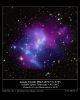
MACS-J0717_5+3745-hs-2009-17-a-print.jpgMACS J0717.5+3745 (Galaxy Cluster)63 visiteThis composite image shows the massive Galaxy Cluster MACS J0717.5+3745 (MACS J0717, for short), where four separate Galaxy Clusters have been involved in a collision — the first time such a phenomenon has been documented. Hot gas is shown in an image from NASA's Chandra X-ray Observatory, and galaxies are shown in an optical image from NASA's Hubble Space Telescope.
The hot gas is color-coded to show temperature, where the coolest gas is reddish purple, the hottest gas is blue, and the temperatures in between are purple.
The repeated collisions in MACS J0717 are caused by a 13 MLY-long stream of galaxies, gas, and dark matter — known as a "Filament" — pouring into a region already full of matter. A collision between the gas in two or more clusters causes the hot gas to flow down. However, the massive and compact galaxies do not slow down as much as the gas does, and so move ahead of it. Therefore, the speed and direction of each cluster's motion — perpendicular to the line of sight — can be estimated by studying the offset between the average position of the galaxies and the peak in the hot gas.
MACS J0717 is located about 5,4 BLY from Earth. It is one of the most complex Galaxy Clusters ever seen. Other well-known Clusters, like the Bullet Cluster and MACS J0025.4-1222, involve the collision of only two galaxy clusters and show much simpler geometry.MareKromiumApr 22, 2009
|
|

M-087-HST-2009-03-a-print.jpgHubble witnesses spectacular flaring in Gas Jet from M 87's Black Hole65 visiteA flare-up in a jet of matter blasting from a monster Black Hole is giving astronomers an incredible light show.
The outburst is coming from a blob of matter, called HST-1, embedded in the jet, a powerful narrow beam of hot gas produced by a supermassive Black Hole residing in the core of the giant elliptical galaxy M 87. HST-1 is so bright that it is outshining even M 87's brilliant core, whose monster black hole is one of the most massive yet discovered.
The glowing gas clump has taken astronomers on a rollercoaster ride of suspense.
Astronomers watched HST-1 brighten steadily for several years, then fade, and then brighten again. They say it's hard to predict what will happen next. NASA's Hubble Space Telescope has been following the surprising activity for seven years, providing the most detailed UltraViolet-Light view of the event.
Other telescopes have been monitoring HST-1 in other wavelengths, including radio and X-rays. The Chandra X-ray Observatory was the first to report the brightening in 2000. HST-1 was first discovered and named by Hubble astronomers in 1999. The gas knot is 214 LY from the galaxy's core.
The flare-up may provide insights into the variability of black hole jets in distant galaxies, which are difficult to study because they are too far away.
M 87 is located 54 MLY away in the Virgo Cluster, a region of the nearby universe with the highest density of galaxies.
"I did not expect the jet in M 87 or any other jet powered by accretion onto a Black Hole to increase in brightness in the way that this jet does," says astronomer Juan Madrid of McMaster University in Hamilton, Ontario, who conducted the Hubble study. "It grew 90 times brighter than normal. But the question is, does this happen to every single jet or active nucleus, or are we seeing some odd behavior from M 87?" Hubble gives astronomers a unique Near-UltraViolet view of the flare that cannot be accomplished with ground-based telescopes. "Hubble's sharp vision allows it to resolve HST-1 and separate it from the black hole," Madrid explains.
Despite the many observations by Hubble and other telescopes, astronomers are not sure what is causing the brightening. One of the simplest explanations is that the jet is hitting a dust lane or gas cloud and then glows due to the collision.
Another possibility is that the jet's magnetic field lines are squeezed together, unleashing a large amount of energy.
This phenomenon is similar to how solar flares develop on the Sun and is even a mechanism for creating Earth's auroras.
The disk around a rapidly spinning Black Hole has Magnetic Field lines that entrap ionized gas falling toward the Black Hole. These particles, along with radiation, flow rapidly away from the black hole along the Magnetic Field Lines. The rotational energy of the spinning accretion disk adds momentum to the outflowing jet.
Madrid assembled seven years' worth of Hubble archival images of the jet to capture changes in the HST-1's behavior over time. Hubble's view of the event. Some of the images came from observing programs that studied the galaxy, but not the jet.
He found data from the Space Telescope Imaging Spectrograph (STIS) that showed a noticeable brightening between 1999 and 2001.
In images from 2002 to 2005, HST-1 continued to rise steadily in brightness. In 2003 the jet knot was more brilliant than M 87's luminous core. In May 2005 HST-1 became 90 times brighter than it was in 1999. After May 2005 the flare began to fade, but it intensified again in November 2006. This second outburst was fainter than the first one.
"By watching the outburst over several years, I was able to follow the brightness and see the evolution of the flare over time," Madrid says. "We are lucky to have telescopes like Hubble and Chandra, because without them we would see the increase in brightness in the core of M 87, but we would not know where it was coming from."
Madrid hopes that future observations of HST-1 will reveal the cause of the mysterious activity. "We hope the observations will yield some theories that will give us some good explanations as to the mechanism that is causing the flaring," Madrid says. "Astronomers would like to know if this is an intrinsic instability of the jet when it plows its way out of the galaxy, or if it is something else."
The study's results are published in the April 2009 issue of the Astronomical Journal.MareKromiumApr 16, 2009
|
|

HR8799b.jpgExoplanet HR8799b65 visiteA powerful, newly refined image-processing technique may allow astronomers to discover extrasolar planets that are possibly lurking in over a decade's worth of Hubble Space Telescope archival data.
David Lafreniere of the University of Toronto, Ontario, Canada, has successfully demonstrated this new strategy for planet hunting by identifying an exoplanet that went undetected in Hubble images taken in 1998 with its Near Infrared Camera and Multi-Object Spectrometer (NICMOS). In addition to illustrating the power of new data-processing techniques, this finding underscores the value of the Hubble data archive, on which those new techniques can be used.
The planet, estimated to be at least seven times Jupiter's mass, was originally discovered in images taken with the Keck and Gemini North telescopes in 2007 and 2008. It is the outermost of three massive planets known to orbit the dusty young star HR 8799, which is 130 light-years away. NICMOS could not see the other two planets because its coronagraphic spot — a device which blots out the glare of the star — also interferes with observing the two inner planets.
"We've shown that NICMOS is more powerful than previously thought for imaging planets," says Lafreniere. "Our new image-processing technique efficiently subtracts the glare from a star that spills over the coronagraph's edge, allowing us to see planets that are one-tenth the brightness of what could be detected before with Hubble." Lafreniere adapted an image reconstruction technique that was first developed for ground-based observatories.
Using the new technique, he recovered the planet in NICMOS observations taken 10 years before the Keck/Gemini discovery. The Hubble picture not only provides important confirmation of the planet's existence, it provides a longer baseline for demonstrating that the object is in an orbit about the star. "To get a good determination of the orbit we have to wait a very long time because the planet is moving so slowly (it has a 400-year period)," says Lafreniere. "The 10-year-old Hubble data take us that much closer to having a precise measure of the orbit."
NICMOS's view provided new insights into the physical characteristics of the planet, too. This was possible because NICMOS works at near-infrared wavelengths that are severely blocked by Earth's atmosphere due to absorption by water vapor.
"The planet seems to be only partially cloud covered and we could be detecting the absorption of water vapor in the atmosphere," says Travis Barman of Lowell Observatory, Flagstaff, Ariz. "The infrared light measured from the Hubble data is consistent with a spectrum showing a broad water absorption feature (at 1.4-1.49 microns), but the level of absorption seen is lower than it would be if the photosphere were completely devoid of dust. Dust clouds can smooth out many of the spectral features that would otherwise be there—including water absorption bands," Barman says. "Measuring the water absorption properties will tell us a great deal about the temperatures and pressures in the atmospheres, in addition to the cloud coverage. If we can accurately measure the water absorption features for the outermost planet around HR 8799, we will learn a great deal about their atmospheric properties. Hubble, situated well above the Earth's atmosphere, is excellently located for such a study."
"During the past 10 years Hubble has been used to look at over 200 stars with coronagraphy, looking for planets and disks. We plan to go back and look at all of those archived images and see if anything can be detected that has gone undetected until now," says Christian Marois of the Herzberg Institute of Astrophysics, Victoria, Canada. "We'll need a baseline of a few years for most objects to detect Keplerian motion and hence confirm their status as planets. The hardest part is to find them in the first place."
If his team sees a companion object to a star in more than one NICMOS picture, and it appears to have moved along an orbit, follow-up observations will be made with ground-based telescopes. If they see something once but its brightness and separation from the star would be reasonable for a planet, they will also do follow-up observations with ground-based telescopes.
Taking the image of an exoplanet is not an easy task. Planets can be billions of times fainter than the star around which they orbit and are typically located at separations smaller than 1/2000th the angular size of the full moon from their star. The planet recovered in the NICMOS data is about 100,000 times fainter than the star when viewed in the near-infrared.
"Even when using the best telescopes available, with the best resolution, the light from the bright star spills out in the area where the much fainter planets are located, making them impossible to see. It is essential to subtract out this bright glare of stellar light from the image to see faint dots, i.e., planets, that could be hidden underneath," says Rene Doyon of the University of Montreal.
The stability of how light is scattered in the NICMOS camera, called the point spread function (PSF), is key for using Hubble images to recover planets. This technique works by taking images of different stars and combining them to create a PSF of a star that closely resembles the star that is being studied for planets. This requires a reasonably steady PSF because images of different stars are taken on different days. Atmospheric conditions would vary from day-to-day for ground-based telescopes, but not for a space telescope that enjoys unprecedented image stability over repeated visits to a target.
MareKromiumApr 08, 2009
|
|

M-033-PIA11969.jpgM 33 - Spiral Galaxy (3-color composite)62 visiteOne of our closest galactic neighbors shows its awesome beauty in this new image from NASA's Spitzer Space Telescope. M 33, also known as the "Triangulum Galaxy", is a member of what's known as our Local Group of galaxies.
Along with our own Milky Way, this group travels together in the universe, as they are gravitationally bound. In fact, M 33 is one of the few galaxies that is moving toward the Milky Way despite the fact that space itself is expanding, causing most galaxies in the universe to grow farther and farther apart.
When viewed with Spitzer's InfraRed eyes, this elegant spiral galaxy sparkles with color and detail. Stars appear as glistening blue gems (several of which are actually foreground stars in our own galaxy), while dust rich in organic molecules glows green. The diffuse orange-red glowing areas indicate star-forming regions, while small red flecks outside the spiral disk of M 33 are most likely distant background galaxies. But not only is this new image beautiful, it also shows M 33 to be surprising large — bigger than its Visible-Light appearance would suggest.
With its ability to detect cold, dark dust, Spitzer can see emission from cooler material well beyond the visible range of M 33's disk. Exactly how this cold material moved outward from the galaxy is still a mystery, but winds from giant stars or supernovas may be responsible.
M 33 is located about 2,9 MLY away in the constellation Triangulum. This is a three-color composite image showing InfraRed observations from two of Spitzer instruments. Blue represents combined 3.6- and 4.5-micron light and green shows light of 8 microns, both captured by Spitzer's IRAC.
Red is 24-micron light detected by Spitzer's Multiband Imaging Photometer.MareKromiumApr 06, 2009
|
|

M-033-PIA11970.jpgM 33 - Spiral Galaxy62 visiteOne of our closest galactic neighbors shows its awesome beauty in this new image from NASA's Spitzer Space Telescope.
M 33, also known as the "Triangulum Galaxy", is a member of what's known as our Local Group of galaxies. Along with our own Milky Way, this group travels together in the universe, as they are gravitationally bound.
In fact, M 33 is one of the few galaxies that is moving toward the Milky Way despite the fact that space itself is expanding, causing most galaxies in the universe to grow farther and farther apart.
When viewed with Spitzer's InfraRed eyes, this elegant spiral galaxy sparkles with color and detail. Stars appear as glistening blue gems (many of which are actually foreground stars in our own galaxy), while dust in the spiral disk of the galaxy glows pink and red. But not only is this new image beautiful, it also shows M 33 to be surprising large —bigger than its Visible-Light appearance would suggest.
With its ability to detect cold, dark dust, Spitzer can see emission from cooler material well beyond the visible range of M 33's disk. Exactly how this cold material moved outward from the galaxy is still a mystery, but winds from giant stars or supernovas may be responsible.
M 33 is located about 2,9 MLY away in the constellation Triangulum. This composite image was taken by Spitzer's InfraRed Array Camera (a.k.a.: IRAC). The color blue indicates InfraRed Light of 3.6 microns, green shows 4.5-micron light, and red 8.0 microns.MareKromiumApr 06, 2009
|
|
NGC-3242-PIA11968.jpgThe Extended Region around the Planetary Nebula NGC 324262 visiteThe unfortunate name of Planetary Nebula for this class of Celestial Objects is a historical legacy credited to William Herschel during the 18th Century — a time when telescopes where small and objects like these, at least the central region, looked very similar to gas-giant planets such as Saturn and Jupiter. In fact, NGC 3242 has no relation to Jupiter or any other planet.
Telescopes and their detectors have dramatically improved over the past few centuries. Our understanding of what Planetary Nebulae truly are has improved accordingly.
When stars with a mass similar to our Sun approach the end of their lives by exhausting supplies of Hydrogen and Helium fuel in their cores, they swell up into cool red-giant stars. In a last gasp before death, they expel the layers of gas in their Outer Atmosphere. This exposes the core of the dying star, a dense hot ball of Carbon and Oxygen called a "White Dwarf".
The White Dwarf is so hot that it shines very brightly in the UltraViolet Spectrum. The UltraViolet Light from the White Dwarf, in turn, ionizes the gaseous material expelled by the star causing it to glow. A Planetary Nebula is really the death of a low-mass star.
Although low-mass stars like our Sun live for billions of years, Planetary Nebulae only last for about ten thousand years. As the central white dwarf quickly cools and the UltraViolet Light dwindles, the surrounding gas also cools and fades.
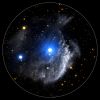
In this image of NGC 3242 from the Galaxy Evolution Explorer, the Extended Region around the Planetary Nebula is shown in dramatic detail. The small circular white and blue area at the center of the image is the well-known portion of the famous Planetary Nebula. The precise origin and composition of the extended wispy white features is not known for certain. It is most likely material ejected during the star's red-giant phase before the White Dwarf was exposed.
However, it may be possible that the extended material is simply interstellar gas that, by coincidence, is located close enough to the White Dwarf to be energized by it, and induced to glow with UltraViolet Light.
NGC 3242 is located 1400 to 2500 Light-Years away in the constellation of Hydra. It was discovered by William Herschel in 1785.MareKromiumApr 05, 2009
|
|
| 157 immagini su 14 pagina(e) |
|
3 | |
|
|
|
|
|
|
|
|
|
|





