| |

| Ultimi arrivi - The Universe in Super Definition |

NGC-2976.jpgNGC 2976 - Galaxy or "Galactic Star-Factory"?63 visiteGalaxies throughout the Universe are ablaze with star birth. But for a nearby, small spiral galaxy, the star-making party is almost over. Astronomers were surprised to find that star-formation activities in the outer regions of NGC 2976 have been virtually asleep because they shut down millions of years ago. The celebration is confined to a few die-hard partygoers huddled in the galaxy's inner region.
The explanation, astronomers say, is that a raucous interaction with the neighboring M 81 group of galaxies ignited star birth in NGC 2976.
Now the star-making fun is beginning to end. Images from NASA's Hubble Space Telescope show that star formation in the galaxy began fizzling out in its outskirts about 500 MY ago as some of the gas was stripped away and the rest collapsed toward the center. With no gas left to fuel the party, more and more regions of the galaxy are taking a much-needed nap. The star-making region is now confined to about 5000 LY around the core.
NGC 2976 does not look like a typical Spiral Galaxy, as this Hubble image shows. In this view of the oddball galaxy's inner region, there are no obvious spiral arms. Dusty filaments running through the disk show no clear spiral structure. Although the gas is centrally concentrated, the galaxy does not have a central bulge of stars. Astronomers pieced together the galaxy's star-formation story with the help of Hubble's sharp vision. The galaxy's relatively close distance to Earth allowed Hubble's Advanced Camera for Surveys (ACS) to resolve hundreds of thousands of individual stars. What look like grains of sand in the image are actually individual stars.
Studying the individual stars allowed astronomers to determine their color and brightness, which provided information about when they formed. The astronomers combined the Hubble results with a map, made from radio observations, showing the current distribution of hydrogen across the galaxy. By analyzing the combined data, the Hubble research team then reconstructed the star-making history for large areas of the galaxy. The Hubble observations are part of the ACS Nearby Galaxy Survey Treasury (ANGST) program. The map is part of The HI Nearby Galaxy Survey by the National Radio Astronomy Observatory's Very Large Array in New Mexico.
The blue dots are fledgling blue giant stars residing in the remaining active star-birth regions. NGC 2976 resides on the fringe of the M 81 Group of Galaxies, located about 12 MLY away in the constellation Ursa Major.MareKromiumGen 22, 2010
|
|

30-Doradus.jpg30 Doradus and R-13664 visiteThe massive, young stellar grouping, called R136, is only a few million years old and resides in the 30 Doradus Nebula, a turbulent star-birth region in the Large Magellanic Cloud (LMC), a satellite galaxy of our Milky Way. Many of the stars are among the most massive known. Several of them are over 100 times more massive than our Sun. These hefty stars are destined to become supernovae in a few million years.
The image, taken by Hubble's Wide Field Camera 3, spans about 100 light-years. The nebula is close enough to Earth that Hubble can resolve individual stars, giving astronomers important information about the stars' birth and evolution.
The brilliant stars are carving deep cavities in the surrounding material by unleashing a torrent of ultraviolet light, and hurricane-force stellar winds (streams of charged particles), which are etching away the enveloping hydrogen gas cloud in which the stars were born. The image reveals a fantasy landscape of pillars, ridges, and valleys, as well as a dark region in the center that roughly looks like the outline of a holiday tree. Besides sculpting the gaseous terrain, the brilliant stars can also help create a successive generation of offspring. When the winds hit dense walls of gas, they create shocks, which may be generating a new wave of star birth.
The movement of the LMC around the Milky Way may have triggered the massive cluster's formation in several ways. The gravitational tug of the Milky Way and the companion Small Magellanic Cloud may have compressed gas in the LMC. Also, the pressure resulting from the LMC plowing through the Milky Way's halo may have compressed gas in the satellite. The cluster is a rare, nearby example of the many super star clusters that formed in the distant, early universe, when star birth and galaxy interactions were more frequent. Previous Hubble observations have shown astronomers that super star clusters in faraway galaxies are ubiquitous. The LMC is located 170,000 light-years away and is a member of the Local Group of Galaxies, which also includes the Milky Way.
The Hubble image was taken at infrared wavelengths (1.1 microns and 1.6 microns). Hubble sees through the dusty nebula, revealing many stars that cannot be seen in visible light. The large bright star just above the center of the image is in the 30 Doradus nebula. The Hubble observations of 30 Doradus were made October 20-27, 2009.MareKromiumDic 21, 2009
|
|

30-Doradus_and_R-136.jpg30 Doradus and R-13669 visiteJust in time for the holidays: a Hubble Space Telescope picture postcard of hundreds of brilliant blue stars wreathed by warm, glowing clouds. The festive portrait is the most detailed view of the largest stellar nursery in our local galactic neighborhood. The massive, young stellar grouping, called R136, is only a few million years old and resides in the 30 Doradus Nebula, a turbulent star-birth region in the Large Magellanic Cloud (LMC), a satellite galaxy of our Milky Way. There is no known star-forming region in our galaxy as large or as prolific as 30 Doradus. Many of the diamond-like icy blue stars are among the most massive stars known. Several of them are over 100 times more massive than our Sun. These hefty stars are destined to pop off, like a string of firecrackers, as supernovas in a few million years.
The image, taken in ultraviolet, visible, and red light by Hubble's Wide Field Camera 3, spans about 100 light-years. The nebula is close enough to Earth that Hubble can resolve individual stars, giving astronomers important information about the birth and evolution of stars in the universe. The Hubble observations were taken Oct. 20-27, 2009. The blue color is light from the hottest, most massive stars; the green from the glow of oxygen; and the red from fluorescing hydrogen.MareKromiumDic 21, 2009
|
|

M-083-a.jpgHubble Wide Field Camera 3 - Image Details Star Birth in Galaxy M-8389 visiteThe spectacular new camera installed on NASA's Hubble Space Telescope during Servicing Mission 4 in May has delivered the most detailed view of star birth in the graceful, curving arms of the nearby spiral galaxy M83.
Nicknamed the Southern Pinwheel, M83 is undergoing more rapid star formation than our own Milky Way galaxy, especially in its nucleus. The sharp "eye" of the Wide Field Camera 3 (WFC3) has captured hundreds of young star clusters, ancient swarms of globular star clusters, and hundreds of thousands of individual stars, mostly blue supergiants and red supergiants.
The image, taken in August 2009, provides a close-up view of the myriad stars near the galaxy's core, the bright whitish region at far right.
WFC3's broad wavelength range, from ultraviolet to near-infrared, reveals stars at different stages of evolution, allowing astronomers to dissect the galaxy's star-formation history.
The image reveals in unprecedented detail the current rapid rate of star birth in this famous "grand design" spiral galaxy. The newest generations of stars are forming largely in clusters on the edges of the dark dust lanes, the backbone of the spiral arms. These fledgling stars, only a few million years old, are bursting out of their dusty cocoons and producing bubbles of reddish glowing hydrogen gas.
The excavated regions give a colorful "Swiss cheese" appearance to the spiral arm. Gradually, the young stars' fierce winds (streams of charged particles) blow away the gas, revealing bright blue star clusters. These stars are about 1 million to 10 million years old. The older populations of stars are not as blue.
A bar of stars, gas, and dust slicing across the core of the galaxy may be instigating most of the star birth in the galaxy's core. The bar funnels material to the galaxy's center, where the most active star formation is taking place. The brightest star clusters reside along an arc near the core.
The remains of about 60 supernova blasts, the deaths of massive stars, can be seen in the image, five times more than known previously in this region. WFC3 identified the remnants of exploded stars. By studying these remnants, astronomers can better understand the nature of the progenitor stars, which are responsible for the creation and dispersal of most of the galaxy's heavy elements.
M83, located in the Southern Hemisphere, is often compared to M51, dubbed the Whirlpool galaxy, in the Northern Hemisphere. Located 15 million light-years away in the constellation Hydra, M83 is two times closer to Earth than M51.
MareKromiumNov 08, 2009
|
|

IC-348-PIA12210.jpgCreation...140 visiteThis artist's conception shows a lump of material in a swirling, planet- forming disk. Astronomers using NASA's Spitzer Space Telescope found evidence that a companion to a star -- either another star or a planet -- could be pushing planetary material together, as illustrated here.
Planets are born out of spinning disks of gas and dust. They can carve out lanes or gaps in the disks as they grow bigger and bigger. Scientists used Spitzer's infrared vision to study the disk around a star called LRLL 31, located about 1000 LY away in the IC 348 Region of the constellation Perseus. Spitzer's new infrared observations reveal that the disk has both an inner and outer gap.
What's more, the data show that infrared light from the disk is changing over as little time as one week -- a very unusual occurrence. In particular, light of different wavelengths seesawed back and forth, with short-wavelength light going up when long-wavelength light went down, and vice versa.
According to astronomers, this change could be caused by a companion to the star (illustrated as a planet in this picture). As the companion spins around, its gravity would cause the wall of the inner disk to squeeze into a lump. This lump would also spin around the star, shadowing part of the outer disk. When the bright side of the lump is on the far side of the star, and facing Earth, more infrared light at shorter wavelengths should be observed (hotter material closer to the star emits shorter wavelengths of infrared light). In addition, the shadow of the lump should cause longer-wavelength infrared light from the outer disk to decrease. The opposite would be true when the lump is in front of the star and its bright side is hidden (shorter-wavelength light would go down, and longer- wavelength light up). This is precisely what Spitzer observed.
The size of the lump and the planet have been exaggerated to better illustrate the dynamics of the system.MareKromiumOtt 07, 2009
|
|

Blue_Star-PIA12174.jpgSpace "Cube"79 visiteThis drawing illustrates the extent to which astronomers have been underestimating the proportion of small to big stars in certain galaxies. Data from NASA's Galaxy Evolution Explorer Spacecraft and the Cerro Tololo Inter-American Observatory in Chile have shown that, in some cases, there can be as many as four times more small stars compared to large ones.
In the drawing, a massive blue star is shown next to a stack of lighter, yellow stars. These big blue stars are 3 to 20 times more massive than our Sun, while the smaller stars are typically about the same mass as the Sun or smaller.
Before the Galaxy Evolution Explorer study, astronomers assumed there were 500 small stars for every massive one (lower stack on right). The new observations reveal that, in certain galaxies, this estimation is off by a factor of four; for every massive star, there could be as many as 2000 small counterparts (such as the entire stack - the "Cube" - on the right).MareKromiumOtt 07, 2009
|
|
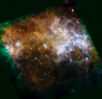
Milky_Way-PIA12251.jpgCold Region in the Milky Way62 visiteSome of the coldest and darkest dust in space shines brightly in this InfraRed image from the Herschel Observatory, a European Space Agency Mission with important participation from NASA.
The image is a composite of light captured simultaneously by two of Herschel's three instruments -- the photodetector array camera and spectrometer, and its spectral and photometric imaging receiver.
The image reveals a cold and turbulent region where material is just beginning to condense into new stars. It is located in the plane of our Milky Way galaxy, 60° from the center. Blue shows warmer material, red the coolest, while green represents intermediate temperatures.
The red filaments are made up of the coldest material pictured here -- material that is slightly warmer than the coldest temperature theoretically attainable in the Universe.
Light captured by the photodetector array camera and spectrometer is colored blue and green (blue represents 70-micron light, and green, 160 micron light). The light detected by the spectral and photometric imaging receiver is colored red (and shows the combined wavelengths of 250, 350 and 500 microns). The image spans a region 2.1 by 2.2 degrees.MareKromiumOtt 07, 2009
|
|
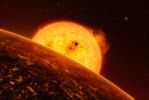
COROT7b-ESO.jpgExo-Planet CoRoT-7b68 visiteHow similar is exoplanet CoRoT-7b to Earth?
The newly discovered Extra-Solar Planet is the closest physical match yet, with a mass about five Earths and a radius of about 1,7 Earths. Also, the home star to CoRoT-7b, although 500 LY distant, is very similar to our Sun.
Unfortunately, the similarities likely end there, as CoRoT-7b orbits its home star well inside the orbit of Mercury, making its year last only 20 hours, and making its peak temperature much hotter than humans might find comfortable. CoRoT-7b was discovered in February by noting a predictable slight decrease in the brightness of its parent star.
Pictured above, an artist's depiction shows how CoRoT-7b might appear in front of its Parent Star. The composition of CoRoT-7b remains unknown, but given its size and mass, it cannot be a gas giant like Jupiter, and is very likely composed predominantly of rock. Future observations will likely narrow the composition of one of the first known rocky planets discovered outside of our Solar System.MareKromiumSet 23, 2009
|
|

DR22.jpgCygnus Region (DR22; NGC 4145 and NGC 4361)64 visiteThese images are some of the first to be taken during Spitzer's warm mission -- a new phase that began after the telescope, which operated for more than five-and-a-half years, ran out of liquid coolant. The pictures were snapped with the two InfraRed Channels that still work at Spitzer's still-quite-chilly temperature of 30 Kelvin (about - 406 degrees Fahrenheit). The two InfraRed Channels are part of Spitzer's InfraRed Array Camera: 3.6-micron light is blue and 4.5-micron light is orange.
The main image shows a cloud, known as DR22, bursting with new stars in the Cygnus Region of the sky.
Spitzer's infrared eyes can see dust, and see through dust, giving it a unique view into star-forming nests. The blue areas are dusty clouds, and the orange is mainly hot gas.MareKromiumSet 13, 2009
|
|

Galactic_Center-PIA12074.jpgNewborn Stars found near the Galactic Centre64 visiteThis InfraRed image from NASA's Spitzer Space Telescope shows 3 "baby stars" in the bustling center of our Milky Way galaxy.
The three stars are the first to be discovered in the region — previous attempts to find them were unsuccessful because there is so much dust standing between us and our galaxy's core.
Spitzer was able to find the newborn stars with its sharp InfraRed eyes, which can cut through dust.
The center of our galaxy is a hectic place. It's stuffed with stars, gas and dust. Astronomers have long wondered how stars can form in such chaotic circumstances. While they have known that stars are born there, they weren't able to see the stars forming until now. Astronomers plan to search for more newborn stars in the region, and ultimately learn more about stellar births at the center of the Milky Way.MareKromiumLug 02, 2009
|
|

VB10-b-PIA12014.jpgThe VB10 Star System and the Solar System63 visiteThis artist's diagram compares our Solar System (below) to the VB 10 Star System. Astronomers successfully used the astrometry planet-hunting method for the first time to discover a gas planet, called VB 10b, around a very tiny star, VB 10. All of the bodies in this diagram are shown in circular insets at the same relative scales.
The VB 10 star is one of the smallest known — and holds the record for the smallest known to host a planet. It's a dim, red M-dwarf with only one-tenth the size, and one-twelfth the mass, of our sun. Its planet, on the other hand, is quite hefty, with six times the mass of Jupiter. Though the planet is less massive than the star, the two orbs would be about the same size.
The VB 10 Star System is essentially a shrunken version of our Solar System. Even though its planet is at a similar distance from its star as Mercury is from our Sun, it wouldn't receive as much heat and would be classified as a "cold Jupiter" similar to our own. If any rocky planets do orbit in the VB 10 System, they would be located even closer in than VB 10b, and could lie within the star's "Habitable Zone" — a region where temperatures are right for water to be liquid.
Astrometry involves measuring the wobble of a star on the sky, caused by an unseen planet yanking it back and forth. Because the VB 10b Planet is so big relative to its star, it really tugs the star around. The red circle seen at the center of the VB 10 system shows just how big this wobble is. Because our sun is more massive than VB 10, its planets do not cause it to wobble nearly as much.MareKromiumGiu 01, 2009
|
|
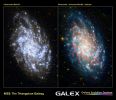
M-033-a.jpgM 33 - The "Triangulum" Spiral Galaxy (a.k.a. NGC 598)61 visiteNASA's Galaxy Evolution Explorer Mission celebrates its sixth anniversary studying galaxies beyond our Milky Way through its sensitive UltraViolet telescope, the only such far-UltraViolet detector in space.
The mission studies the shape, brightness, size and distance of distant galaxies across 10 BY of cosmic history, giving scientists a wealth of data to help us better understand the origins of the universe. One such object is pictured here, the galaxy NGC 598, more commonly known as M 33.
The image shows a map of the recent star formation history of M 33. The bright blue and white areas are where star formation has been extremely active over the past few million years. The patches of yellow and gold are regions where star formation was more active 100 MY ago.
In addition, the UltraViolet image shows the most massive young stars in M 33. These stars burn their large supply of Hydrogen fuel quickly, burning hot and bright while emitting most of their energy at UV wavelengths. Compared with low-mass stars like our Sun, which live for billions of years, these massive stars never reach old age, having a lifespan as short as a few million years.
The California Institute of Technology, in Pasadena, Calif., leads the Galaxy Evolution Explorer Mission and is responsible for science operations and data analysis. NASA's Jet Propulsion Laboratory, also in Pasadena, manages the mission and built the science instrument. The mission was developed under NASA's Explorers Program managed by the Goddard Space Flight Center, Greenbelt, Md. South Korea and France are the mission's international partners.MareKromiumMag 24, 2009
|
|
| 157 immagini su 14 pagina(e) |
2 | |
|
|
|
|
|
|
|
|
|
|
|





