| Ultimi arrivi - The Universe in Super Definition |

NGC-4696.jpgNGC 4696103 visiteIn many cosmic environments, when material falls toward a Black Hole energy is produced as some of the matter is blasted back out in jets. In fact, such Black Hole "Engines" appear to be the most efficient in the Universe, at least on a galactic scale. This composite image illustrates one example of an elliptical galaxy with an efficient Black Hole Engine, NGC 4696. The large galaxy is the brightest member of the Centaurus galaxy cluster, some 150 MLY away. Exploring NGC 4696 in X-Rays (red) astronomers can measure the rate at which infalling matter fuels the supermassive Black Hole and compare it to the energy output in the jets to produce giant radio emitting bubbles. The bubbles, shown here in blue, are about 10.000 LY across. The results confirm that the process is much more efficient than producing energy through nuclear reactions - not to mention using fossil fuels. Astronomers also suggest that as the Black Hole pumps out energy and heats the surrounding gas, star formation is ultimately shut off, limiting the size of large galaxies like NGC 4696.Apr 27, 2006
|
|

M 42 - HST-1.jpgOrion's Nebula an LL Orionis (the "Bow-Shock" effect)74 visiteThis close-up of cosmic clouds and stellar winds features LL Orionis interacting with the Orion Nebula flow. Adrift in Orion's stellar nursery and still in its formative years, variable star LL Orionis produces a wind more energetic than the wind from our own middle-aged Sun.
As the fast stellar wind runs into slow moving gas, a shock front is formed, analogous to the bow wave of a boat moving through water or a plane traveling at supersonic speed.
The small and graceful structure just above and left of center, is LL Ori's "Cosmic Bow Shock", measuring about 1/2 a LY across.
The slower gas is flowing away from the Orion Nebula's hot central star cluster, the Trapezium, located off the upper left corner of the picture.
In 3D, LL Ori's wrap-around shock front is shaped like a bowl that appears brightest when viewed along the bottom edge.
The beautiful picture is part of a large mosaic view of the complex stellar nursery in Orion, filled with a myriad of fluid shapes associated with star formation.Gen 20, 2006
|
|
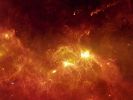
M 42~3.jpgM 42 - In Memory Of IRAS (infrared vision)153 visiteCaption NASA originale:"Do you recognize the constellation Orion? This striking but unfamiliar looking picture of the familiar Orion region of the sky was produced using survey data from the now-defunct InfraRed Astronomical Satellite (IRAS). The above image combines information recorded at three different invisible infrared wavelengths and covers about 30x24° on the sky. Most of Orion's visually impressive stars don't stand out, but bright Betelgeuse does appear as a small bright purplish dot on the lower left. The bright region on the right contains the Great Nebula in Orion, while the bright region just above the image bottom is the Rosette Nebula. Surrounding these regions are a jumble of chaotic glowing gas and dark dust jettisoned by stars forming and exploding over millions of years".Apr 19, 2005
|
|

M-002-PIA04926.jpgM 2 - Globular Star Cluster in Aquarius85 visiteCaption NASA originale:"This image of the Globular Cluster Messier 2 (M2) was taken by Galaxy Evolution Explorer on August 20, 2003. This image is a small section of a single All Sky Imaging Survey exposure of only 129 seconds in the constellation Aquarius. This picture is a combination of Galaxy Evolution Explorer images taken with the far ultraviolet (colored blue) and near ultraviolet detectors (colored red). Globular clusters are gravitationally bound systems of hundreds of thousands of stars that orbit in the halos of galaxies. The globular clusters in out Milky Way galaxy contain some of the oldest stars known. M2 lies 33.000 LY from our Sun with stars distributed in a spherical system with a radius of approximately 100 LY".Mar 09, 2005
|
|
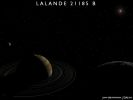
Lalande Solar System.jpgLalande 21185 and a possible extra-solar system164 visiteThe closest extrasolar planetary system could be made by the planets of the dim red dwarf star known as Lalande 21185: only 8 LY distant! This star is too faint to be seen by the naked eye and its planets have never been imaged directly but their presence is inferred by a long series of telescopic observations, tracking the star as it wiggles and wobbles in mutual gravitational response to the masses of its orbiting planets. University of Pitsburgh astronomer George Gatewood recently announced that much of Lalande 21185's wobble is most likely due to an unseen planet with approximately 90% of the mass of Jupiter and an orbital period of 5.8 years. His work also indicates that a second and possibly third planet of similar mass could well be present in the system. Nov 14, 2004
|
|

SN-1987A-Starfield_-_HST_(dtl).jpgSupernova 1987A - HST215 visiteDa NASA - Picture of the Day del 9-02-1999: "Bright stars don't last forever. A bright star similar to others in this field exploded in a spectacular supernova that was witnessed on Earth in 1987. The result is visible even today as unusual rings and glowing gas. The above picture is a composite of recent images taken over several years. The explosion originated from a bright massive star that ran out of nuclear fuel. SN1987A occurred in the Large Magellanic Cloud (LMC), a satellite galaxy only 150.000 LY from our Milky Way Galaxy. The rings of SN1987A are currently excited by light from the initial explosion. Astronomers expect the inner ring to brighten in the next few years as expanding supernova debris overtakes it".Ott 18, 2004
|
|

M 84.jpgM 84 - Galactic nucleus and... a Black Hole?77 visiteIs this "almost artistic graph" the signature of a supermassive Black Hole in the center of distant galaxy M 84 (based on data recorded by Hubble's new Space Telescope Imaging Spectrograph (STIS)?. The presence of a Black Hole can also be revealed by watching matter fall into it.
In fact, material spiraling into a Black Hole would find its speed increasing at a drastic rate. These extreme velocity increases provide what we call a 'signature' of the Black Hole's presence. The STIS data show that radiation from approaching gas, shifted to blue wavelengths left of the centerline, is suddenly redshifted to the right of center indicating a rapidly rotating disk of material near the galactic nucleus. The resulting sharp S-shape is effectively the signature of a Black Hole estimated to contain at least 300 million solar masses. Now the question is: do all galaxies have central Black Holes? And, if "Yes", then "Why"?Ott 14, 2004
|
|
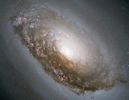
M 64.jpgM 64 (NGC 4826) - Great Spiral Galaxy114 visiteThe "Sleeping Beauty Galaxy" may appear peaceful at first sight but it is actually tossing and turning. In an unexpected twist, recent observations have shown that the gas in the outer regions of this spiral is rotating in the opposite direction from all of the stars! Collisions between gas in the inner and outer regions are creating many hot blue stars and pink emission nebulae. The above image was taken by the Hubble Space Telescope in 2001. The fascinating internal motions of M 64 (also known as NGC 4826), are thought to be the result of a collision between a small galaxy and a large galaxy where the resultant mix has not yet settled down. Set 27, 2004
|
|
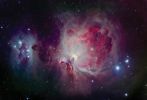
M 42~0.jpgM 42 in real colors174 visiteUna visione ad HD della Grande Nebulosa di Orione: visibile nei nostri cieli invernali anche ad occhio nudo, ma in forma di gran lunga meno spettacolare rispetto a quanto ci è dato vedere in questa ed in altre immagini similari. Ma cos'è che permette alla splendida Grande Nebulosa di Orione di manifestarsi così come noi la vediamo? La "fonte" dello splendore della Nebulosa è dato dal "Trapezio": un gruppo di 4 stelle, le più luminose presenti nella nebulosa. Le strutture a "filamento" che rendono la Nebulosa ancora più suggestiva alla vista sono il prodotto di "onde d'urto" (ovvero di "collisioni" vere e proprie fra elementi pesanti - e che si muovono velocemente nello spazio - con gas stazionari o anch'essi in movimento, ma più lentamente rispetto ai primi). La Grande Nebulosa di Orione si estende nello spazio interstellare per oltre 40 AL e si trova ad una distanza da noi pari a circa 1500 AL, comunque all'interno del medesimo braccio della Via Lattea in cui si trova il nostro Sole (e noi con esso).Set 27, 2004
|
|

M 17.jpgM 17 - The "Omega Nebula" detail mgnf130 visiteIn the depths of the dark clouds of dust and molecular gas known as M 17, stars continue to form. Also known as the Omega Nebula and Horseshoe Nebula, the darkness of M17's molecular clouds results from background starlight being absorbed by thick filaments of carbon-based smoke-sized dust. As bright massive stars form, they produce intense and energetic light that slowly boils away the dark shroud. Colors in the above image were picked to highlight specific elements that emit nebular light: red indicates emission from sulfur, green from hydrogen, and blue from oxygen. The Swan Nebula is visible with binoculars towards the constellation of Sagittarius, lies 5000 LY away, and spans 20 LY across. Set 20, 2004
|
|

M 42.jpgM 42 in different colors184 visiteUna suggestiva combinazione di immagini ottenute con 3 filtri distinti, ciascuno capace di registrare una diversa linea di emissione: Zolfo (S), Ossigeno (O2) e Idrogeno (H). A bassa densità (ovvero nelle condizioni esistenti all'interno della Grande Nebulosa di Orione), S ed H emettono luce rossa mentre l'O2 emette luce verde. Per distinguerli bene nell'immagine, tuttavia, allo Zolfo è stato - in sede di sviluppo finale - assegnato il rosso, all'Idrogeno il verde ed all'Ossigeno il blu.
Il risultato, sebbene la colorazione finale NON sia "realistica", appare comunque non solo utile a fini della ricerca e dell'esatta mappatura dei gas presenti nella Nebulosa, ma anche molto suggestivo.
Set 19, 2004
|
|

M-087.jpgM 87 - Elliptical Galaxy92 visiteElliptical galaxy M 87 is a type of galaxy that looks much different than our own Milky Way Galaxy. Even for an elliptical galaxy, though, M 87 is peculiar. M 87 is MUCH bigger than an average galaxy, appears near the center of a whole cluster of galaxies (known as the Virgo Cluster) and shows an unusually high number of globular clusters. These globular clusters are visible as faint spots surrounding the bright center of M 87. In general, elliptical galaxies contain similar numbers of stars as spiral galaxies, but are ellipsoidal in shape (spirals are mostly flat), have no spiral structure and little gas and dust.Set 19, 2004
|
|
| 157 immagini su 14 pagina(e) |
 |
|
|
|
|
|
|
|
|
13 |
|





