| Ultimi arrivi - The Universe in Super Definition |

M 74-PIA08533.jpgM 74 - Spiral Galaxy65 visiteGiu 11, 2006
|
|

M 74-PIA08533_fig3.jpgSupernova SN2003gd in January 2005 (2)63 visiteBy January 2005, the dust had cooled and completely faded from the camera's view (here). However, it was still detected in January 2005 by another instrument aboard Spitzer called the Multiband Imaging Photometer.
All the images are false-color, infrared composites, in which 3,6-micron light is blue, 4,5-micron light is green, and 8-micron light is red.
Giu 11, 2006
|
|

M 74-PIA08533_fig2.jpgSupernova SN2003gd in July 2004 (1)64 visiteThe dust factory, also known as supernova SN 2003gd, is shown at the center of the two small insets from Spitzer's infrared array camera. A white arrow points to its exact location.
The yellow-green dot shown in the July 2004 inset (here) shows that the source's temperature is warmer than the surrounding material. This is because newly formed dust within the Supernova is just starting to cool. Giu 11, 2006
|
|

M 74-PIA08533_fig1.jpgM 74 and Supernova SN2003gd63 visiteThis image is the galaxy M 74, as seen by SST's infrared array camera. The white box to the left of the Galaxy's center identifies the location of the Supernova Remnant. In all the images, the blue dots represent hot gas and stars. The galaxy's cool dust is shown in red.
Astronomers using NASA's SST have spotted a "dust factory" 30 MLY away in the spiral galaxy M 74. The factory is located at the scene of a massive star's explosive death, or supernova.
While astronomers have suspected for years that supernovae could be producers of cosmic dust particles, the technology to confirm this suspicion has only recently become available.Giu 11, 2006
|
|

Large Magellanic Cloud-1.jpgThe Large Cloud of Magellan (HR)69 visiteAn alluring sight in dark Southern skies, the Large Magellanic Cloud (LMC) is seen here through a narrow filter that transmits only the red light of Hydrogen Atoms. Ionized by energetic starlight, a Hydrogen Atom emits the characteristic red H-alpha light as its single electron is recaptured and transitions to lower energy states. As a result, this image of the LMC seems covered with shell-shaped clouds of Hydrogen gas surrounding massive, young stars. Sculpted by the strong stellar winds and ultraviolet radiation, the glowing Hydrogen clouds are known as "H-II" (such as Ionized Hydrogen) Regions. This HR mosaic view was recorded in 6 segments, each with 200 minutes of exposure time. Itself composed of many overlapping shells, the Tarantula Nebula, is the large star forming Region near top center. A satellite of our Milky Way Galaxy, the LMC is about 15,000 light-years across and lies a mere 180.000 LY away in the constellation known as Dorado.Mag 18, 2006
|
|

PIA07854.jpgA beautiful "Asteroid Belt"68 visiteThis artist's animation illustrates a massive asteroid belt in orbit around a star the same age and size as our Sun. Evidence for this possible belt was discovered by NASA's Spitzer Space Telescope when it spotted warm dust around the star, presumably from asteroids smashing together.
The view starts from outside the belt, where planets like the one shown here might possibly reside, then moves into to the dusty belt itself. A collision between two asteroids is depicted near the end of the movie. Collisions like this replenish the dust in the asteroid belt, making it detectable to Spitzer.
The alien belt circles a faint, nearby star called HD 69830 located 41 light-years away in the constellation Puppis. Compared to our own solar system's asteroid belt, this one is larger and closer to its star - it is 25 times as massive, and lies just inside an orbit equivalent to that of Venus. Our asteroid belt circles between the orbits of Mars and Jupiter.
Because Jupiter acts as an outer wall to our asteroid belt, shepherding its debris into a series of bands, it is possible that an unseen planet is likewise marshalling this belt's rubble. Previous observations using the radial velocity technique did not locate any large gas giant planets, indicating that any planets present in this system would have to be the size of Saturn or smaller.
Asteroids are chunks of rock from "failed" planets, which never managed to coalesce into full-sized planets. Asteroid belts can be thought of as construction sites that accompany the building of rocky planets.
Apr 27, 2006
|
|

Life-PIA03538.jpgLife!70 visiteThis artist's conception symbolically represents complex organic molecules, known as polycyclic aromatic hydrocarbons, seen in the early universe. These large molecules, comprised of carbon and hydrogen, are considered among the building blocks of life.
NASA's Spitzer Space Telescope is the first telescope to see polycyclic aromatic hydrocarbons so early -- 10 billion years further back in time than seen previously. Spitzer detected these molecules in galaxies when our universe was one-fourth of its current age of about 14 billion years.
These complex molecules are very common on Earth. They form any time carbon-based materials are not burned completely. They can be found in sooty exhaust from cars and airplanes, and in charcoal broiled hamburgers and burnt toast.
Polycyclic aromatic hydrocarbons are pervasive in galaxies like our own Milky Way, and play a significant role in star and planet formation.
Apr 27, 2006
|
|
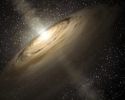
PIA03243.jpgThe way we were...82 visiteThis artist's concept illustrates a solar system that is a much younger version of our own. Dusty disks, like the one shown here circling the star, are thought to be the breeding grounds of planets, including rocky ones like Earth. Astronomers using NASA's Spitzer Space Telescope spotted some of the raw ingredients for DNA and protein in one such disk belonging to a star called IRS 46. The ingredients, gaseous precursors to DNA and protein called acetylene and hydrogen cyanide, were detected in the star's inner disk, the region where scientists believe Earth-like planets would be most likely to form.Apr 27, 2006
|
|

GALEX Portrait-PIA03295.jpgPortrait of the Universe69 visiteFrom sparkling blue rings to dazzling golden disks, Galaxy Evolution Explorer (Galex) scientists are handing out a collection of their finest galactic treasures at the January 2006 American Astronomical Society meeting in Washington, D.C.
Mined from the mission's Survey of Nearby Galaxies data, these cosmic gems were collected with the telescope's sensitive ultraviolet instruments. The gallery of galaxies has been made into a poster for meeting attendees visiting the mission's booth. Organized from far-ultraviolet to near-ultraviolet bright galaxies, this poster encapsulates the heart of the mission to study how galaxies and star formation rates have changed over the past 10 billion years.
Events in space take millions or billions of years to unfold, which means that astronomers can't watch individual galaxies and stars age over time. Luckily, because the physics of light travel dictates that the farther away an object is from Earth, the longer it takes for its light to travel to us, the universe can be thought of as a time machine. By building telescopes sensitive enough to capture objects that are 10 billion light-years away, astronomers can essentially see an object the way it looked 10 billion years ago. Galex astronomers are using this phenomenon to their advantage by taking snapshots of different galaxies at various distances in space. By comparing portraits of numerous objects at various times in the universe's history, the team can begin to piece together the life cycle of stars and galaxies.
For the poster, Galex scientists organized 196 different nearby galaxies in bins of increasing ultraviolet color. By placing the various snapshots side by side, astronomers can see how galaxies age differently. When viewed in ultraviolet, active star-forming regions in galaxies can be seen as glittering blue structures, while a soft, golden glow indicates the presence of older stars.
The 196 galaxies represented in the poster were selected from more than 1,000 galaxies in the "Ultraviolet Atlas of Nearby Galaxies." So far, the Galex mission has surveyed more than 100 million galaxies.
Apr 27, 2006
|
|
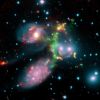
Stephan_s Quintet-PIA02587.jpgStephan's Quintet63 visiteThis false-color composite image of the Stephan's Quintet galaxy cluster clearly shows one of the largest shock waves ever seen (green arc). The wave was produced by one galaxy falling toward another at speeds of more than one million miles per hour. The image is made up of data from NASA's Spitzer Space Telescope and a ground-based telescope in Spain.
Four of the five galaxies in this picture are involved in a violent collision, which has already stripped most of the hydrogen gas from the interiors of the galaxies. The centers of the galaxies appear as bright yellow-pink knots inside a blue haze of stars, and the galaxy producing all the turmoil, NGC7318b, is the left of two small bright regions in the middle right of the image. One galaxy, the large spiral at the bottom left of the image, is a foreground object and is not associated with the cluster.
The titanic shock wave, larger than our own Milky Way galaxy, was detected by the ground-based telescope using visible-light wavelengths. It consists of hot hydrogen gas. As NGC7318b collides with gas spread throughout the cluster, atoms of hydrogen are heated in the shock wave, producing the green glow.
Spitzer pointed its infrared spectrograph at the peak of this shock wave (middle of green glow) to learn more about its inner workings. This instrument breaks light apart into its basic components. Data from the instrument are referred to as spectra and are displayed as curving lines that indicate the amount of light coming at each specific wavelength.
The Spitzer spectrum showed a strong infrared signature for incredibly turbulent gas made up of hydrogen molecules. This gas is caused when atoms of hydrogen rapidly pair-up to form molecules in the wake of the shock wave. Molecular hydrogen, unlike atomic hydrogen, gives off most of its energy through vibrations that emit in the infrared.
This highly disturbed gas is the most turbulent molecular hydrogen ever seen. Astronomers were surprised not only by the turbulence of the gas, but by the incredible strength of the emission. The reason the molecular hydrogen emission is so powerful is not yet completely understood.
Stephan's Quintet is located 300 million light-years away in the Pegasus constellation.
This image is composed of three data sets: near-infrared light (blue) and visible light called H-alpha (green) from the Calar Alto Observatory in Spain, operated by the Max Planck Institute in Germany; and 8-micron infrared light (red) from Spitzer's infrared array camera.
Apr 27, 2006
|
|
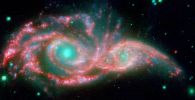
NGC-2207-PIA08097.jpgNGC 2207 and IC 2163: Colliding Galaxies65 visiteThese shape-shifting galaxies have taken on the form of a giant mask. The icy blue eyes are actually the cores of two merging galaxies, called NGC 2207 and IC 2163, and the mask is their spiral arms. The false-colored image consists of infrared data from NASA's Spitzer Space Telescope (red) and visible data from NASA's Hubble Space Telescope (blue/green).
NGC 2207 and IC 2163 met and began a sort of gravitational tango about 40 million years ago. The two galaxies are tugging at each other, stimulating new stars to form. Eventually, this cosmic ball will come to an end, when the galaxies meld into one. The dancing duo is located 140 million light-years away in the Canis Major constellation.
The infrared data from Spitzer highlight the galaxies' dusty regions, while the visible data from Hubble indicates starlight. In the Hubble-only image (not pictured here), the dusty regions appear as dark lanes.
The Hubble data correspond to light with wavelengths of .44 and .55 microns (blue and green, respectively). The Spitzer data represent light of 8 microns.
Apr 27, 2006
|
|

M 82-PIA08093.jpgM 82: A "Space Rainbow"70 visiteCaption NASA originale:"NASA's Spitzer, Hubble and Chandra Space Observatories teamed up to create this multi-wavelength, false-colored view of the M82 galaxy.
The lively portrait celebrates Hubble's "sweet sixteen" birthday.
X-ray data recorded by Chandra appears in blue; infrared light recorded by Spitzer appears in red; Hubble's observations of hydrogen emission appear in orange, and the bluest visible light appears in yellow-green".Apr 27, 2006
|
|
| 157 immagini su 14 pagina(e) |
 |
|
|
|
|
|
|
|
12 | |
|





