| |

| Ultimi arrivi - The Universe in Super Definition |

M-016-PIA09108.jpgThe many colors of the Eagle65 visiteThis set of images from NASA's Spitzer Space Telescope shows the Eagle Nebula in different hues of infrared light. Each view tells a different tale. The left picture shows lots of stars and dusty structures with clarity. Dusty molecules found on Earth called polycyclic aromatic hydrocarbons produce most of the red; gas is green and stars are blue.
The middle view is packed with drama, because it tells astronomers that a star in this region violently erupted, or went supernova, heating surrounding dust (orange). This view also reveals that the hot dust is shell shaped, another indication that a star exploded.
The final picture highlights the contrast between the hot, supernova-heated dust (green) and the cooler dust making up the region's dusty star-forming clouds and towers (red, blue and purple).
The left image is a composite of infrared light with the following wavelengths: 3.6 microns (blue); 4.5 microns (green); 5.8 microns (orange); and 8 microns (red). The right image includes longer infrared wavelengths, and is a composite of light of 4.5 to 8.0 microns (blue); 24 microns (green); and 70 microns (red). The middle image is made up solely of 24-micron light. Gen 10, 2007
|
|

M-016-PIA09109.jpgM 16 - The "Eagle Nebula"63 visiteThis image composite highlights the pillars of the Eagle Nebula, as seen in infrared light by NASA's Spitzer Space Telescope (bottom) and visible light by NASA's Hubble Space Telescope (top insets).
The top right inset focuses on the 3 famous pillars, dubbed the "Pillars of Creation", which were photographed by Hubble in 1995. Hubble's optical view shows the dusty towers in exquisite detail, while Spitzer's infrared eyes penetrate through the thick dust, revealing ghostly transparent structures. The same effect can be seen for the pillar outlined in the top left box.
In both cases, Spitzer's view exposes newborn stars that were hidden inside the cocoon-like pillars, invisible to Hubble. These stars were first uncovered by the European Space Agency's Infrared Satellite Observatory. In the Spitzer image, two embedded stars are visible at the tip and the base of the left pillar, while one star can be seen at the tip of the tallest pillar on the right. Gen 10, 2007
|
|

Dark_Matter.jpgBright Universe, Dark Matter70 visiteAn international team of astronomers using NASA's Hubble Space Telescope has created a three-dimensional map that provides the first direct look at the large-scale distribution of dark matter in the universe.
Dark matter is an invisible form of matter that accounts for most of the universe's mass.
The map provides the best evidence yet that normal matter, largely in the form of galaxies, accumulates along the densest concentrations of dark matter. The map reveals a loose network of filaments that grew over time and intersect in massive structures at the locations of clusters of galaxies.
The map stretches halfway back to the beginning of the universe and shows how dark matter has grown increasingly "clumpy" as it collapses under gravity.
This milestone takes astronomers from inference to direct observation of dark matter's influence in the universe. Previous studies of dark matter are based largely on numerical simulations of the expected evolution of large-scale structure. This evolution is driven by the gravitational attraction of dark matter.
Mapping dark matter's distribution in space and time is fundamental to understanding how galaxies grew and clustered over billions of years. Tracing the growth of clustering in the dark matter may eventually also shed light on dark energy, a repulsive form of gravity that influences how dark matter clumps.
The new maps of dark matter and galaxies will provide critical observational underpinnings to future theories for how structure formed in the evolving universe under the relentless pull of gravity. Theories suggest the universe transitioned from a smooth distribution of matter into a sponge-like structure of long filaments.
The research results appeared online today in the journal Nature and were presented at the 209th meeting of the American Astronomical Society in Seattle, Wash., by Richard Massey for the dark matter and Nick Scoville for the galaxies. Both researchers are from the California Institute of Technology, Pasadena, Calif.
"It's reassuring how well our map confirms the standard theories for structure formation." said Massey. He calls dark matter the "scaffolding" inside of which stars and galaxies have been assembled over billions of years.
Researchers created the map using Hubble's largest survey of the universe, the Cosmic Evolution Survey ("COSMOS") with an international team of 70 astronomers led by Scoville. The COSMOS survey covers a sufficiently wide area of sky – nine times the area of the Earth's Moon. This allows for the large-scale filamentary structure of dark matter to be evident. To add 3-D distance information, the Hubble observations were combined with multicolor data from powerful ground-based telescopes. "The 3-D information is vital to studying the evolution of the structures over cosmic time," said Jason Rhodes, a collaborator in the study at the Jet Propulsion Laboratory in Pasadena, Calif.
The dark matter map was constructed by measuring the shapes of half a million faraway galaxies. To reach us, the galaxies' light has traveled through intervening dark matter. The dark matter deflected the light slightly as it traveled through space. Researchers used the observed, subtle distortion of the galaxies' shapes to reconstruct the distribution of intervening mass along Hubble's line of sight — a method called weak gravitational lensing. This effect is analogous to deducing the rippling pattern in a glass shower door by measuring how light from behind it is distorted as it passes through the glass.
"Although this technique has been employed previously, the depth of the COSMOS image and its superior resolution enables a more precise and detailed map, covering a large enough area to see the extended filamentary structures," said co-investigator Richard Ellis of the California Institute of Technology.
For astronomers, the challenge of mapping the universe has been similar to mapping a city from nighttime aerial snapshots showing only streetlights. Dark matter is invisible, so only the luminous galaxies can be seen directly. The new images are equivalent to seeing a city, its suburbs and country roads — in daylight, for the first time. Major arteries and intersections become evident, and a variety of neighborhoods are revealed.
A separate COSMOS team led by Scoville presented images of the large scale galactic structures in the same area with the dark matter. Galaxies appear in visible light seen with Hubble and in ground-based Subaru telescope images by Yoshiaku Taniguchi and colleagues. The hot gas in the densest galaxy clusters was imaged in X-rays by Gunther Hasinger and colleagues using the European Space Agency's XMM-Newton telescope.
Galaxy structures inside the dark matter scaffolding show clusters of galaxies in the process of assembly. These structures can be traced over more than 80 million light-years in the COSMOS survey – approximately five times the extent of the nearby Virgo galaxy cluster. In the densest early universe structures, many galaxies already have old stellar populations, implying that these galaxies formed first and accumulated the greatest masses in a bottom-up assembly process where smaller galaxies merge to make bigger galaxies — like tributaries converging to form a large river.
The COSMOS survey shows that galaxies with on-going star formation, even to the present epoch, dwell in less populated voids and dark matter filaments. "It is remarkable how the environment on the enormous cosmic scales seen in the dark matter structures can influence the properties of individual stars and galaxies — both the maturity of the stellar populations and the progressive 'downsizing' of star formation to smaller galaxies is clearly dependent on the dark matter environment," said Scoville.
"The comparison is of fundamental importance," said Massey. "Almost all current scientific knowledge concerns only baryonic matter. Now that we have begun to map out where dark matter is, the next challenge is to determine what it is, and specifically its relationship to normal matter."
In making the COSMOS survey, Hubble photographed 575 slightly overlapping views of the universe using the Advanced Camera for Surveys' (ACS) Wide Field Camera onboard Hubble. It took nearly 1,000 hours of observations. Thousands of galaxies' spectra were obtained by using the European Southern Observatory's Very Large Telescope in Chile, and the Subaru telescope in Hawaii. The distances to the galaxies were accurately determined through their spectral redshifts. The distribution of the normal matter was partly determined with the European Space Agency's XMM-Newton telescope.
MareKromiumGen 08, 2007
|
|

Upsilon Andromedae-PIA01937.jpgUpsilon Andromedae63 visiteThe top graph consists of infrared data from NASA's Spitzer Space Telescope. It tells astronomers that a distant planet, called Upsilon Andromedae b, always has a giant hot spot on the side that faces the star, while the other side is cold and dark. The artist's concepts above the graph illustrate how the planet might look throughout its orbit if viewed up close with infrared eyes.
Spitzer was able to determine the difference in temperature between the two sides of this planet by measuring the planet's infrared light, or heat, at five points during its 4.6-day-long trip around its star. The temperature rose and fell depending on which face, the sunlit or dark, was pointed toward Spitzer's cameras. Those temperature oscillations are traced by the wavy orange curve. They indicate that Upsilon Andromedae b has an extreme range of temperatures across its surface, about 1,400 degrees Celsius (2,550 degrees Fahrenheit). This means that hot gas moving across the bright side of the planet cools off by the time it reaches the dark side.
The bottom graph and artist's concepts represent what astronomers might have seen if the planet had bands of different temperatures girdling it, like Jupiter. Some astronomers had speculated that "hot-Jupiter" planets like Upsilon Andromedae b, which circle very closely around their stars, might resemble Jupiter in this way. If Upsilon Andromedae b had been like this, there would have been no difference between the average temperatures of the sunlit and dark sides to detect, and Spitzer's data would have appeared as a flat line.
Ott 19, 2006
|
|

M 45 - PIA08260.jpgM 45 - The "Seven Sisters", from Cassini61 visiteCaption NASA originale:"The stars of the Pleiades cluster, also known by the names "M 45" and "The Seven Sisters," shine brightly in this view from the Cassini spacecraft. The cluster is comprised of hundreds of stars, a few of which are visible to the unaided eye on Earth as a brilliant grouping in the constellation Taurus.
Some faint nebulous material is seen here. This reflection nebula is dust that reflects the light of the hot, blue stars in the cluster.
The monochrome view was made by combining 49 clear filter images of the Pleiades taken with the Cassini spacecraft wide-angle camera on Aug. 1, 2006. The images were taken as a part of a sequence designed to help calibrate the camera electronics".Set 07, 2006
|
|

Black Hole-PIA08696.jpgBlack Hole70 visiteThis artist's concept depicts a supermassive black hole at the center of a galaxy. NASA's Galaxy Evolution Explorer found evidence that black holes -- once they grow to a critical size -- stifle the formation of new stars in elliptical galaxies. Black holes are thought to do this by heating up and blasting away the gas that fuels star formation.
The blue color here represents radiation pouring out from material very close to the black hole. The grayish structure surrounding the black hole, called a torus, is made up of gas and dust. Beyond the torus, only the old red-colored stars that make up the galaxy can be seen. There are no new stars in the galaxy.
Ago 26, 2006
|
|

Black Hole-PIA08697_fig1.jpgBlack Holes70 visiteThis diagram illustrates research from NASA's Galaxy Evolution Explorer showing that black holes -- once they reach a critical size -- can put the brakes on new star formation in elliptical galaxies.
In this graph, galaxies and their supermassive black holes are indicated by the drawings (the black circle at the center of each galaxy represents the black hole). The relative masses of the galaxies and their black holes are reflected in the sizes of the drawings. Blue indicates that the galaxy has new stars, while red means the galaxy does not have any detectable new stars.
The Galaxy Evolution Explorer observed the following trend: the biggest galaxies and black holes (shown in upper right corner) are more likely to have no observable star formation (red) than the smaller galaxies with smaller black holes. This is evidence that black holes can create environments unsuitable for stellar birth.
The white line in the diagram illustrates that, for any galaxy no matter what the mass, its black hole must reach a critical size before it can shut down star formation.
Ago 26, 2006
|
|

M 42-PIA08653.jpgMoments of M-4269 visiteThis infrared image from NASA's Spitzer Space Telescope shows the Orion nebula, our closest massive star-making factory, 1,450 light-years from Earth. The nebula is close enough to appear to the naked eye as a fuzzy star in the sword of the popular hunter constellation.
The nebula itself is located on the lower half of the image, surrounded by a ring of dust. It formed in a cold cloud of gas and dust and contains about 1,000 young stars. These stars illuminate the cloud, creating the beautiful nebulosity, or swirls of material, seen here in infrared.
In the center of the nebula (bottom inset of figure 1) are four monstrously massive stars, up to 100,000 times as luminous as our sun, called the Trapezium (tiny yellow smudge to the lower left of green splotches. Radiation and winds from these stars are blasting gas and dust away, excavating a cavity walled in by the large ring of dust.
Behind the Trapezium, still buried deeply in the cloud, a second generation of massive stars is forming (in the area with green splotches). The speckled green fuzz in this bright region is created when bullets of gas shoot out from the juvenile stars and ram into the surrounding cloud.
Above this region of intense activity are networks of cold material that appear as dark veins against the pinkish nebulosity (upper inset pf figure 1). These dark veins contain embryonic stars. Some of the natal stars illuminate the cloud, creating small, aqua-colored wisps. In addition, jets of gas from the stars ram into the cloud, resulting in the green horseshoe-shaped globs.
Spitzer surveyed a significant swath of the Orion constellation, beyond what is highlighted in this image. Within that region, called the Orion cloud complex, the telescope found 2,300 stars circled by disks of planet-forming dust and 200 stellar embryos too young to have developed disks.
This image shows infrared light captured by Spitzer's infrared array camera. Light with wavelengths of 8 and 5.8 microns (red and orange) comes mainly from dust that has been heated by starlight. Light of 4.5 microns (green) shows hot gas and dust; and light of 3.6 microns (blue) is from starlight.
Ago 17, 2006
|
|

M 42-PIA08655-ed.jpgThe "Great Cloud" around Orion62 visiteThis image composite shows a part of the Orion constellation surveyed by NASA's Spitzer Space Telescope. The shape of the main image was designed by astronomers to roughly follow the shape of Orion cloud A, an enormous star-making factory containing about 1,800 young stars. This giant cloud includes the famous Orion nebula (bright circular area in "blade" part of hockey stick-shaped box at the bottom), which is visible to the naked eye on a clear, dark night as a fuzzy star in the hunter constellation's sword.
The region that makes up the shaft part of the hockey stick box stretches 70 light-years beyond the Orion nebula. This particular area does not contain massive young stars like those of the Orion nebula, but is filled with 800 stars about the same mass as the sun. These sun-like stars don't live in big "cities," or clusters, of stars like the one in the Orion nebula; instead, they can be found in small clusters (right inset), or in relative isolation (middle insert).
In the right inset, developing stars are illuminating the dusty cloud, creating small wisps that appear greenish. The stars also power speedy jets of gas (also green), which glow as the jets ram into the cloudy material.
Since infrared light can penetrate through dust, we see not only stars within the cloud, but thousands of stars many light-years behind it, which just happen to be in the picture like unwanted bystanders. Astronomers carefully separate the young stars in the Orion cloud complex from the bystanders by looking for their telltale infrared glow.
The infrared image shows light captured by Spitzer's infrared array camera. Light with wavelengths of 8 and 5.8 microns (red and orange) comes mainly from dust that has been heated by starlight. Light of 4.5 microns (green) shows hot gas and dust; and light of 3.6 microns (blue) is from starlight.
Ago 17, 2006
|
|

M 42-PIA08656.jpgOrion's "Sword"61 visiteThis image composite outlines the region near Orion's sword that was surveyed by NASA's Spitzer Space Telescope (white box). The view on the left (figure 1) is from a visible-light telescope, and the view on the right (figure 2) shows infrared light captured by a previous infrared mission, the Infrared Astronomical Satellite.
The Orion nebula, our closest massive star-making factory, is the brightest spot near the hunter's sword. On a dark night, it can appear to the naked eye as a fuzzy star, and it looks like a ghostly blob through a pair of binoculars. The Orion constellation is one of the most prominent winter constellations, and can be seen from all northern latitudes starting in the fall.
Spitzer used its infrared eyes to probe the dusty clouds of a region called Orion cloud A. outlined here in the hockey stick-shaped box (see PIA08655). This giant cloud stretches almost a quarter of the length of the constellation, an area equivalent to 18 full moons. The small box within the hockey stick shows the location of another image released by Spitzer (see PIA08653), which mainly features the Orion nebula itself.
The bright spot that shows up in the infrared view in the area of Orion's belt is known as Orion cloud B. Together, Orion clouds A and B make up the Orion cloud complex. In a survey of this entire complex, Spitzer unearthed 2,300 stars circled by disks of planet-forming dust and 200 stellar embryos too young to have developed disks.
The Infrared Astronomical Satellite was a joint effort between NASA, the Science and Engineering Research Council, United Kingdom and the Netherlands Agency for Aerospace Programmes, the Netherlands. Spitzer has extended the legacy of the satellite by providing much better resolution and sensitivity.
The visible-light image comes courtesy of Howard McCallon of the Infrared Processing and Analysis Center at the California Institute of Technology of Pasadena.
Ago 17, 2006
|
|

M 42-PIA08654-ed.jpgInfrared Orion62 visiteThis image composite compares infrared and visible views of the famous Orion nebula and its surrounding cloud, an industrious star-making region located near the hunter constellation's sword. The infrared picture is from NASA's Spitzer Space Telescope, and the visible image is from the National Optical Astronomy Observatory, headquartered in Tucson, Ariz.
In addition to Orion, two other nebulas can be seen in both pictures. The Orion nebula, or M42, is the largest and takes up the lower half of the images; the small nebula to the upper left of Orion is called M43; and the medium-sized nebula at the top is NGC 1977. Each nebula is marked by a ring of dust that stands out in the infrared view. These rings make up the walls of cavities that are being excavated by radiation and winds from massive stars. The visible view of the nebulas shows gas heated by ultraviolet radiation from the massive stars.
Above the Orion nebula, where the massive stars have not yet ejected much of the obscuring dust, the visible image appears dark with only a faint glow. In contrast, the infrared view penetrates the dark lanes of dust, revealing bright swirling clouds and numerous developing stars that have shot out jets of gas (green). This is because infrared light can travel through dust, whereas visible light is stopped short by it.
The infrared image shows light captured by Spitzer's infrared array camera. Light with wavelengths of 8 and 5.8 microns (red and orange) comes mainly from dust that has been heated by starlight. Light of 4.5 microns (green) shows hot gas and dust; and light of 3.6 microns (blue) is from starlight.
Ago 17, 2006
|
|
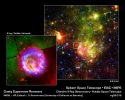
N76-PIA08516-2.jpgThe "N 76 Nebula"60 visiteThe supernova remnant1E0102.2-7219 sits next to the Nebula N76 in a bright, Star-Forming Region of the Small Magellanic Cloud, a satellite galaxy to our Milky Way galaxy located about 200.000 LY from Earth. A Supernova Remnant is made up of the messy bits and pieces of a massive star that exploded, or went Supernova. This image shows glowing dust grains in three wavelengths of infrared radiation: 24 microns (red) measured by the Multiband Imaging Photometer aboard NASA's Spitzer Space Telescope; and 8.0 microns (green) and 3.6 microns (blue) measured by Spitzer's infrared array camera. The red bubble is a dust envelope around the supernova remnant E0102, which is being heated by the shock wave created in the explosion of the remnant's massive progenitor star some 1,000 years ago. Most of the blue stars are in the Small Magellanic Cloud, though some are in our own galaxy.Giu 11, 2006
|
|
| 157 immagini su 14 pagina(e) |
|
|
|
|
|
|
|
11 | |
|
|
|
|





