| |

| Ultimi arrivi - The Universe in Super Definition |
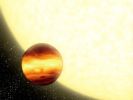
LonelyPlanet-PIA09118.jpgWhat's the weather like over there?70 visiteCaption NASA:"An artist's conception shows a gas-giant planet orbiting very close to its parent star, creating searingly hot conditions on the planet's surface.
New research suggests that for three such planets lying from 50 to 150 light-years from Earth, strong winds thousands of miles per hour mix the atmosphere so that the temperature is relatively uniform from the permanently light side to the permanently dark side.
This illustration represents an infrared view of a planetary system, in which brightness indicates warmer temperatures. For example, the bright band around the equator of the planet denotes warmer temperatures on both the dark and sunlit sides.
The planet's poles, shown in darker colors, would be cooler".MareKromiumMar 06, 2007
|
|
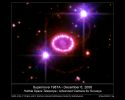
SN-1987A.jpgSupernova 1987A65 visiteTwenty years ago, astronomers witnessed one of the brightest stellar explosions in more than 400 years. The titanic supernova, called SN 1987A, blazed with the power of 100 million suns for several months following its discovery on Feb. 23, 1987.
Observations of SN 1987A, made over the past 20 years by NASA's Hubble Space Telescope and many other major ground- and space-based telescopes, have significantly changed astronomers' views of how massive stars end their lives. Astronomers credit Hubble's sharp vision with yielding important clues about the massive star's demise.
"The sharp pictures from the Hubble telescope help us ask and answer new questions about Supernova 1987A," said Robert Kirshner, of the Harvard-Smithsonian Center for Astrophysics in Cambridge, Mass. "In fact, without Hubble we wouldn't even know what to ask."
Kirshner is the lead investigator of an international collaboration to study the doomed star. Studying supernovae like SN 1987A is important because the exploding stars create elements, such as carbon and iron, that make up new stars, galaxies, and even humans. The iron in a person's blood, for example, was manufactured in supernova explosions. SN 1987A ejected 20,000 Earth masses of radioactive iron. The core of the shredded star is now glowing because of radioactive titanium that was cooked up in the explosion.
The star is 163,000 light-years away in the Large Magellanic Cloud. It actually blew up about 161,000 B.C., but its light arrived here in 1987.
Kirshner has used the Hubble telescope to monitor the supernova. "The Hubble observations have helped us rewrite the textbooks on exploding stars. We found that the actual world is more complicated and interesting than anyone dared to imagine. There are mysterious triple rings of glowing gas and powerful blasts sent out from the explosion that are just having an impact now, 20 years later."
Before SN 1987A, astronomers had a "simplified, idealized model of a supernova," Kirshner explained. "We thought the explosions were spherical and we didn't think much about the gas a star would exhale in the thousands of years before it exploded. The actual shreds of the star in SN 1987A are elongated — more like a jellybean than a gumball, and the fastest-moving debris is slamming into the gas that was already out there from previous millennia. Who would have guessed?"
Hubble wasn't even around when astronomers first spotted the supernova in 1987. When Hubble was launched three years later, astronomers didn't waste any time in using the telescope to study the stellar blast. Its first peek was in 1990, the year the observatory launched. Since then, the telescope has taken hundreds of pictures of the doomed star.
The Hubble studies have revealed the following details about the supernova:
*A glowing ring, about a light-year in diameter, around the supernova. The ring was there at least 20,000 years before the star exploded. X-rays from the explosion energized the gas in the ring, making it glow for two decades.
*Two outer loops of glowing gas, which had been imaged by ground-based telescopes, were seen more clearly by Hubble.
*A dumbbell-shaped central structure that has now grown to one-tenth of a light-year long. The structure consists of two blobs of debris in the center of the supernova racing away from each other at roughly 20 million miles an hour.
*The onrushing stellar shock wave from the stellar explosion is slamming into, heating up, and illuminating the inner regions of the narrow ring surrounding the doomed star.
Hubble continues to watch as the blast debris moves through the ring. The light show makes the glowing ring look like a pearl necklace. Astronomers think the whole ring will be illuminated in a few years.
The glowing ring is expected to become bright enough to illuminate the star's surroundings, which will provide astronomers with new information on how the star ejected material before the explosion.
Astronomers are analyzing images by NASA's Spitzer Space Telescope to try to understand the fate of the dust that surrounds the exploded star and in the neighborhood around the blast.
"We will learn more in the future when the shock wave moves through the inner ring and slams into the outer rings and illuminates them," Kirshner said. "It could lead to clues about the last 20,000 years of the star. But there are many things that are still a mystery. We still do not understand the evolution of the star before the explosion or how the three rings formed. We also think that the star may be part of a binary system."
Astronomers also are still looking for evidence of a black hole or a neutron star left behind by the blast. The fiery death of massive stars usually creates these energetic objects. Most astronomers think a neutron star formed 20 years ago. Kirshner said the object could be obscured by dust or it could have become a black hole.
He plans to use the infrared capabilities of the Wide Field Camera 3 — an instrument scheduled to be installed during the upcoming Hubble servicing mission — to hunt for a stellar remnant. Scientists will use another instrument planned for installment during the mission, the Cosmic Origins Spectrograph, to analyze the supernova's chemical composition and velocities.
The James Webb Space Telescope, scheduled for launch in 2013, will be able to see infrared light from the ring that is 10 times fainter than what astronomers see today. The debris inside the ring will begin to brighten, and astronomers will get another chance to study the interior of an exploded star.
Feb 28, 2007
|
|

Spectrum-PIA09199.jpgSpectrum of an Alien World64 visiteThis infrared data from NASA's Spitzer Space Telescope - called a spectrum - tells astronomers that a distant gas planet, a so-called "hot Jupiter" called HD 189733b, might be smothered with high clouds. It is one of the first spectra of an alien world.
A spectrum is created when an instrument called a spectrograph cracks light from an object open into a rainbow of different wavelengths. Patterns or ripples within the spectrum indicate the presence, or absence, of molecules making up the object.
Astronomers using Spitzer's spectrograph were able to obtain infrared spectra for two so-called "transiting" hot-Jupiter planets using the "secondary eclipse" technique. In this method, the spectrograph first collects the combined infrared light from the planet plus its star, then, as the planet is eclipsed by the star, the infrared light of just the star. Subtracting the latter from the former reveals the planet's own rainbow of infrared colors.
Astronomers were perplexed when they first saw the infrared spectrum above. It doesn't look anything like what theorists had predicted. Theorists thought the spectra of hot, Jupiter-like planets like this one would be filled with the signatures of molecules in the planets' atmospheres. But the spectrum doesn't show any molecules, and is instead what astronomers call "flat." For example, theorists thought there'd be a strong signature of water in the form of a big drop in the wavelength range between 7 and 10 microns. The fact that water is not detected may indicate that it is hidden underneath a thick blanket of high, dry clouds. The average brightness of the spectrum is also a bit lower than theoretical predictions, suggesting that very high winds are rapidly moving the terrific heat of the noonday sun from the day side of HD 189733b to the night side.
This spectrum was produced by Dr. Carl Grillmair of NASA's Spitzer Science Center at the California Institute of Technology in Pasadena, Calif., and his colleagues. The data were taken by Spitzer's infrared spectrograph on November 22, 2006.
Feb 22, 2007
|
|

Spectrum-PIA09196.jpgHow to get a Spectrum of an Alien World60 visiteThis diagram illustrates how astronomers using NASA's Spitzer Space Telescope can capture the elusive spectra of hot-Jupiter planets. Spectra are an object's light spread apart into its basic components, or wavelengths. By dissecting light in this way, scientists can sort through it and uncover clues about the composition of the object giving off the light.
To obtain a spectrum for an object, one first needs to capture its light. Hot-Jupiter planets are so close to their stars that even the most powerful telescopes can't distinguish their light from the light of their much brighter stars.
But, there are a few planetary systems that allow astronomers to measure the light from just the planet by using a clever technique. Such "transiting" systems are oriented in such a way that, from our vantage point, the planets' orbits are seen edge-on and cross directly in front of and behind their stars.
In this technique, known as the secondary eclipse method, changes in the total infrared light from a star system are measured as its planet transits behind the star, vanishing from our Earthly point of view. The dip in observed light can then be attributed to the planet alone.
To capture a spectrum of the planet, Spitzer must observe the system twice. It takes a spectrum of the star together with the planet (first panel), then, as the planet disappears from view, a spectrum of just the star (second panel). By subtracting the star's spectrum from the combined spectrum of the star plus the planet, it is able to get the spectrum for just the planet (third panel).
This ground-breaking technique was used by Spitzer to obtain the first-ever spectra of two planets beyond our solar system, HD 209458b and HD 189733b. The results suggest that the hot planets are socked in with dry clouds high up in the planet's stratospheres. In addition, HD 209458b showed hints of silicates, indicating those high clouds might be made of very fine sand-like particles.
Feb 22, 2007
|
|

Spectrum-PIA09197.jpgSpectrum of an Alien World63 visiteThis infrared data from NASA's Spitzer Space Telescope - called a spectrum - tells astronomers that a distant gas planet, a so-called "hot Jupiter" called HD 209458b, might be smothered with high clouds. It is one of the first spectra of an alien world.
A spectrum is created when an instrument called a spectrograph cracks light from an object open into a rainbow of different wavelengths. Patterns or ripples within the spectrum indicate the presence, or absence, of molecules making up the object.
Astronomers using Spitzer's spectrograph were able to obtain infrared spectra for two so-called "transiting" hot-Jupiter planets using the "secondary eclipse" technique. In this method, the spectrograph first collects the combined infrared light from the planet plus its star, then, as the planet is eclipsed by the star, the infrared light of just the star. Subtracting the latter from the former reveals the planet's own rainbow of infrared colors.
When astronomers first saw the infrared spectrum above, they were shocked. It doesn't look anything like what theorists had predicted. For example, theorists thought there'd be signatures of water in the wavelength ranges of 8 to 9 microns. The fact that water is not detected might indicate that it is hidden under a thick blanket of high, dry clouds.
In addition, the spectrum shows signs of silicate dust -- tiny grains of sand -- in the wavelength range of 9 to 10 microns. This suggests that the planet's skies could be filled with high clouds of dust unlike anything seen in our own solar system.
There is also an unidentified molecular signature at 7.78 microns. Future observations using Spitzer's spectrograph should be able to determine the nature of the mysterious feature.
This spectrum was produced by Dr. Jeremy Richardson of NASA's Goddard Space Flight Center, Greenbelt, Md. and his colleagues. The data were taken by Spitzer's infrared spectrograph on July 6 and 13, 2005.
Feb 22, 2007
|
|

Spectrum-PIA09198.jpgSpectrum of an Alien World61 visiteThis infrared data from NASA's Spitzer Space Telescope - called a spectrum - tells astronomers that a distant gas planet, a so-called "hot Jupiter" called HD 209458b, might be smothered with high clouds. It is one of the first spectra of an alien world.
A spectrum is created when an instrument called a spectrograph spreads light from an object apart into a rainbow of different wavelengths. Patterns or ripples within the spectrum indicate the presence, or absence, of molecules making up the object.
Astronomers using Spitzer's spectrograph were able to obtain infrared spectra for two so-called "transiting" hot-Jupiter planets using the "secondary eclipse" technique. In this method, the spectrograph first collects the combined infrared light from the planet plus its star, then, as the planet is eclipsed by the star, the infrared light of just the star. Subtracting the latter from the former reveals the planet's own rainbow of infrared colors.
When astronomers first saw the infrared spectrum above, they were shocked. It doesn't look anything like what theorists had predicted. Theorists though the spectra for hot, Jupiter-like planets like this one would be filled with the signatures of molecules in the planets' atmospheres. But the spectrum doesn't show any molecules. It is what astronomers call "flat." For example, theorists thought there'd be signatures of water in the wavelength ranges of 8 to 9 microns. The fact that water is not seen there might indicate that the water is hidden under a thick blanket of high, dry clouds.
This spectrum was produced by Dr. Mark R. Swain of NASA's Jet Propulsion Laboratory in Pasadena, Calif., using a complex set of mathematical tools. It was derived using two different methods, both of which led to the same result. The data were taken on July 6 and 13, 2005, by Dr. Jeremy Richardson of NASA's Goddard Space Flight Center and his team using Spitzer's infrared spectrograph.
Feb 22, 2007
|
|
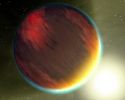
HD189733b-PIA09200.jpgJust like Jupiter...63 visiteThis artist's concept shows a cloudy Jupiter-like planet that orbits very close to its fiery hot star. NASA's Spitzer Space Telescope was recently used to capture spectra, or molecular fingerprints, of two "hot Jupiter" worlds like the one depicted here. This is the first time a spectrum has ever been obtained for an exoplanet, or a planet beyond our solar system.
The ground-breaking observations were made with Spitzer's spectrograph, which pries apart infrared light into its basic wavelengths, revealing the "fingerprints" of molecules imprinted inside. Spitzer studied two planets, HD 209458b and HD 189733b, both of which were found, surprisingly, to have no water in the tops of their atmospheres. The results suggest that the hot planets are socked in with dry, high clouds, which are obscuring water that lies underneath. In addition, HD209458b showed hints of silicates, suggesting that the high clouds on that planet contain very fine sand-like particles.
Capturing the spectra from the two hot-Jupiter planets was no easy feat. The planets cannot be distinguished from their stars and instead appear to telescopes as single blurs of light. One way to get around this is through what is known as the secondary eclipse technique. In this method, changes in the total light from a so-called transiting planet system are measured as a planet is eclipsed by its star, vanishing from our Earthly point of view. The dip in observed light can then be attributed to the planet alone.
This technique, first used by Spitzer in 2005 to directly detect the light from an exoplanet, currently only works at infrared wavelengths, where the differences in brightness between the planet and star are less, and the planet's light is easier to pick out. For example, if the experiment had been done in visible light, the total light from the system would appear to be unchanged, even as the planet disappeared from view.
To capture spectra of the planets, Spitzer observed their secondary eclipses with its spectrograph. It took a spectrum of a star together with its planet, then, as the planet disappeared from view, a spectrum of just the star. By subtracting the spectrum of the star from the spectrum of the star and planet together, astronomers were able to determine the spectrum of the planet itself.
Neither of the parent stars for HD 209458b or HD 189733b can be seen with the naked eye. HD 209458b is located about 153 light-years away in the constellation Pegasus, while HD 189733b is about 62 light-years away in the constellation Vulpecula. Both planets zip around their stars in very tight orbits; HD 209458b circles once every 3.5 days, while HD 189733b orbits once every 2.2 days.
Of the approximately 200 known exoplanets, there are 12 besides HD 209458b and HD 189733b whose orbits are inclined in such a way that, from our point of view, they pass in front of their stars. At least three of these transiting exoplanets are bright enough to follow in the footsteps of HD 209458b and HD 189733 and reveal their infrared spectra to Spitzer. Astronomers hope to use Spitzer's spectrograph in the future to study HD 209458b and HD 189733b again in much greater detail, and to examine some of the other candidates for the first time.
Feb 22, 2007
|
|

HD-209458b-00.jpgExtra-Solar Planet HD-209458b (1)68 visiteThe powerful vision of NASA's HST has allowed astronomers to study for the first time the layer-cake structure of the atmosphere of a planet orbiting another star. HST discovered a dense upper layer of hot Hydrogen gas where the super-hot planet's atmosphere is bleeding off into space.
The planet, designated HD 209458b, is unlike any world in our Solar System. It orbits so close to its star and gets so hot that its gas is streaming into space, making the planet appear to have a comet-like tail. This new research reveals the layer in the planet's upper atmosphere where the gas becomes so heated it escapes, like steam rising from a boiler.
"The layer we studied is actually a transition zone where the temperature skyrockets from about 1340 deg. Fahrenheit (1000 Kelvin) to about 25.540 degrees (15.000 Kelvin), which is hotter than the Sun " said Gilda Ballester of the University of Arizona in Tucson, leader of the research team.
"With this detection we see the details of how a planet loses its atmosphere."
The findings by Ballester, David K. Sing of the University of Arizona and the Institut d'Astrophysique de Paris, and Floyd Herbert of the University of Arizona will appear Feb. 1 in a letter to the journal Nature.
The Hubble data show how intense ultraviolet radiation from the host star heats the gas in the upper atmosphere, inflating the atmosphere like a balloon. The gas is so hot that it moves very fast and escapes the planet's gravitational pull at a rate of 10,000 tons a second, more than three times the rate of water flowing over Niagara Falls. The planet, however, will not wither away any time soon. Astronomers estimate its lifetime is more than 5 billion years.
The scorched planet is a big puffy version of Jupiter. In fact, it is called a "hot Jupiter," a large gaseous planet orbiting very close to its parent star. Jupiter might even look like HD 209458b if it were close to the Sun, Ballester said.
The planet completes an orbit around its star every 3.5 days. It orbits 4.7 million miles from its host, 20 times closer than the Earth is to the Sun. By comparison, Mercury, the closest planet to our Sun, is 10 times farther away from the Sun than HD 209458b is from its star. Unlike HD 209458b, Mercury is a small ball of iron with a rocky crust.
Feb 04, 2007
|
|
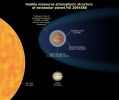
HD-209458b-01.jpgExtra-Solar Planet HD-209458b (2)63 visiteAlthough HD 209458b does not have a twin in our Solar System, it has plenty of relatives beyond our Solar System. About 10 to 15% of the more than 200 known extrasolar planets are hot Jupiters. A recent HST survey netted 16 hot Jupiter candidates in the central region of our Milky Way Galaxy, suggesting that there may be billions of these gas-giant star huggers in our galaxy.
HD 209458b is one of the most intensely studied extrasolar planets because it is one of the few known alien worlds that can be seen passing in front of, or transiting, its star, causing the star to dim slightly. In fact, the gas giant is the first such alien world discovered to transit its star.
HD 209458b is 150 LY from Earth, in the Constellation of Pegasus.
The planet's transits allow astronomers to analyze the structure and chemical makeup of the gas giant's atmosphere by sampling the starlight that passes through it. The effect is similar to finding fingerprints on a window by watching how sunlight filters through the glass.
Previous HST observatoins revealed Oxygen, Carbon and Sodium in the planet's atmosphere, as well as a huge Hydrogen upper atmosphere with a comet-like tail. These landmark studies provided the first detection of the chemical makeup of an extrasolar planet's atmosphere.
Additional observations by NASA's SST captured the infrared glow from the planet's hot atmosphere.
The new study by Ballester and her team is based on an analysis of archival observations made in 2003 with HST's Imaging Spectrograph by David Charbonneau of the Harvard-Smithsonian Center for Astrophysics in Cambridge, Mass. Ballester's team analyzed spectra from hot hydrogen atoms in the planet's upper atmosphere, a region not studied by Charbonneau's group.Feb 04, 2007
|
|
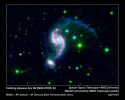
NGC-2535-PIA09106.jpgNGC 2535 and NGC 2536 (alias Arp 82)63 visiteA pair of interacting galaxies might be experiencing the galactic equivalent of a mid-life crisis. For some reason, the pair, called Arp 82, didn't make their stars early on as is typical of most galaxies. Instead, they got a second wind later in life -- about 2 billion years ago -- and started pumping out waves of new stars as if they were young again.
Arp 82 is an interacting pair of galaxies with a strong bridge and a long tail. NGC 2535 is the big galaxy and NGC 2536 is its smaller companion. The disk of the main galaxy looks like an eye, with a bright "pupil" in the center and oval-shaped "eyelids." Dramatic "beads on a string" features are visible as chains of evenly spaced star-formation complexes along the eyelids. These are presumably the result of large-scale gaseous shocks from a grazing encounter. The colors of this galaxy indicate that the observed stars are young to intermediate in age, around 2 million to 2 billion years old, much less than the age of the universe (13.7 billion years).
The puzzle is: why didn't Arp 82 form many stars earlier, like most galaxies of that mass range? Scientifically, it is an oddball and provides a relatively nearby lab for studying the age of intermediate-mass galaxies.
This picture is a composite captured by Spitzer's infrared array camera with light at wavelength 8 microns shown in red, NASA's Galaxy Evolution Explorer combined 1530 and 2310 Angstroms shown in blue, and the Southeastern Association for Research in Astronomy Observatory light at 6940 Angstroms shown in green. Gen 24, 2007
|
|

NGC-1313.jpgNCG 1313 - Barred Spiral65 visite"...You have no idea how much nastier would be if I was not a Catholic.
Without "Supernatural Aid" I would hardly be a human being..."
Evelyn Waugh (1903 - 1966) - replying to Nancy Mitford who rebuked her for cruelty
Gen 13, 2007
|
|

M-016-PIA09107.jpgM 16 - The "Eagle Nebula"65 visiteThis majestic view taken by NASA's Spitzer Space Telescope tells an untold story of life and death in the Eagle Nebula, an industrious star-making factory located 7000 L.Y. away in the Serpens constellation. The image shows the region's entire network of turbulent clouds and newborn stars in infrared light.
The color green denotes cooler towers and fields of dust, including the three famous space pillars, dubbed the "Pillars of Creation," which were photographed by NASA's Hubble Space Telescope in 1995 (see inset).
But it is the color red that speaks of the drama taking place in this region. Red represents hotter dust thought to have been warmed by the explosion of a massive star about 8,000 to 9,000 years ago. Since light from the Eagle nebula takes 7000 years to reach us, this "supernova" explosion would have appeared as an oddly bright star in our skies about 1000 to 2000 years ago.
According to astronomers' estimations, the explosion's blast wave would have spread outward and toppled the three pillars about 6,000 years ago (which means we wouldn't witness the destruction for another 1,000 years or so). The blast wave would have crumbled the mighty towers, exposing newborn stars that were buried inside, and triggering the birth of new ones.
The pillars of the Eagle nebula were originally sculpted by radiation and wind from about 20 or so massive stars hidden from view in the upper left portion of the image. The radiation and wind blew dust away, carving out a hollow cavity (center) and leaving only the densest nuggets of dust and gas (tops of pillars) flanked by columns of lighter dust that lie in shadow (base of pillars). This sculpting process led to the creation of a second generation of stars inside the pillars.
If a star did blow up in this region, it is probably located among the other massive stars in the upper left portion of the image. Its blast wave might have already caused a third generation of stars to spring from the wreckage of the busted pillars.
This image is a composite of infrared light detected by Spitzer's infrared array camera and multiband imaging photometer. Blue is 4.5-micron light; green is 8-micron light; and red is 24-micron light.
Gen 10, 2007
|
|
| 157 immagini su 14 pagina(e) |
|
|
|
|
|
|
10 | |
|
|
|
|
|





