| Ultimi arrivi - The Universe in Super Definition |

Proxima_Centauri_B_-_5.jpgOverview of Proxima and its Parent Star104 visiteOverview and comparison of the orbital distance of the habitable zones of Proxima Centauri compared to the Solar System.MareKromiumAgo 10, 2023
|
|

Proxima_Centauri_B_-_4.jpgNightside of Proxima Centauri "b" (Imagination)125 visitenessun commentoMareKromiumAgo 10, 2023
|
|
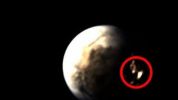
Proxima_Centauri_B_-_3~0.jpgProxima Centauri "b" - Just like Tharsis, BUT ACTIVE! (Extra Mgnf - 3)136 visiteE' come Tharsis, attiva, enorme e situata sul Pianeta (una "Super-Terra") Proxima Centauri b.MareKromiumAgo 10, 2023
|
|
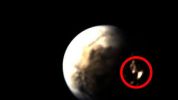
Proxima_Centauri_B_-_2.jpgProxima Centauri "b" - Alien City Lights or Super-volcanic Activity? (2)145 visiteE', a mio umile avviso, un Fenomeno di Super-vulcanismo che accade su scala (di fatto) planetaria. Guardate BENE! E guardate bene le foto di "Io"...MareKromiumAgo 09, 2023
|
|
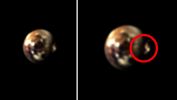
Proxima_Centauri_B_-_1.jpgProxima Centauri "b" - Alien City Lights or Super-volcanic Activity? (1)177 visiteE', a mio umile avviso, un Fenomeno di Super-vulcanismo che accade su scala (di fatto) planetaria. Guardate BENE! E guardate bene le foto di "Io"...MareKromiumAgo 09, 2023
|
|

Unusual_Phenomenon~1.jpgUnusual Phenomenon in the Space of Saturn (sometime things go wrong...)154 visitenessun commentoMareKromiumLug 14, 2022
|
|

Red_Sun-PIA13994.jpgRed Sun125 visiteCaption NASA:"This artist's concept illustrates a young, Red Dwarf Star surrounded by three planets. Such stars are dimmer and smaller than yellow stars like our Sun, which makes them ideal targets for astronomers wishing to take images of planets (called "Exoplanets") outside our Solar System. NASA's Galaxy Evolution Explorer is helping to identify young, Red Dwarf Stars that are close to us by detecting their UltraViolet Light (stars give off a lot of UV Light in their youth). Astronomers will use telescopes to try to image giant planets that orbit farther out from these stars, such as the one depicted here at lower left".MareKromiumMag 14, 2011
|
|

Wasp_12b-PIA13691.jpgExo-Planet "Wasp 12b"134 visiteCaption NASA:"This artist's concept shows the searing-hot Gas Planet WASP-12b (the orange orb) and its Parent (or Host) Star. NASA's Spitzer Space Telescope discovered that the Planet has more Carbon than Oxygen, making it the first Carbon-rich Planet ever observed. Our Earth has relatively little amounts of Carbon - which it is made largely of Oxygen and Silicon.
Other gas planets in our Solar System, for example Jupiter, are expected to have less Carbon than Oxygen, but this is not known. Unlike WASP-12b, these Planets harbor water, the main Oxygen carrier, deep in their Atmospheres, where it is difficult to measure.
Concentrated Carbon can take the form of diamond, so Astronomers say that Carbon-rich Gas Planets could have abundant diamond in their interiors. WASP-12b is located roughly 1200 LY (Light Years) away in the constellation Auriga. It swings around its Parent Star every 1,1 days. Because the Planet is so close to its Parent Star, the Star's gravity stretches it slightly into an egg shape. The Star's gravity also pulls material off the Planet thus creating a disk around the Parent Star itself (shown here in transparent, white hues)".MareKromiumGen 27, 2011
|
|

Kepler_10b-PIA13776.jpgExo-Planet "Kepler 10b"159 visiteCaption NASA:"Artist's concept of the first rocky world discovered by NASA's Kepler Mission. The Planet, called Kepler 10-b, is shown in front of its Host (Parent) Star".MareKromiumGen 27, 2011
|
|

NGC-2683.jpgNGC 2683 - Spiral Edge-On Galaxy107 visitenessun commentoMareKromiumOtt 11, 2010
|
|

PIA13120.jpgWISE Eyes...69 visiteThis frame shows the progress of the WISE All-Sky Survey at the present time. WISE, or NASA's Wide-field InfraRed Survey Explorer, is perched up in the sky like a wise, old owl, scanning the whole sky one-and-a-half times in IR Light. On July 17, 2010, it will have completed its first scan of the entire sky, delivering more than one million image frames so far.
This map is filled in to show the sky areas that WISE scanned over time. Red indicates regions with the greatest coverage, and blue the least. The Poles received the most coverage because WISE orbits Earth around the Poles, scanning out strips of sky as Earth moves around the Sun. The red lines between the Poles show areas that received extra coverage because of the mission's strategy to avoid the Moon.
When the moon is in WISE's field of view, about twice every month, the space telescope captures the region it blocks, by first moving ahead of the moon and then behind it. This results in overlapped coverage for certain slices of sky. During this first all-sky scan, every point was covered by at least eight image frames.
The Infrared Astronomical Satellite was a joint project of the United States, United Kingdom and the Netherlands.
The Two-Micron All-Sky Survey was a project of NASA; the National Science Foundation; the University of Massachusetts, Amherst, and the California Institute of Technology, Pasadena, California.MareKromiumAgo 02, 2010
|
|

Black_Hole-PIA13275.jpgDisk around a massive "Baby Star"?77 visiteCaption NASA:"Astronomers have obtained the first clear look at a Dusty Disk closely encircling a massive "Baby Star", providing direct evidence that massive stars do form in the same way as their smaller brethren -- and closing an enduring debate.
This artist's concept shows what such a massive Disk might look like. The Flared Disk extends to about 130 times the Earth-Sun distance (such as 130 UA), and has a mass similar to that of the star, roughly twenty times the Sun. The inner parts of the Disk are shown to be devoid of dust).
Nota Lunexit: questa č dunque, according to NASA, la rappresentazione artistica di un Disco di polveri e materiale Primordiale posizionato attorno ad una giovane stella supermassiva.
Puņ anche darsi, ma secondo noi la NASA ha scelto male l'immagine da abbinare alla caption e questa, in effetti, č la rappresentazione artistica di un Buco Nero, oppure di un Quasar.
Chissą...MareKromiumAgo 01, 2010
|
|
| 157 immagini su 14 pagina(e) |
1 |
 |
|
|
|
|
|
|
|
|
|





