| |
| Ultimi commenti |

The_Tower-1.jpgA new "Monolith-like Structure" on Mars...120 visiteWith thousands of images taken by various probes sent to Mars, it would seem inevitable that unusual or puzzling objects might be seen in some of them. And of course, there have been, most notably the famous “Face on Mars” first seen in low-resolution Viking Orbiter images in the 1970s. Higher-resolution images taken later by other orbiters with better cameras showed it, and nearby interesting formations, to be just natural hills and mesas. Despite that, other curious things are seen in both orbital and ground images from time to time, although they almost always have a simple prosaic explanation. Another such oddity was seen in an image taken by the Mars Reconnaissance Orbiter (MRO), which has attracted some attention. Most likely it is a natural rock formation, but it’s also not, as described by the tabloid Daily Mail, a “spherule” either.
The image shows a bright object casting a long shadow across the Floor of what might be a dried-up lakebed. Some observers have said it might be a Tower (or "Spire"), judging by the long shadow, but the view is from directly above and not enough detail can be seen on the object itself. The object does stand out for its brightness, but little more can be said about it. Using Occam’s Razor, it is most likely a natural geological rock formation, and not an alien tower, but it also can’t be a round “spherule” as referred to. The spherules seen by the Opportunity and Curiosity rovers are tiny, only a few millimeters across, way, way too small to be seen from orbit. If at all sphere-shaped, it is much bigger than that. Simply being round or tall also wouldn’t prove it was something artificial.MareKromium03/11/23 at 15:21Paolo C. Fienga: Hai ragione Anakin, ho scritto una scemenza. Non s...
|
|
The_Tower-1.jpgA new "Monolith-like Structure" on Mars...120 visiteWith thousands of images taken by various probes sent to Mars, it would seem inevitable that unusual or puzzling objects might be seen in some of them. And of course, there have been, most notably the famous “Face on Mars” first seen in low-resolution Viking Orbiter images in the 1970s. Higher-resolution images taken later by other orbiters with better cameras showed it, and nearby interesting formations, to be just natural hills and mesas. Despite that, other curious things are seen in both orbital and ground images from time to time, although they almost always have a simple prosaic explanation. Another such oddity was seen in an image taken by the Mars Reconnaissance Orbiter (MRO), which has attracted some attention. Most likely it is a natural rock formation, but it’s also not, as described by the tabloid Daily Mail, a “spherule” either.
The image shows a bright object casting a long shadow across the Floor of what might be a dried-up lakebed. Some observers have said it might be a Tower (or "Spire"), judging by the long shadow, but the view is from directly above and not enough detail can be seen on the object itself. The object does stand out for its brightness, but little more can be said about it. Using Occam’s Razor, it is most likely a natural geological rock formation, and not an alien tower, but it also can’t be a round “spherule” as referred to. The spherules seen by the Opportunity and Curiosity rovers are tiny, only a few millimeters across, way, way too small to be seen from orbit. If at all sphere-shaped, it is much bigger than that. Simply being round or tall also wouldn’t prove it was something artificial.MareKromium03/08/23 at 09:43Anakin: Ho trovato un articolo con questo titolo:
Bradi...
|
|
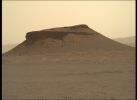
SOL0410-Mars_Perseverance_ZR0_0410_0703339797_332EBY_N0220000ZCAM03343_0340LMJ.pngSliced... - Sol 41081 visitenessun commentoMareKromium03/08/23 at 09:42Anakin: Mi ricorda Masada, un'antica fortezza situata ...
|
|

SOL3423-PIA25176-8192x2276.jpg"(Alli)Gator Back" Rocks on "Greenheugh" - Sol 3423159 visiteNASA’s Curiosity Mars rover used its Mast Camera, or MastCam, to take this 360° panorama on March 23, 2022, the 3.423th Martian Day, or Sol, of the Mission. The team has informally described the wind-sharpened rocks seen here as “gator-back” rocks because of their scaly appearance.
Wind-sharpened rocks like these are called ventifacts, and are responsible for chewing up Curiosity’s wheels earlier in the mission. Since then, rover engineers have found ways to slow wheel wear, including a traction control algorithm. They also plan rover routes that avoid driving over such rocks, including these latest ventifacts, which are made of sandstone – the hardest type of rock Curiosity has encountered on Mars.
These rocks form the Surface of the “Greenheugh Pediment,” a broad, sloping plain in the foothills of Mount Sharp. The floor of Gale Crater is visible along the edges of the mosaic. When Curiosity’s team saw the gator-back rocks, they ultimately decided to turn the rover around and take an alternative path to continue climbing Mount Sharp, a 3,4-mile-tall (approx. 5,5-Km-tall) mountain that Curiosity has been ascending since 2014. As it climbs, Curiosity is able to study different sedimentary layers shaped by water billions of years ago. These layers help scientists understand whether microscopic life could have survived in the ancient Martian Environment.MareKromium03/08/23 at 09:41Ufologo: Bah .....
Faccio una riflessione personale, una...
|
|
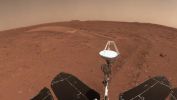
Zhurong-1.jpgA Distant Horizon83 visiteSolita "Cartolina da Marte". Bella. Come e SOLO come "Cartolina" però...MareKromium03/08/23 at 09:39Anakin: ahahahahahahah! Per? sembra che il rover cinese si...
|
|
SOL3423-PIA25176-8192x2276.jpg"(Alli)Gator Back" Rocks on "Greenheugh" - Sol 3423159 visiteNASA’s Curiosity Mars rover used its Mast Camera, or MastCam, to take this 360° panorama on March 23, 2022, the 3.423th Martian Day, or Sol, of the Mission. The team has informally described the wind-sharpened rocks seen here as “gator-back” rocks because of their scaly appearance.
Wind-sharpened rocks like these are called ventifacts, and are responsible for chewing up Curiosity’s wheels earlier in the mission. Since then, rover engineers have found ways to slow wheel wear, including a traction control algorithm. They also plan rover routes that avoid driving over such rocks, including these latest ventifacts, which are made of sandstone – the hardest type of rock Curiosity has encountered on Mars.
These rocks form the Surface of the “Greenheugh Pediment,” a broad, sloping plain in the foothills of Mount Sharp. The floor of Gale Crater is visible along the edges of the mosaic. When Curiosity’s team saw the gator-back rocks, they ultimately decided to turn the rover around and take an alternative path to continue climbing Mount Sharp, a 3,4-mile-tall (approx. 5,5-Km-tall) mountain that Curiosity has been ascending since 2014. As it climbs, Curiosity is able to study different sedimentary layers shaped by water billions of years ago. These layers help scientists understand whether microscopic life could have survived in the ancient Martian Environment.MareKromium03/08/23 at 09:39Anakin: S? Vero Paolo, ma leggendo il tuo commento mi vien...
|
|

The_Lion_sleeps_tonight.jpgJust leave me alone...87 visite"...You thought the lion was sleeping just because he didn’t roar?..."
Friedrich SchillerMareKromium03/06/23 at 17:25Paolo C. Fienga: Condivido. La mia stupida storia (che pochi conosc...
|
|
SOL3423-PIA25176-8192x2276.jpg"(Alli)Gator Back" Rocks on "Greenheugh" - Sol 3423159 visiteNASA’s Curiosity Mars rover used its Mast Camera, or MastCam, to take this 360° panorama on March 23, 2022, the 3.423th Martian Day, or Sol, of the Mission. The team has informally described the wind-sharpened rocks seen here as “gator-back” rocks because of their scaly appearance.
Wind-sharpened rocks like these are called ventifacts, and are responsible for chewing up Curiosity’s wheels earlier in the mission. Since then, rover engineers have found ways to slow wheel wear, including a traction control algorithm. They also plan rover routes that avoid driving over such rocks, including these latest ventifacts, which are made of sandstone – the hardest type of rock Curiosity has encountered on Mars.
These rocks form the Surface of the “Greenheugh Pediment,” a broad, sloping plain in the foothills of Mount Sharp. The floor of Gale Crater is visible along the edges of the mosaic. When Curiosity’s team saw the gator-back rocks, they ultimately decided to turn the rover around and take an alternative path to continue climbing Mount Sharp, a 3,4-mile-tall (approx. 5,5-Km-tall) mountain that Curiosity has been ascending since 2014. As it climbs, Curiosity is able to study different sedimentary layers shaped by water billions of years ago. These layers help scientists understand whether microscopic life could have survived in the ancient Martian Environment.MareKromium03/06/23 at 17:23Paolo C. Fienga: Si Anakin: parole Tue: "Ci saremo!". In ...
|
|
Zhurong-1.jpgA Distant Horizon83 visiteSolita "Cartolina da Marte". Bella. Come e SOLO come "Cartolina" però...MareKromium03/06/23 at 17:21Paolo C. Fienga: Non lo so. Le info attendibili sono praticamente i...
|
|

Comet_Borisov_-_GIF_3.gifFrom far away: the Comet Borisov through the Solar System (GIF-Movie)285 visiteGuardate bene! EccoVi la differenza (REALE ed IN FATTO) tra un Fly-By and uno Swing-By...E senza dimenticare "Oumuamua"!
As the first known object of its type, Oumuamua presented a unique case for the International Astronomical Union (IAU, for short), which assigns designations for astronomical objects. Originally classified as comet C/2017 U1, it was later reclassified as Asteroid A/2017 U1, due to the absence of a coma (--> "Chioma", in Italian).
Once it was unambiguously identified as coming from outside the Solar System, a new designation was created.
The name comes from the Hawaiian word "oumuamua", meaning 'scout' (from ou, meaning 'reach out for', and mua, reduplicated for emphasis, meaning 'first, in advance of', and reflects the way this object is like a scout or messenger sent from the distant past to reach out to Humanity.
It roughly translates to 'first distant messenger' (or "The First Messenger from the distance").
Before the official name was decided upon, the name "Rama" was suggested by the name given to an Alien Spacecraft discovered under similar circumstances in the 1973 science fiction novel "Rendezvous with Rama", by Sir Arthur C. Clarke.MareKromium03/06/23 at 17:20Paolo C. Fienga: Vero. O forse no. Ma, come diceva Mio Padre "...
|
|
The_Tower-1.jpgA new "Monolith-like Structure" on Mars...120 visiteWith thousands of images taken by various probes sent to Mars, it would seem inevitable that unusual or puzzling objects might be seen in some of them. And of course, there have been, most notably the famous “Face on Mars” first seen in low-resolution Viking Orbiter images in the 1970s. Higher-resolution images taken later by other orbiters with better cameras showed it, and nearby interesting formations, to be just natural hills and mesas. Despite that, other curious things are seen in both orbital and ground images from time to time, although they almost always have a simple prosaic explanation. Another such oddity was seen in an image taken by the Mars Reconnaissance Orbiter (MRO), which has attracted some attention. Most likely it is a natural rock formation, but it’s also not, as described by the tabloid Daily Mail, a “spherule” either.
The image shows a bright object casting a long shadow across the Floor of what might be a dried-up lakebed. Some observers have said it might be a Tower (or "Spire"), judging by the long shadow, but the view is from directly above and not enough detail can be seen on the object itself. The object does stand out for its brightness, but little more can be said about it. Using Occam’s Razor, it is most likely a natural geological rock formation, and not an alien tower, but it also can’t be a round “spherule” as referred to. The spherules seen by the Opportunity and Curiosity rovers are tiny, only a few millimeters across, way, way too small to be seen from orbit. If at all sphere-shaped, it is much bigger than that. Simply being round or tall also wouldn’t prove it was something artificial.MareKromium03/06/23 at 17:18Paolo C. Fienga: Qui non saprei, Amico Mio. Ma Pozzuoli ? nota per ...
|
|

Mars_Explorer.jpgFunny...123 visiteNiente rover rigidi e pesanti: la chiave per l'esplorazione marziana è tutta in questa ingegnosa "lucertola cibernetica". La tecnologia ci ha dato nuove opportunità per esplorare lo spazio, specialmente con i robot che sono risultati essere strumenti particolarmente efficaci per l'esplorazione di altri pianeti.
Escludendo l'imminente ritorno sulla Luna, il traguardo spaziale umano più prossimo è l'esplorazione di Marte. Avventura emozionante, che potrebbe svelare tracce risorse, o di vita extraterrestre passata o presente: e se la affrontassimo con una lucertola robotica?
A quattro zampe sul pianeta rosso
Gli scienziati della Nanjing University of Aeronautics and Astronautics hanno realizzato un robot a quattro zampe ispirato alla lucertola che potrebbe essere utile per esplorare Marte. Questo robot, descritto nella rivista Biomimetics di MDPI, possiede una struttura flessibile che imita i movimenti e lo stile di cammino delle lucertole del deserto.MareKromium03/06/23 at 17:13Paolo C. Fienga: No Anakin e no Max, sbagliate. Schiaparelli (con u...
|
|
| 25244 immagini su 2104 pagina(e) |
 |
|
|
|
|
39 | |
|
|
|
|
|
|





