| Ultimi commenti |

OPP-SOL125-2.jpg"Martian Berry" or "Martian Mushroom"? - Sol 125 (Superdefinition + MULTISPECTRUM; credits: Dr G. Barca & Lunexit)92 visitenessun commentoMareKromium05/26/08 at 00:09Ivana Tognoloni: Buonasera a tutti! Sono nuova e vorrei dire la mia...
|
|

MARS-012.jpgThe Planet Mars with "Blue Limb Reflections" (2)335 visitenessun commento05/25/08 at 22:35titanio44: ci siamo ragazzi......vediamo che succede a Phoeni...
|
|
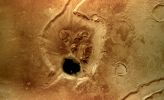
Craters-Unnamed_Crater_at_the_end_of_Mamers_Valles-392-250408-3304-6-co-01.jpgBird's-Eye view of Mamers Valles (MULTISPECTRUM; credits: Lunexit)108 visiteThe High-Resolution Stereo Camera (HRSC) onboard the ESA Spacecraft Mars Express obtained images focusing on a depression that displays a crater at the end of the long, winding Valley System known as Mamers Valles.
The data was obtained on 5 August 2006, with a ground resolution of approx. 14 mt/pixel. The image is centred at approx. 39° North and 17° East on the Planet.
The Mamers Valles System is approx. 1000 Km long, running along the boundary between the Northern Lowlands and Southern Highlands in the Region of Deuteronilus Mensae.
Scientists term a Region such as Mamers Valles ‘fretted terrain’ because it shows numerous deep and wide labyrinth-like valleys and circular depressions which often show structures formed by flowing liquid on their even floors. The structures formed by the flows are thought to be ice-rich debris flows. They show some resemblance to block glaciers seen on Earth.
The patches of rock at the centre of the depression are thought to be remnants of rock detached from the flanks of the depression and transported into its centre MareKromium05/25/08 at 17:51MareKromium: Carissimo Cano00, anch'io ho avuto la medesima...
|
|
Craters-Unnamed_Crater_at_the_end_of_Mamers_Valles-392-250408-3304-6-co-01.jpgBird's-Eye view of Mamers Valles (MULTISPECTRUM; credits: Lunexit)108 visiteThe High-Resolution Stereo Camera (HRSC) onboard the ESA Spacecraft Mars Express obtained images focusing on a depression that displays a crater at the end of the long, winding Valley System known as Mamers Valles.
The data was obtained on 5 August 2006, with a ground resolution of approx. 14 mt/pixel. The image is centred at approx. 39° North and 17° East on the Planet.
The Mamers Valles System is approx. 1000 Km long, running along the boundary between the Northern Lowlands and Southern Highlands in the Region of Deuteronilus Mensae.
Scientists term a Region such as Mamers Valles ‘fretted terrain’ because it shows numerous deep and wide labyrinth-like valleys and circular depressions which often show structures formed by flowing liquid on their even floors. The structures formed by the flows are thought to be ice-rich debris flows. They show some resemblance to block glaciers seen on Earth.
The patches of rock at the centre of the depression are thought to be remnants of rock detached from the flanks of the depression and transported into its centre MareKromium05/25/08 at 16:47broken: nn credo che fantastichi troppo.......
|
|
Craters-Unnamed_Crater_at_the_end_of_Mamers_Valles-392-250408-3304-6-co-01.jpgBird's-Eye view of Mamers Valles (MULTISPECTRUM; credits: Lunexit)108 visiteThe High-Resolution Stereo Camera (HRSC) onboard the ESA Spacecraft Mars Express obtained images focusing on a depression that displays a crater at the end of the long, winding Valley System known as Mamers Valles.
The data was obtained on 5 August 2006, with a ground resolution of approx. 14 mt/pixel. The image is centred at approx. 39° North and 17° East on the Planet.
The Mamers Valles System is approx. 1000 Km long, running along the boundary between the Northern Lowlands and Southern Highlands in the Region of Deuteronilus Mensae.
Scientists term a Region such as Mamers Valles ‘fretted terrain’ because it shows numerous deep and wide labyrinth-like valleys and circular depressions which often show structures formed by flowing liquid on their even floors. The structures formed by the flows are thought to be ice-rich debris flows. They show some resemblance to block glaciers seen on Earth.
The patches of rock at the centre of the depression are thought to be remnants of rock detached from the flanks of the depression and transported into its centre MareKromium05/25/08 at 15:50cano00: bello il laghetto! Queta ? una situazione che si r...
|
|

A-The Sun from Spitzer - spicules_sst_big.jpgSun "Spicules" from the Sptizer Space Telescope (SST)140 visiteCaption NASA originale: "Pictured above is perhaps the highest resolution image yet of the enigmatic "Solar Flux Tubes" known as "Spicules". Spicules dot the above frame of solar active region, but they are particularly evident as a carpet of dark tubes on the right. Time-sequenced images have recently shown that spicules "Life-span" is of about 5 minutes, starting out as tall tubes of rapidly rising gas but eventually fading as the gas peaks and falls back down to the Sun". 05/25/08 at 14:35charlie64: Non lo so. Noi in Sardegna abbiamo fatto lo switch...
|
|
A-The Sun from Spitzer - spicules_sst_big.jpgSun "Spicules" from the Sptizer Space Telescope (SST)140 visiteCaption NASA originale: "Pictured above is perhaps the highest resolution image yet of the enigmatic "Solar Flux Tubes" known as "Spicules". Spicules dot the above frame of solar active region, but they are particularly evident as a carpet of dark tubes on the right. Time-sequenced images have recently shown that spicules "Life-span" is of about 5 minutes, starting out as tall tubes of rapidly rising gas but eventually fading as the gas peaks and falls back down to the Sun". 05/25/08 at 14:33Anubi: si vede Rai News 24 per chi ha Sky?
|
|
A-The Sun from Spitzer - spicules_sst_big.jpgSun "Spicules" from the Sptizer Space Telescope (SST)140 visiteCaption NASA originale: "Pictured above is perhaps the highest resolution image yet of the enigmatic "Solar Flux Tubes" known as "Spicules". Spicules dot the above frame of solar active region, but they are particularly evident as a carpet of dark tubes on the right. Time-sequenced images have recently shown that spicules "Life-span" is of about 5 minutes, starting out as tall tubes of rapidly rising gas but eventually fading as the gas peaks and falls back down to the Sun". 05/25/08 at 14:33charlie64: Verr? seguito in diretta su Rai News 24 sul digita...
|
|
A-The Sun from Spitzer - spicules_sst_big.jpgSun "Spicules" from the Sptizer Space Telescope (SST)140 visiteCaption NASA originale: "Pictured above is perhaps the highest resolution image yet of the enigmatic "Solar Flux Tubes" known as "Spicules". Spicules dot the above frame of solar active region, but they are particularly evident as a carpet of dark tubes on the right. Time-sequenced images have recently shown that spicules "Life-span" is of about 5 minutes, starting out as tall tubes of rapidly rising gas but eventually fading as the gas peaks and falls back down to the Sun". 05/25/08 at 14:33Anubi: Io non credo che avremo immagini "guidate/sce...
|
|
A-The Sun from Spitzer - spicules_sst_big.jpgSun "Spicules" from the Sptizer Space Telescope (SST)140 visiteCaption NASA originale: "Pictured above is perhaps the highest resolution image yet of the enigmatic "Solar Flux Tubes" known as "Spicules". Spicules dot the above frame of solar active region, but they are particularly evident as a carpet of dark tubes on the right. Time-sequenced images have recently shown that spicules "Life-span" is of about 5 minutes, starting out as tall tubes of rapidly rising gas but eventually fading as the gas peaks and falls back down to the Sun". 05/25/08 at 14:10Ufologo: Tra qualche giorno ci mostreranno quello che vorra...
|
|
A-The Sun from Spitzer - spicules_sst_big.jpgSun "Spicules" from the Sptizer Space Telescope (SST)140 visiteCaption NASA originale: "Pictured above is perhaps the highest resolution image yet of the enigmatic "Solar Flux Tubes" known as "Spicules". Spicules dot the above frame of solar active region, but they are particularly evident as a carpet of dark tubes on the right. Time-sequenced images have recently shown that spicules "Life-span" is of about 5 minutes, starting out as tall tubes of rapidly rising gas but eventually fading as the gas peaks and falls back down to the Sun". 05/25/08 at 14:09MareKromium: Carissimo Anakin,
per quanto ne so, il Landing...
|
|
A-The Sun from Spitzer - spicules_sst_big.jpgSun "Spicules" from the Sptizer Space Telescope (SST)140 visiteCaption NASA originale: "Pictured above is perhaps the highest resolution image yet of the enigmatic "Solar Flux Tubes" known as "Spicules". Spicules dot the above frame of solar active region, but they are particularly evident as a carpet of dark tubes on the right. Time-sequenced images have recently shown that spicules "Life-span" is of about 5 minutes, starting out as tall tubes of rapidly rising gas but eventually fading as the gas peaks and falls back down to the Sun". 05/25/08 at 13:11Anakin: non viene monitorato da nessuna parte (ovvero TV) ...
|
|
| 25244 immagini su 2104 pagina(e) |
 |
|
|
|
|
1904 | |
|
|
|
|





