| Ultimi commenti |

Titan-Lakes-Unnamed_North_Polar_Lake-PIA12481.jpgReflection of Sunlight off a Titanian Northern Lake (Natural Colors; credits: NASA/JPL/University of Arizona/DLR)176 visiteThis image shows the first flash of sunlight reflected off a lake on Saturn's moon Titan. The glint off a mirror-like surface is known as a specular reflection. This kind of glint was detected by the visual and infrared mapping spectrometer (VIMS) on NASA's Cassini spacecraft on July 8, 2009. It confirmed the presence of liquid in the moon's northern hemisphere, where lakes are more numerous and larger than those in the southern hemisphere. Scientists using VIMS had confirmed the presence of liquid in Ontario Lacus, the largest lake in the southern hemisphere, in 2008.
The northern hemisphere was shrouded in darkness for nearly 15 years, but the sun began to illuminate the area again as it approached its spring equinox in August 2009. VIMS was able to detect the glint as the viewing geometry changed. Titan's hazy atmosphere also scatters and absorbs many wavelengths of light, including most of the visible light spectrum. But the VIMS instrument enabled scientists to look for the glint in infrared wavelengths that were able to penetrate through the moon's atmosphere. This image was created using wavelengths of light in the 5 micron range.
By comparing the new image to radar and near-infrared light images acquired from 2006 to 2008, Cassini scientists were able to correlate the reflection to the southern shoreline of a Titan lake called Kraken Mare. The sprawling Kraken Mare covers about 400,000 square kilometers (150,000 square miles). The reflection appeared to come from a part of the lake around 71 degrees north latitude and 337 degrees west latitude.
It was taken on Cassini's 59th flyby of Titan on July 8, 2009, at a distance of about 200,000 kilometers (120,000 miles). The image resolution was about 100 kilometers (60 miles) per pixel. Image processing was done at the German Aerospace Center in Berlin and the University of Arizona in Tucson.
MareKromium03/16/22 at 15:59Paolo C. Fienga: ,,,penso Forme di Vita "esotiche", compl...
|
|
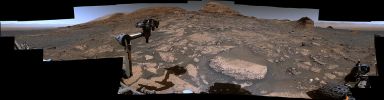
SOL3167.jpgFunny Sky... - Sol 3167141 visiteLa NASA ci dice che si tratta di "false colors" (od anche "white balanced"). Va bene. Ci credo. O forse no...
Caption NASA originale: "Images of knobbly rocks and rounded hills are delighting scientists as NASA’s Curiosity Rover climbs Mount Sharp, a 5-mile-tall (such as approx. 8-Km tall) mountain within the 96-mile-wide (such as about 154-Km wide) basin of Mars’ Gale Crater. The rover’s Mast Camera, a.k.a. MastCam, highlights those features in a panorama captured on July, 3rd, 2021 (i.e. the 3167th Martian Day, or Sol, of the Mission)".
This location is particularly exciting: Spacecraft orbiting Mars show that Curiosity is now somewhere between a Region enriched with clay minerals and one dominated by salty minerals called Sulfates. The mountain’s layers in this area may reveal how the ancient environment within Gale Crater dried up over time. Similar changes are seen across the planet, and studying this Region up close (---> da vicino) has been a major long-term goal for the mission.
"The rocks here will begin to tell us how this once-wet planet changed into the dry Mars of today, and how long habitable environments persisted even after that happened,” said Abigail Fraeman, Curiosity’s deputy project scientist, at NASA’s Jet Propulsion Laboratory in Southern California".
The "Dry Mars of today"... Mmmmmhhhhh.... Are we really sure about that?!? I am not. And You?!?MareKromium03/13/22 at 08:37Ufologo: Da ricordare per? che la Russia vinse con gli aiut...
|
|
Titan-Lakes-Unnamed_North_Polar_Lake-PIA12481.jpgReflection of Sunlight off a Titanian Northern Lake (Natural Colors; credits: NASA/JPL/University of Arizona/DLR)176 visiteThis image shows the first flash of sunlight reflected off a lake on Saturn's moon Titan. The glint off a mirror-like surface is known as a specular reflection. This kind of glint was detected by the visual and infrared mapping spectrometer (VIMS) on NASA's Cassini spacecraft on July 8, 2009. It confirmed the presence of liquid in the moon's northern hemisphere, where lakes are more numerous and larger than those in the southern hemisphere. Scientists using VIMS had confirmed the presence of liquid in Ontario Lacus, the largest lake in the southern hemisphere, in 2008.
The northern hemisphere was shrouded in darkness for nearly 15 years, but the sun began to illuminate the area again as it approached its spring equinox in August 2009. VIMS was able to detect the glint as the viewing geometry changed. Titan's hazy atmosphere also scatters and absorbs many wavelengths of light, including most of the visible light spectrum. But the VIMS instrument enabled scientists to look for the glint in infrared wavelengths that were able to penetrate through the moon's atmosphere. This image was created using wavelengths of light in the 5 micron range.
By comparing the new image to radar and near-infrared light images acquired from 2006 to 2008, Cassini scientists were able to correlate the reflection to the southern shoreline of a Titan lake called Kraken Mare. The sprawling Kraken Mare covers about 400,000 square kilometers (150,000 square miles). The reflection appeared to come from a part of the lake around 71 degrees north latitude and 337 degrees west latitude.
It was taken on Cassini's 59th flyby of Titan on July 8, 2009, at a distance of about 200,000 kilometers (120,000 miles). The image resolution was about 100 kilometers (60 miles) per pixel. Image processing was done at the German Aerospace Center in Berlin and the University of Arizona in Tucson.
MareKromium03/12/22 at 18:59walthari: Titano ? veramente un mondo interessante sotto mol...
|
|
SOL3167.jpgFunny Sky... - Sol 3167141 visiteLa NASA ci dice che si tratta di "false colors" (od anche "white balanced"). Va bene. Ci credo. O forse no...
Caption NASA originale: "Images of knobbly rocks and rounded hills are delighting scientists as NASA’s Curiosity Rover climbs Mount Sharp, a 5-mile-tall (such as approx. 8-Km tall) mountain within the 96-mile-wide (such as about 154-Km wide) basin of Mars’ Gale Crater. The rover’s Mast Camera, a.k.a. MastCam, highlights those features in a panorama captured on July, 3rd, 2021 (i.e. the 3167th Martian Day, or Sol, of the Mission)".
This location is particularly exciting: Spacecraft orbiting Mars show that Curiosity is now somewhere between a Region enriched with clay minerals and one dominated by salty minerals called Sulfates. The mountain’s layers in this area may reveal how the ancient environment within Gale Crater dried up over time. Similar changes are seen across the planet, and studying this Region up close (---> da vicino) has been a major long-term goal for the mission.
"The rocks here will begin to tell us how this once-wet planet changed into the dry Mars of today, and how long habitable environments persisted even after that happened,” said Abigail Fraeman, Curiosity’s deputy project scientist, at NASA’s Jet Propulsion Laboratory in Southern California".
The "Dry Mars of today"... Mmmmmhhhhh.... Are we really sure about that?!? I am not. And You?!?MareKromium03/12/22 at 18:56walthari: la Russia che abbia ragione o torto non perde le g...
|
|

R-Hydrae-PIA09070.jpgR-Hydrae61 visite"...Un Paese che si reputa Democratico e che fa della "Democrazia" il vessillo dietro al quale - o sotto il quale... - nascondere tutte le proprie inefficienze e manchevolezze, non è un Paese Democratico..."
P.C. Floegers03/12/22 at 18:55walthari: vero!!!
|
|
R-Hydrae-PIA09070.jpgR-Hydrae61 visite"...Un Paese che si reputa Democratico e che fa della "Democrazia" il vessillo dietro al quale - o sotto il quale... - nascondere tutte le proprie inefficienze e manchevolezze, non è un Paese Democratico..."
P.C. Floegers03/12/22 at 15:58Paolo C. Fienga: Commentando la frase, ecco l'Italia (e non sol...
|
|
SOL3167.jpgFunny Sky... - Sol 3167141 visiteLa NASA ci dice che si tratta di "false colors" (od anche "white balanced"). Va bene. Ci credo. O forse no...
Caption NASA originale: "Images of knobbly rocks and rounded hills are delighting scientists as NASA’s Curiosity Rover climbs Mount Sharp, a 5-mile-tall (such as approx. 8-Km tall) mountain within the 96-mile-wide (such as about 154-Km wide) basin of Mars’ Gale Crater. The rover’s Mast Camera, a.k.a. MastCam, highlights those features in a panorama captured on July, 3rd, 2021 (i.e. the 3167th Martian Day, or Sol, of the Mission)".
This location is particularly exciting: Spacecraft orbiting Mars show that Curiosity is now somewhere between a Region enriched with clay minerals and one dominated by salty minerals called Sulfates. The mountain’s layers in this area may reveal how the ancient environment within Gale Crater dried up over time. Similar changes are seen across the planet, and studying this Region up close (---> da vicino) has been a major long-term goal for the mission.
"The rocks here will begin to tell us how this once-wet planet changed into the dry Mars of today, and how long habitable environments persisted even after that happened,” said Abigail Fraeman, Curiosity’s deputy project scientist, at NASA’s Jet Propulsion Laboratory in Southern California".
The "Dry Mars of today"... Mmmmmhhhhh.... Are we really sure about that?!? I am not. And You?!?MareKromium03/12/22 at 15:54Paolo C. Fienga: Non so dove vada a parare n? come e dove possa and...
|
|

OPP-SOL657-PIA03622~1.jpgErebus' rim95 visiteOriginal caption:"The center upper portion of this image shows a portion of the rim of Erebus Crater in the Meridiani Planum Region of Mars. This approximately true-color view from the PanCam on Rover Opportunity is a composite of frames acquired on the Rover's 657th Martian day (Nov. 28, 2005). This is a small portion of a large panorama. Other portions of the panorama were still being shot 3 Soles later. This view is a composite of separate images taken through the camera's 750-, 530- and 430-nanometer filters".
Nota --> ormai è evidente: la superficie di Marte, in Area Meridiani, è color verde scuro (verde "marcio"). Il rosso e l'arancione dominanti, come ripresi durante i primi Soles, anche se pure in quei casi si trattava (a detta della NASA!) di frames in "approximate true colors", a questo punto dobbiamo concludere che quei "true colors" dovevano essere dei "wrong true colors".
Ad ogni modo: il frame è bello; gli eventuali ed ulteriori commenti...Inutili.03/12/22 at 15:52Paolo C. Fienga: Troppo uniforme, denso e marcato. E poi...la sabbi...
|
|

w-Eclipse-PIA23135.gifAnnular Eclipse from Mars (GIF-Movie)106 visiteLe "eclissi", su Marte, sono SEMPRE "presso-anulari". Il che significa "MAI" oscurità assoluta. Solo "penumbra". Ecco un esempio.MareKromium03/12/22 at 15:50Paolo C. Fienga: Caro Anakin, sono d'accordo: Phobos ? un sasso...
|
|
w-Eclipse-PIA23135.gifAnnular Eclipse from Mars (GIF-Movie)106 visiteLe "eclissi", su Marte, sono SEMPRE "presso-anulari". Il che significa "MAI" oscurità assoluta. Solo "penumbra". Ecco un esempio.MareKromium03/11/22 at 14:57Anakin: Phobos ? un sasso che gira in orbita. Non si pu? n...
|
|
OPP-SOL657-PIA03622~1.jpgErebus' rim95 visiteOriginal caption:"The center upper portion of this image shows a portion of the rim of Erebus Crater in the Meridiani Planum Region of Mars. This approximately true-color view from the PanCam on Rover Opportunity is a composite of frames acquired on the Rover's 657th Martian day (Nov. 28, 2005). This is a small portion of a large panorama. Other portions of the panorama were still being shot 3 Soles later. This view is a composite of separate images taken through the camera's 750-, 530- and 430-nanometer filters".
Nota --> ormai è evidente: la superficie di Marte, in Area Meridiani, è color verde scuro (verde "marcio"). Il rosso e l'arancione dominanti, come ripresi durante i primi Soles, anche se pure in quei casi si trattava (a detta della NASA!) di frames in "approximate true colors", a questo punto dobbiamo concludere che quei "true colors" dovevano essere dei "wrong true colors".
Ad ogni modo: il frame è bello; gli eventuali ed ulteriori commenti...Inutili.03/11/22 at 14:51Anakin: perch? non potrebbero essere le polveri sottili a ...
|
|
SOL3167.jpgFunny Sky... - Sol 3167141 visiteLa NASA ci dice che si tratta di "false colors" (od anche "white balanced"). Va bene. Ci credo. O forse no...
Caption NASA originale: "Images of knobbly rocks and rounded hills are delighting scientists as NASA’s Curiosity Rover climbs Mount Sharp, a 5-mile-tall (such as approx. 8-Km tall) mountain within the 96-mile-wide (such as about 154-Km wide) basin of Mars’ Gale Crater. The rover’s Mast Camera, a.k.a. MastCam, highlights those features in a panorama captured on July, 3rd, 2021 (i.e. the 3167th Martian Day, or Sol, of the Mission)".
This location is particularly exciting: Spacecraft orbiting Mars show that Curiosity is now somewhere between a Region enriched with clay minerals and one dominated by salty minerals called Sulfates. The mountain’s layers in this area may reveal how the ancient environment within Gale Crater dried up over time. Similar changes are seen across the planet, and studying this Region up close (---> da vicino) has been a major long-term goal for the mission.
"The rocks here will begin to tell us how this once-wet planet changed into the dry Mars of today, and how long habitable environments persisted even after that happened,” said Abigail Fraeman, Curiosity’s deputy project scientist, at NASA’s Jet Propulsion Laboratory in Southern California".
The "Dry Mars of today"... Mmmmmhhhhh.... Are we really sure about that?!? I am not. And You?!?MareKromium03/11/22 at 14:48Anakin: sta terza guerra mondiale, nelle sue narrazioni e ...
|
|
| 25244 immagini su 2104 pagina(e) |
 |
|
|
|
|
176 | |
|
|
|
|





