| Ultimi commenti - Asteroids and Comets |

Itokawa.gifRevolving around Itokawa (a GIF-Movie by Dr Gianluigi Barca - Lunexit Team)60 visitenessun commentoMareKromium06/15/10 at 13:45MareKromium: Ben detto Andrea! doc
|
|
Itokawa.gifRevolving around Itokawa (a GIF-Movie by Dr Gianluigi Barca - Lunexit Team)60 visitenessun commentoMareKromium06/15/10 at 11:14andreagg: "fanno schifo"? Immagini di una sonda so...
|
|
Itokawa.gifRevolving around Itokawa (a GIF-Movie by Dr Gianluigi Barca - Lunexit Team)60 visitenessun commentoMareKromium06/15/10 at 11:08MareKromium: Ribadisco: secondo "qualcuno", le nostre...
|
|
Itokawa.gifRevolving around Itokawa (a GIF-Movie by Dr Gianluigi Barca - Lunexit Team)60 visitenessun commentoMareKromium06/15/10 at 10:52Gianluigi: Grazie a te Andrea! Per la cronaca... la gif mostr...
|
|
Itokawa.gifRevolving around Itokawa (a GIF-Movie by Dr Gianluigi Barca - Lunexit Team)60 visitenessun commentoMareKromium06/14/10 at 21:31andreagg: meraviglioso questo gif! Grazie
|
|

Itokawa-05.jpgOrbiting around Itokawa (2)67 visiteHayabusa is a technology demonstration spacecraft focusing on key technologies that are required for future large-scale sample and return missions, yet is also making new scientific observations and discoveries. The technology demonstration component of the mission consists of 5 goals:
1) ion engine propulsion in interplanetary cruise;
2) ion engine propulsion in combination with an Earth gravity assist;
3) autonomous guidance and navigation using optical measurements;
4) collection of surface samples in an ultra-low gravity environment and
5) the direct recovery of these samples on the ground after its return from interplanetary flight.
To date the Hayabusa project has accomplished these demonstrations up through
the third goal.06/14/10 at 08:16walthari: incrociamo le dita sul contenuto di campioni....
|
|
Itokawa-05.jpgOrbiting around Itokawa (2)67 visiteHayabusa is a technology demonstration spacecraft focusing on key technologies that are required for future large-scale sample and return missions, yet is also making new scientific observations and discoveries. The technology demonstration component of the mission consists of 5 goals:
1) ion engine propulsion in interplanetary cruise;
2) ion engine propulsion in combination with an Earth gravity assist;
3) autonomous guidance and navigation using optical measurements;
4) collection of surface samples in an ultra-low gravity environment and
5) the direct recovery of these samples on the ground after its return from interplanetary flight.
To date the Hayabusa project has accomplished these demonstrations up through
the third goal.06/14/10 at 07:272di7: Buongiorno Gigi, buongiorno a tutti!!! Ho appena l...
|
|
Itokawa-05.jpgOrbiting around Itokawa (2)67 visiteHayabusa is a technology demonstration spacecraft focusing on key technologies that are required for future large-scale sample and return missions, yet is also making new scientific observations and discoveries. The technology demonstration component of the mission consists of 5 goals:
1) ion engine propulsion in interplanetary cruise;
2) ion engine propulsion in combination with an Earth gravity assist;
3) autonomous guidance and navigation using optical measurements;
4) collection of surface samples in an ultra-low gravity environment and
5) the direct recovery of these samples on the ground after its return from interplanetary flight.
To date the Hayabusa project has accomplished these demonstrations up through
the third goal.06/14/10 at 06:48Gianluigi: Fonte: la Repubblica
? tornata la sonda giappon...
|
|
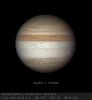
Comets-Wesley-Jupiter_Impact-2.jpgCometary Impact on Jupiter 179 visitenessun commentoMareKromium06/11/10 at 10:00walthari: lo spero!!!!;-)
|
|
Comets-Wesley-Jupiter_Impact-2.jpgCometary Impact on Jupiter 179 visitenessun commentoMareKromium06/11/10 at 09:48Anakin: E' stato messo li apposta. Non è un caso ;-)
|
|
Comets-Wesley-Jupiter_Impact-2.jpgCometary Impact on Jupiter 179 visitenessun commentoMareKromium06/11/10 at 09:47walthari: e meno male che c'? Giove a parare un po' ...
|
|

Comets-Comet_Siding_Spring-PIA12836.jpgComet Siding Spring64 visiteCaption NASA:"Is it a bird, or a plane? It's comet Siding Spring streaking across the sky, as seen by NASA's Wide-field Infrared Survey Explorer, or WISE.
The comet, also known as C/2007 Q3, was discovered in 2007 by observers in Australia. The snowball-like mass of ice and dust spent billions of years orbiting in the deep freeze of the Oort Cloud, a spherical cloud of comets surrounding our Solar System. At some point, it got knocked out of this orbit and onto a course that brings it closer to the Sun. Sunlight has warmed the Comet, causing it to shed ices and dust in a long tail that trails behind it.
On October 7, 2009, comet Siding Spring passed as close as 1,2 Astronomical Units from Earth and 2,25 Astronomical Units from the Sun (an Astronomical Unit - AU - is the distance between the Sun and Earth). Now, the comet is leaving the warmer, more hospitable neighborhood of the Solar System and heading back out to chillier parts. In this view, longer wavelengths of InfraRed Light are red and shorter wavelengths are blue.
The comet appears red because it is more than ten times colder than the surrounding stars. Colder objects give off more of their light at longer wavelengths.
An ice cube, for example, pours out a larger fraction of its light at longer InfraRed wavelengths than a cup of hot tea emits".MareKromium04/16/10 at 07:17MareKromium: L'indirizzo ? il solito (Sugarmoon@intercom.it...
|
|
| 603 immagini su 51 pagina(e) |
 |
|
|
|
|
44 | |
|
|
|
|





