| |

| Ultimi commenti - Asteroids and Comets |

Tempel1-ZZ-ZJ-Stardust_1024-PIA13860-PCF-LXTT.jpgComet Tempel-1 from Stardust NeXT Spacecraft (Natural Colors; credits for the additional process. and color.: Dr Paolo C. Fienga - Lunexit Team) 120 visiteCaption NASA:"This image mosaic shows 4 different views of comet Tempel-1 as seen by NASA's Stardust Spacecraft as it flew by it on February 14, 2011.
The images progress in time beginning at upper left, moving to upper right, then proceeding from lower left to lower right. When the Spacecraft first approached, it got a clear look at the same Surface that was imaged previously by NASA's Deep Impact Spacecraft in 2005. Deep Impact sent a projectile into the Comet, creating a crater that is located in the upper left image, but is difficult to see at this particular contrast level.
As Stardust flew closer to the Comet, it began to see New Territory that had not been imaged before. The New Territory appears on the left side of the upper right image. The Deep Impact Crater is also located in this view, on the right side.
Both the upper right and lower left images are the Closest Approach images for Stardust, taken at 3" before, and 3" after it. The images were taken from a distance of about 185 Km (approx. 115 miles). In the lower left image, the vast majority of Terrain pictured had not been seen until now. The fourth image, at lower right, shows Stardust's view as the Spacecraft was on the way out.
The image at upper left was taken 15" before the Encounter (or Closest Approach) from a distance of approx. 244 Km (about 152 miles); the image at lower right was taken 15" after the Encounter, from a distance of approx. 245 Km (about 152 miles)".MareKromium10/15/13 at 10:54MareKromium: Ancora il Nucleo di Tempel-1.
|
|

Tempel1-ZZ-ZI.jpgA few seconds before the "Space-Fireworks"60 visiteDa "NASA - Picture of the Day" del 15 Settembre 2005:"Approaching the nucleus of comet Tempel 1 at 10 Km/sec., the Deep Impact probe's targeting camera recorded a truly dramatic series of images. Successive pictures improve in resolution and have been composited here at a scale of 5 mt per pixel - including images taken within a few meters of the surface moments before the July 4th impact. Analyzing the resulting cloud of debris, researchers are directly exploring the makeup of a comet, a primordial chunk of Solar System material. Described as a recipe for primordial soup, the list of Tempel 1's ingredients - tiny grains of silicates, iron compounds, complex hydrocarbons and clay and carbonates thought to require liquid water to form - might be more appropriate for a cosmic souffle, as the nucleus is apparently porous and fluffy.
Seen here, Tempel 1's nucleus is about 5 Km long, with the impact site between the two large craters near the bottom".10/15/13 at 10:54MareKromium: Nucleo di Tempel-1.
|
|

Comets-Hale-Bopp-01.jpgHale-Bopp - HST (2)60 visiteIn questi 8 frames HST l'Anomalia di cui parlavamo per il quadro precedente si vede ancora solo nelle prime due immagini (26 Settembre e 23 Ottobre). Noi diciamo con chiarezza che si tratta di qualcosa di reale e di inspiegabile; magari non sarà una Nave Spaziale aliena che si è accodata ad Hale-Bopp ma è certo che qualcosa era vicino alla cometa e 1) la seguiva oppure 2) faceva parte di essa.
Le Fonti Ufficiali non hanno detto MAI nulla, ma queste immagini parlano - chiaramente - da sole.
Che cosa, dunque, seguiva e/o accompagnava Hale-Bopp?!?...10/15/13 at 10:53MareKromium: Nucleo di Hale-Bopp.
|
|

Comets-Halley-30155.jpgThe Halley Comet, from Giotto62 visiteCaption ESA originale:"A composite image of the nucleus of comet Halley. This image is composed of 68 images of varying resolution. The data at the brightest point on the nucleus is at the highest resolution (50 m).
The Sun comes from 30° above the horizontal to the left and is 17° behind the image plane (observation phase angle of 107°). The night side of the nucleus can be seen silhouetted against a background of bright dust in the far-field. Jets can be seen originating from 2 regions on the nucleus. Structure can be seen within the jets. A bright area is seen within the night side of the nucleus. We believe this to be a hill or mountain approximately 500 mt high. Other surface details can be seen in the illuminated region".10/15/13 at 10:53MareKromium: Nucleo di Halley.
|
|

Comets-Wild_2-02.jpgWild 2 - stereo image pair62 visitenessun commento10/15/13 at 10:52MareKromium: ...ancora il Nucleo di Wild 2.
|
|
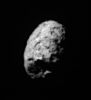
Comets-Wild_2-00.jpgApproaching Wild 2 (1)61 visiteCaption NASA originale:"This image was taken during the close approach phase of Stardust's Jan 2, 2004 flyby of comet Wild 2. It is a distant side view of the roughly spherical comet nucleus. One hemisphere is in sunlight and the other is in shadow analogous to a view of the quarter moon. Several large depressed regions can be seen. Comet Wild 2 is about 5 Km (3,1 miles) in diameter".10/15/13 at 10:51MareKromium: Nucleo di Wild 2.
|
|

Comets-Halley-nucleus.jpgThe Nucleus of Halley62 visiteWhat does a Comet Nucleus look like?
Formed from the primordial stuff of the Solar System, Comet Nuclei were thought to resemble to very dirty icebergs. But ground-based telescopes revealed only the surrounding cloud of gas and dust of Active Comets nearing the Sun, clearly resolving only the Comet's Coma, and the characteristic cometary tails.
In 1986, however, the European Spacecraft "Giotto" became one of the first group of spacecrafts which encountered and photographed the Nucleus of a Comet, when it passed and imaged Halley's Nucleus as it approached the Sun.
Data from Giotto's camera were used to generate this enhanced image of the potato shaped Nucleus that measures roughly 15 Km across. Some Surface Features on the dark Nucleus are on the right, while gas and dust flowing into Halley's Coma are on the left.
Every 76 years Comet Halley returns to the Inner Solar System and each time the Nucleus sheds about a 6-meter deep layer of its ice and rock into space. This debris shed from Halley's Nucleus eventually disperses into an orbiting trail responsible for the Orionids Meteor Shower, which occurs in October of every year, and the Eta Aquariids Meteor Shower, that occurs in May.MareKromium10/15/13 at 10:51MareKromium: Nucleo di Halley.
|
|

Comets-Comet_Hartley_2-NASA-1.jpgComet "Hartley 2" (Dimensions)99 visitenessun commentoMareKromium10/15/13 at 10:50MareKromium: Si parlava di Nuclei Cometari: ecco quello di Hart...
|
|
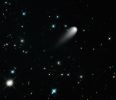
Comets-Comet_ISON-HST-30Apr-V_I-L-800.jpgComet ISON (Hubble Space Telescope's View)149 visiteAdvanced amateur astronomers are already getting good images of Comet ISON, which currently shines at around +12th magnitude in the constellation Cancer. And although NASA’s Deep Impact/EPOXI mission is down for the count, plans are afoot for the Curiosity rover and the Mars Reconnaissance Orbiter to attempt imaging the comet when it makes its closest approach to the Red Planet on October 1st at 0.0724 Astronomical Units (A.U.) or 10,830,000 kilometres distant. If MSL is successful, it would be the first time that a comet has been observed from the surface of another world.
Currently, ISON sits about a magnitude below the projected light curve, (see below) but that isn’t all that unusual for a comet. Already, there’s been increasing talk of “ISON being a dud,” but as Universe Today’s Nancy Atkinson pointed out in a recent post, these assertions are still premature. The big question is what ISON will do leading up to perihelion, and if it will survive its passage 1.1 million kilometres above the surface of the Sun on November 28th to become a fine comet in the dawn skies in the weeks leading up to Christmas.
ISON is already starting to show a short, spikey tail in amateur images. Tsutomu Seki estimated it to be shining at about magnitude +11.1 on September 16th. Keep in mind, a caveat is in order when talking about the magnitudes of comets. Unlike stars, which are essentially a point source, the brightness of a comet is spread out over a large surface area. Thus, a comet may appear visually fainter than the quoted magnitude, much like a diffuse nebula. Although +6th magnitude is usually the limit for naked eye visibility, I’ll bet that most folks won’t pick up ISON with the unaided eye from typical suburban sites until it breaks +4th magnitude or so.
The forward scattering of light also plays a key role in the predicted brightness of a comet. The November issue of Astronomy Magazine has a great article on this phenomenon. It’s interesting to note that ISON stacks up as a “9” on their accumulated point scale, right at the lower threshold of comet “greatness,” versus a 15 for sungrazing Comet C/1965 S1 Ikeya-Seki. Another famous “9” was Comet C/1996 B2 Hyakutake, which passed 0.1018 A.U. or 15.8 million kilometres from Earth on March 25, 1996.
ISON will pass 0.429 A.U. or 64.2 million kilometres from Earth the day after Christmas. Bruce Willis can stay home for this one.
Here is a blow-by-blow breakdown of some key dates to watch for as ISON makes its plunge into the inner solar system:
-September 25th: ISON crosses the border from the astronomical constellation of Cancer into Leo.
-September 27th: ISON passes 2 degrees north of the planet Mars.
-October 1st: The 12% illuminated waning crescent Moon passes 10 degrees south of Mars & ISON.
-Early October: ISON may break +10th magnitude and become visible with binoculars or a small telescope.
-October 4th: New Moon occurs. The Moon then exits the dawn sky, making for two weeks of prime viewing.
-October 10th: ISON enters view of NASA’s STEREO/SECCHI HI-2A CAMERA:
-October 16th: ISON passes just 2 degrees NNE of the bright star Regulus, making a great “guidepost” to pin it down with binoculars.
-October 18th: The Full Moon occurs, after which the Moon enters the morning sky.
-October 26th: A great photo-op for astro-imagers occurs, as ISON passes within three degrees the Leo galaxy trio of M95, M96, & M105.
-October 30th: The 17% illuminated Moon passes 6 degrees south of ISON.
-Early November: Comet ISON may make its naked eye debut for observers based at dark sky sites.
-November 3rd: A hybrid (annular-total) solar eclipse occurs, spanning the Atlantic and Central Africa. It may just be possible for well placed observers to catch sight of ISON in the daytime during totality, depending on how quickly it brightens up. The Moon reaching New phase also means that the next two weeks will be prime view time for ISON at dawn.
-November 5th: ISON crosses the border from the astronomical constellation of Leo into Virgo.
-November 7th: ISON passes less than a degree from the +3.6 magnitude star Zavijava (Beta Virginis).
-November 8th: ISON passes through the equinoctial point in Virgo around 16:00 EDT/20:00 UT, passing into the southern celestial hemisphere and south of the ecliptic.
-November 14th: ISON passes less than a degree from the 10th magnitude galaxy NGC 4697.
-November 17th: The Moon reaches Full, passing into the morning sky.
-November 18th: ISON passes just 0.38 degrees north of the bright star Spica.
-November 22nd: ISON crosses into the astronomical constellation of Libra.
-November 23rd: ISON sits 4.7 degrees SSW of the planet Mercury and 4.9 SSW of Saturn, respectively.
-November 25th: ISON pays a visit to another famous comet, passing just 1.2 degrees south of short period comet 2P/Encke which may shine at +8th magnitude.
-November 27th: ISON enters the field of view of SOHO’s LASCO C3 coronagraph.
-November 28th: ISON reaches perihelion at ~18:00 PM EST/ 23:00 UT.
After that, all bets are off. The days leading up to perihelion will be tense ones, as ISON then rounds the Sun on a date with astronomical destiny. Will it join the ranks of the great comets of the past? Will it stay intact, or shatter in a spectacular fashion? Watch this space for ISON updates… we’ll be back in late November with our post-perihelion guide!
Be sure to also enjoy recently discovered Comet C/2013 R1 Lovejoy later the year.
(source: http://www.universetoday.com/104818/comet-ison-a-viewing-guide-from-now-to-perihelion/#ixzz2fpLTKJwD)
Read more: http://www.universetoday.com/104818/comet-ison-a-viewing-guide-from-now-to-perihelion/#ixzz2fpLG75usMareKromium10/15/13 at 09:20Anakin: La sonda Deep Impact della NASA, ribattezzata EPOX...
|
|
Comets-Comet_ISON-HST-30Apr-V_I-L-800.jpgComet ISON (Hubble Space Telescope's View)149 visiteAdvanced amateur astronomers are already getting good images of Comet ISON, which currently shines at around +12th magnitude in the constellation Cancer. And although NASA’s Deep Impact/EPOXI mission is down for the count, plans are afoot for the Curiosity rover and the Mars Reconnaissance Orbiter to attempt imaging the comet when it makes its closest approach to the Red Planet on October 1st at 0.0724 Astronomical Units (A.U.) or 10,830,000 kilometres distant. If MSL is successful, it would be the first time that a comet has been observed from the surface of another world.
Currently, ISON sits about a magnitude below the projected light curve, (see below) but that isn’t all that unusual for a comet. Already, there’s been increasing talk of “ISON being a dud,” but as Universe Today’s Nancy Atkinson pointed out in a recent post, these assertions are still premature. The big question is what ISON will do leading up to perihelion, and if it will survive its passage 1.1 million kilometres above the surface of the Sun on November 28th to become a fine comet in the dawn skies in the weeks leading up to Christmas.
ISON is already starting to show a short, spikey tail in amateur images. Tsutomu Seki estimated it to be shining at about magnitude +11.1 on September 16th. Keep in mind, a caveat is in order when talking about the magnitudes of comets. Unlike stars, which are essentially a point source, the brightness of a comet is spread out over a large surface area. Thus, a comet may appear visually fainter than the quoted magnitude, much like a diffuse nebula. Although +6th magnitude is usually the limit for naked eye visibility, I’ll bet that most folks won’t pick up ISON with the unaided eye from typical suburban sites until it breaks +4th magnitude or so.
The forward scattering of light also plays a key role in the predicted brightness of a comet. The November issue of Astronomy Magazine has a great article on this phenomenon. It’s interesting to note that ISON stacks up as a “9” on their accumulated point scale, right at the lower threshold of comet “greatness,” versus a 15 for sungrazing Comet C/1965 S1 Ikeya-Seki. Another famous “9” was Comet C/1996 B2 Hyakutake, which passed 0.1018 A.U. or 15.8 million kilometres from Earth on March 25, 1996.
ISON will pass 0.429 A.U. or 64.2 million kilometres from Earth the day after Christmas. Bruce Willis can stay home for this one.
Here is a blow-by-blow breakdown of some key dates to watch for as ISON makes its plunge into the inner solar system:
-September 25th: ISON crosses the border from the astronomical constellation of Cancer into Leo.
-September 27th: ISON passes 2 degrees north of the planet Mars.
-October 1st: The 12% illuminated waning crescent Moon passes 10 degrees south of Mars & ISON.
-Early October: ISON may break +10th magnitude and become visible with binoculars or a small telescope.
-October 4th: New Moon occurs. The Moon then exits the dawn sky, making for two weeks of prime viewing.
-October 10th: ISON enters view of NASA’s STEREO/SECCHI HI-2A CAMERA:
-October 16th: ISON passes just 2 degrees NNE of the bright star Regulus, making a great “guidepost” to pin it down with binoculars.
-October 18th: The Full Moon occurs, after which the Moon enters the morning sky.
-October 26th: A great photo-op for astro-imagers occurs, as ISON passes within three degrees the Leo galaxy trio of M95, M96, & M105.
-October 30th: The 17% illuminated Moon passes 6 degrees south of ISON.
-Early November: Comet ISON may make its naked eye debut for observers based at dark sky sites.
-November 3rd: A hybrid (annular-total) solar eclipse occurs, spanning the Atlantic and Central Africa. It may just be possible for well placed observers to catch sight of ISON in the daytime during totality, depending on how quickly it brightens up. The Moon reaching New phase also means that the next two weeks will be prime view time for ISON at dawn.
-November 5th: ISON crosses the border from the astronomical constellation of Leo into Virgo.
-November 7th: ISON passes less than a degree from the +3.6 magnitude star Zavijava (Beta Virginis).
-November 8th: ISON passes through the equinoctial point in Virgo around 16:00 EDT/20:00 UT, passing into the southern celestial hemisphere and south of the ecliptic.
-November 14th: ISON passes less than a degree from the 10th magnitude galaxy NGC 4697.
-November 17th: The Moon reaches Full, passing into the morning sky.
-November 18th: ISON passes just 0.38 degrees north of the bright star Spica.
-November 22nd: ISON crosses into the astronomical constellation of Libra.
-November 23rd: ISON sits 4.7 degrees SSW of the planet Mercury and 4.9 SSW of Saturn, respectively.
-November 25th: ISON pays a visit to another famous comet, passing just 1.2 degrees south of short period comet 2P/Encke which may shine at +8th magnitude.
-November 27th: ISON enters the field of view of SOHO’s LASCO C3 coronagraph.
-November 28th: ISON reaches perihelion at ~18:00 PM EST/ 23:00 UT.
After that, all bets are off. The days leading up to perihelion will be tense ones, as ISON then rounds the Sun on a date with astronomical destiny. Will it join the ranks of the great comets of the past? Will it stay intact, or shatter in a spectacular fashion? Watch this space for ISON updates… we’ll be back in late November with our post-perihelion guide!
Be sure to also enjoy recently discovered Comet C/2013 R1 Lovejoy later the year.
(source: http://www.universetoday.com/104818/comet-ison-a-viewing-guide-from-now-to-perihelion/#ixzz2fpLTKJwD)
Read more: http://www.universetoday.com/104818/comet-ison-a-viewing-guide-from-now-to-perihelion/#ixzz2fpLG75usMareKromium10/15/13 at 09:14AndreaGG: Vuoi dirmi che l'unica volta che hanno sfrutta...
|
|
Comets-Comet_ISON-HST-30Apr-V_I-L-800.jpgComet ISON (Hubble Space Telescope's View)149 visiteAdvanced amateur astronomers are already getting good images of Comet ISON, which currently shines at around +12th magnitude in the constellation Cancer. And although NASA’s Deep Impact/EPOXI mission is down for the count, plans are afoot for the Curiosity rover and the Mars Reconnaissance Orbiter to attempt imaging the comet when it makes its closest approach to the Red Planet on October 1st at 0.0724 Astronomical Units (A.U.) or 10,830,000 kilometres distant. If MSL is successful, it would be the first time that a comet has been observed from the surface of another world.
Currently, ISON sits about a magnitude below the projected light curve, (see below) but that isn’t all that unusual for a comet. Already, there’s been increasing talk of “ISON being a dud,” but as Universe Today’s Nancy Atkinson pointed out in a recent post, these assertions are still premature. The big question is what ISON will do leading up to perihelion, and if it will survive its passage 1.1 million kilometres above the surface of the Sun on November 28th to become a fine comet in the dawn skies in the weeks leading up to Christmas.
ISON is already starting to show a short, spikey tail in amateur images. Tsutomu Seki estimated it to be shining at about magnitude +11.1 on September 16th. Keep in mind, a caveat is in order when talking about the magnitudes of comets. Unlike stars, which are essentially a point source, the brightness of a comet is spread out over a large surface area. Thus, a comet may appear visually fainter than the quoted magnitude, much like a diffuse nebula. Although +6th magnitude is usually the limit for naked eye visibility, I’ll bet that most folks won’t pick up ISON with the unaided eye from typical suburban sites until it breaks +4th magnitude or so.
The forward scattering of light also plays a key role in the predicted brightness of a comet. The November issue of Astronomy Magazine has a great article on this phenomenon. It’s interesting to note that ISON stacks up as a “9” on their accumulated point scale, right at the lower threshold of comet “greatness,” versus a 15 for sungrazing Comet C/1965 S1 Ikeya-Seki. Another famous “9” was Comet C/1996 B2 Hyakutake, which passed 0.1018 A.U. or 15.8 million kilometres from Earth on March 25, 1996.
ISON will pass 0.429 A.U. or 64.2 million kilometres from Earth the day after Christmas. Bruce Willis can stay home for this one.
Here is a blow-by-blow breakdown of some key dates to watch for as ISON makes its plunge into the inner solar system:
-September 25th: ISON crosses the border from the astronomical constellation of Cancer into Leo.
-September 27th: ISON passes 2 degrees north of the planet Mars.
-October 1st: The 12% illuminated waning crescent Moon passes 10 degrees south of Mars & ISON.
-Early October: ISON may break +10th magnitude and become visible with binoculars or a small telescope.
-October 4th: New Moon occurs. The Moon then exits the dawn sky, making for two weeks of prime viewing.
-October 10th: ISON enters view of NASA’s STEREO/SECCHI HI-2A CAMERA:
-October 16th: ISON passes just 2 degrees NNE of the bright star Regulus, making a great “guidepost” to pin it down with binoculars.
-October 18th: The Full Moon occurs, after which the Moon enters the morning sky.
-October 26th: A great photo-op for astro-imagers occurs, as ISON passes within three degrees the Leo galaxy trio of M95, M96, & M105.
-October 30th: The 17% illuminated Moon passes 6 degrees south of ISON.
-Early November: Comet ISON may make its naked eye debut for observers based at dark sky sites.
-November 3rd: A hybrid (annular-total) solar eclipse occurs, spanning the Atlantic and Central Africa. It may just be possible for well placed observers to catch sight of ISON in the daytime during totality, depending on how quickly it brightens up. The Moon reaching New phase also means that the next two weeks will be prime view time for ISON at dawn.
-November 5th: ISON crosses the border from the astronomical constellation of Leo into Virgo.
-November 7th: ISON passes less than a degree from the +3.6 magnitude star Zavijava (Beta Virginis).
-November 8th: ISON passes through the equinoctial point in Virgo around 16:00 EDT/20:00 UT, passing into the southern celestial hemisphere and south of the ecliptic.
-November 14th: ISON passes less than a degree from the 10th magnitude galaxy NGC 4697.
-November 17th: The Moon reaches Full, passing into the morning sky.
-November 18th: ISON passes just 0.38 degrees north of the bright star Spica.
-November 22nd: ISON crosses into the astronomical constellation of Libra.
-November 23rd: ISON sits 4.7 degrees SSW of the planet Mercury and 4.9 SSW of Saturn, respectively.
-November 25th: ISON pays a visit to another famous comet, passing just 1.2 degrees south of short period comet 2P/Encke which may shine at +8th magnitude.
-November 27th: ISON enters the field of view of SOHO’s LASCO C3 coronagraph.
-November 28th: ISON reaches perihelion at ~18:00 PM EST/ 23:00 UT.
After that, all bets are off. The days leading up to perihelion will be tense ones, as ISON then rounds the Sun on a date with astronomical destiny. Will it join the ranks of the great comets of the past? Will it stay intact, or shatter in a spectacular fashion? Watch this space for ISON updates… we’ll be back in late November with our post-perihelion guide!
Be sure to also enjoy recently discovered Comet C/2013 R1 Lovejoy later the year.
(source: http://www.universetoday.com/104818/comet-ison-a-viewing-guide-from-now-to-perihelion/#ixzz2fpLTKJwD)
Read more: http://www.universetoday.com/104818/comet-ison-a-viewing-guide-from-now-to-perihelion/#ixzz2fpLG75usMareKromium10/15/13 at 08:56Anakin: Il primo dubbio ?: con quali strumenti i cinesi sa...
|
|
Comets-Comet_ISON-HST-30Apr-V_I-L-800.jpgComet ISON (Hubble Space Telescope's View)149 visiteAdvanced amateur astronomers are already getting good images of Comet ISON, which currently shines at around +12th magnitude in the constellation Cancer. And although NASA’s Deep Impact/EPOXI mission is down for the count, plans are afoot for the Curiosity rover and the Mars Reconnaissance Orbiter to attempt imaging the comet when it makes its closest approach to the Red Planet on October 1st at 0.0724 Astronomical Units (A.U.) or 10,830,000 kilometres distant. If MSL is successful, it would be the first time that a comet has been observed from the surface of another world.
Currently, ISON sits about a magnitude below the projected light curve, (see below) but that isn’t all that unusual for a comet. Already, there’s been increasing talk of “ISON being a dud,” but as Universe Today’s Nancy Atkinson pointed out in a recent post, these assertions are still premature. The big question is what ISON will do leading up to perihelion, and if it will survive its passage 1.1 million kilometres above the surface of the Sun on November 28th to become a fine comet in the dawn skies in the weeks leading up to Christmas.
ISON is already starting to show a short, spikey tail in amateur images. Tsutomu Seki estimated it to be shining at about magnitude +11.1 on September 16th. Keep in mind, a caveat is in order when talking about the magnitudes of comets. Unlike stars, which are essentially a point source, the brightness of a comet is spread out over a large surface area. Thus, a comet may appear visually fainter than the quoted magnitude, much like a diffuse nebula. Although +6th magnitude is usually the limit for naked eye visibility, I’ll bet that most folks won’t pick up ISON with the unaided eye from typical suburban sites until it breaks +4th magnitude or so.
The forward scattering of light also plays a key role in the predicted brightness of a comet. The November issue of Astronomy Magazine has a great article on this phenomenon. It’s interesting to note that ISON stacks up as a “9” on their accumulated point scale, right at the lower threshold of comet “greatness,” versus a 15 for sungrazing Comet C/1965 S1 Ikeya-Seki. Another famous “9” was Comet C/1996 B2 Hyakutake, which passed 0.1018 A.U. or 15.8 million kilometres from Earth on March 25, 1996.
ISON will pass 0.429 A.U. or 64.2 million kilometres from Earth the day after Christmas. Bruce Willis can stay home for this one.
Here is a blow-by-blow breakdown of some key dates to watch for as ISON makes its plunge into the inner solar system:
-September 25th: ISON crosses the border from the astronomical constellation of Cancer into Leo.
-September 27th: ISON passes 2 degrees north of the planet Mars.
-October 1st: The 12% illuminated waning crescent Moon passes 10 degrees south of Mars & ISON.
-Early October: ISON may break +10th magnitude and become visible with binoculars or a small telescope.
-October 4th: New Moon occurs. The Moon then exits the dawn sky, making for two weeks of prime viewing.
-October 10th: ISON enters view of NASA’s STEREO/SECCHI HI-2A CAMERA:
-October 16th: ISON passes just 2 degrees NNE of the bright star Regulus, making a great “guidepost” to pin it down with binoculars.
-October 18th: The Full Moon occurs, after which the Moon enters the morning sky.
-October 26th: A great photo-op for astro-imagers occurs, as ISON passes within three degrees the Leo galaxy trio of M95, M96, & M105.
-October 30th: The 17% illuminated Moon passes 6 degrees south of ISON.
-Early November: Comet ISON may make its naked eye debut for observers based at dark sky sites.
-November 3rd: A hybrid (annular-total) solar eclipse occurs, spanning the Atlantic and Central Africa. It may just be possible for well placed observers to catch sight of ISON in the daytime during totality, depending on how quickly it brightens up. The Moon reaching New phase also means that the next two weeks will be prime view time for ISON at dawn.
-November 5th: ISON crosses the border from the astronomical constellation of Leo into Virgo.
-November 7th: ISON passes less than a degree from the +3.6 magnitude star Zavijava (Beta Virginis).
-November 8th: ISON passes through the equinoctial point in Virgo around 16:00 EDT/20:00 UT, passing into the southern celestial hemisphere and south of the ecliptic.
-November 14th: ISON passes less than a degree from the 10th magnitude galaxy NGC 4697.
-November 17th: The Moon reaches Full, passing into the morning sky.
-November 18th: ISON passes just 0.38 degrees north of the bright star Spica.
-November 22nd: ISON crosses into the astronomical constellation of Libra.
-November 23rd: ISON sits 4.7 degrees SSW of the planet Mercury and 4.9 SSW of Saturn, respectively.
-November 25th: ISON pays a visit to another famous comet, passing just 1.2 degrees south of short period comet 2P/Encke which may shine at +8th magnitude.
-November 27th: ISON enters the field of view of SOHO’s LASCO C3 coronagraph.
-November 28th: ISON reaches perihelion at ~18:00 PM EST/ 23:00 UT.
After that, all bets are off. The days leading up to perihelion will be tense ones, as ISON then rounds the Sun on a date with astronomical destiny. Will it join the ranks of the great comets of the past? Will it stay intact, or shatter in a spectacular fashion? Watch this space for ISON updates… we’ll be back in late November with our post-perihelion guide!
Be sure to also enjoy recently discovered Comet C/2013 R1 Lovejoy later the year.
(source: http://www.universetoday.com/104818/comet-ison-a-viewing-guide-from-now-to-perihelion/#ixzz2fpLTKJwD)
Read more: http://www.universetoday.com/104818/comet-ison-a-viewing-guide-from-now-to-perihelion/#ixzz2fpLG75usMareKromium10/15/13 at 08:30AndreaGG: Ma stiamo parlando di una sonda a 600km dal nucleo...
|
|
| 603 immagini su 51 pagina(e) |
|
|
|
|
|
34 | |
|
|
|
|
|
|





