| |

| Ultimi commenti - A Tribute To Mars Global Surveyor |
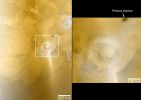
Volcanoes-Arsia_Mons.jpgArsia Mons with Water-Ice Clouds and the shadow of Phobos (credits NASA/JPL/MSSS)107 visiteCaption originale:"This pair of MGS-MOC color images shows early Autumn Clouds over the Arsia Mons Volcano, plus the shadow of the innermost of the Martain Moon Phobos. The picture on the left is taken from the MOC daily global map acquired at 7,5 km (~4,7 mi) per pixel on 28 January 2006, about a week after the start of Southern Autumn.
The picture on the right was taken at the same time, but at a higher resolution of 489 mt (~1604 ft) per pixel.
Both pictures are composites of MOC red and blue wide angle images, and both are oriented such that North is up and East is to the right. Arsia Mons and the other large Tharsis volcanoes commonly develop afternoon orographic (i.e., topographically-controlled) water ice clouds at this time of year. The equatorial Tharsis volcano, Pavonis Mons, is also under a deck of Water-Ice Clouds; it is located toward the upper right corner of the left, lower-resolution image.
Sunlight glints off the dusty Surface and the Clouds and Aerosols in the Atmosphere, producing the bright diagonal Streak located just South/East (lower right) of Arsia Mons. A Water-Ice Haze is seen on the left side of the lower-resolution image. The dark oval to the North-East of Arsia Mons, as noted above, is the shadow of Phobos".01/28/22 at 17:41Paolo C. Fienga: "...E la nostra societ??..." (Clint East...
|
|
Volcanoes-Arsia_Mons.jpgArsia Mons with Water-Ice Clouds and the shadow of Phobos (credits NASA/JPL/MSSS)107 visiteCaption originale:"This pair of MGS-MOC color images shows early Autumn Clouds over the Arsia Mons Volcano, plus the shadow of the innermost of the Martain Moon Phobos. The picture on the left is taken from the MOC daily global map acquired at 7,5 km (~4,7 mi) per pixel on 28 January 2006, about a week after the start of Southern Autumn.
The picture on the right was taken at the same time, but at a higher resolution of 489 mt (~1604 ft) per pixel.
Both pictures are composites of MOC red and blue wide angle images, and both are oriented such that North is up and East is to the right. Arsia Mons and the other large Tharsis volcanoes commonly develop afternoon orographic (i.e., topographically-controlled) water ice clouds at this time of year. The equatorial Tharsis volcano, Pavonis Mons, is also under a deck of Water-Ice Clouds; it is located toward the upper right corner of the left, lower-resolution image.
Sunlight glints off the dusty Surface and the Clouds and Aerosols in the Atmosphere, producing the bright diagonal Streak located just South/East (lower right) of Arsia Mons. A Water-Ice Haze is seen on the left side of the lower-resolution image. The dark oval to the North-East of Arsia Mons, as noted above, is the shadow of Phobos".01/28/22 at 17:39walthari: eggià...il capolavoro di Leone...
|
|
Volcanoes-Arsia_Mons.jpgArsia Mons with Water-Ice Clouds and the shadow of Phobos (credits NASA/JPL/MSSS)107 visiteCaption originale:"This pair of MGS-MOC color images shows early Autumn Clouds over the Arsia Mons Volcano, plus the shadow of the innermost of the Martain Moon Phobos. The picture on the left is taken from the MOC daily global map acquired at 7,5 km (~4,7 mi) per pixel on 28 January 2006, about a week after the start of Southern Autumn.
The picture on the right was taken at the same time, but at a higher resolution of 489 mt (~1604 ft) per pixel.
Both pictures are composites of MOC red and blue wide angle images, and both are oriented such that North is up and East is to the right. Arsia Mons and the other large Tharsis volcanoes commonly develop afternoon orographic (i.e., topographically-controlled) water ice clouds at this time of year. The equatorial Tharsis volcano, Pavonis Mons, is also under a deck of Water-Ice Clouds; it is located toward the upper right corner of the left, lower-resolution image.
Sunlight glints off the dusty Surface and the Clouds and Aerosols in the Atmosphere, producing the bright diagonal Streak located just South/East (lower right) of Arsia Mons. A Water-Ice Haze is seen on the left side of the lower-resolution image. The dark oval to the North-East of Arsia Mons, as noted above, is the shadow of Phobos".01/28/22 at 17:38Paolo C. Fienga: Ed infatti la mia domanda non ? "indiscreta&q...
|
|
Volcanoes-Arsia_Mons.jpgArsia Mons with Water-Ice Clouds and the shadow of Phobos (credits NASA/JPL/MSSS)107 visiteCaption originale:"This pair of MGS-MOC color images shows early Autumn Clouds over the Arsia Mons Volcano, plus the shadow of the innermost of the Martain Moon Phobos. The picture on the left is taken from the MOC daily global map acquired at 7,5 km (~4,7 mi) per pixel on 28 January 2006, about a week after the start of Southern Autumn.
The picture on the right was taken at the same time, but at a higher resolution of 489 mt (~1604 ft) per pixel.
Both pictures are composites of MOC red and blue wide angle images, and both are oriented such that North is up and East is to the right. Arsia Mons and the other large Tharsis volcanoes commonly develop afternoon orographic (i.e., topographically-controlled) water ice clouds at this time of year. The equatorial Tharsis volcano, Pavonis Mons, is also under a deck of Water-Ice Clouds; it is located toward the upper right corner of the left, lower-resolution image.
Sunlight glints off the dusty Surface and the Clouds and Aerosols in the Atmosphere, producing the bright diagonal Streak located just South/East (lower right) of Arsia Mons. A Water-Ice Haze is seen on the left side of the lower-resolution image. The dark oval to the North-East of Arsia Mons, as noted above, is the shadow of Phobos".01/28/22 at 17:37walthari: "le domande non sono mai indiscrete, ma spess...
|
|
Volcanoes-Arsia_Mons.jpgArsia Mons with Water-Ice Clouds and the shadow of Phobos (credits NASA/JPL/MSSS)107 visiteCaption originale:"This pair of MGS-MOC color images shows early Autumn Clouds over the Arsia Mons Volcano, plus the shadow of the innermost of the Martain Moon Phobos. The picture on the left is taken from the MOC daily global map acquired at 7,5 km (~4,7 mi) per pixel on 28 January 2006, about a week after the start of Southern Autumn.
The picture on the right was taken at the same time, but at a higher resolution of 489 mt (~1604 ft) per pixel.
Both pictures are composites of MOC red and blue wide angle images, and both are oriented such that North is up and East is to the right. Arsia Mons and the other large Tharsis volcanoes commonly develop afternoon orographic (i.e., topographically-controlled) water ice clouds at this time of year. The equatorial Tharsis volcano, Pavonis Mons, is also under a deck of Water-Ice Clouds; it is located toward the upper right corner of the left, lower-resolution image.
Sunlight glints off the dusty Surface and the Clouds and Aerosols in the Atmosphere, producing the bright diagonal Streak located just South/East (lower right) of Arsia Mons. A Water-Ice Haze is seen on the left side of the lower-resolution image. The dark oval to the North-East of Arsia Mons, as noted above, is the shadow of Phobos".01/28/22 at 17:34Paolo C. Fienga: Probabilmente perché è una domanda stupida Walt...
|
|
Volcanoes-Arsia_Mons.jpgArsia Mons with Water-Ice Clouds and the shadow of Phobos (credits NASA/JPL/MSSS)107 visiteCaption originale:"This pair of MGS-MOC color images shows early Autumn Clouds over the Arsia Mons Volcano, plus the shadow of the innermost of the Martain Moon Phobos. The picture on the left is taken from the MOC daily global map acquired at 7,5 km (~4,7 mi) per pixel on 28 January 2006, about a week after the start of Southern Autumn.
The picture on the right was taken at the same time, but at a higher resolution of 489 mt (~1604 ft) per pixel.
Both pictures are composites of MOC red and blue wide angle images, and both are oriented such that North is up and East is to the right. Arsia Mons and the other large Tharsis volcanoes commonly develop afternoon orographic (i.e., topographically-controlled) water ice clouds at this time of year. The equatorial Tharsis volcano, Pavonis Mons, is also under a deck of Water-Ice Clouds; it is located toward the upper right corner of the left, lower-resolution image.
Sunlight glints off the dusty Surface and the Clouds and Aerosols in the Atmosphere, producing the bright diagonal Streak located just South/East (lower right) of Arsia Mons. A Water-Ice Haze is seen on the left side of the lower-resolution image. The dark oval to the North-East of Arsia Mons, as noted above, is the shadow of Phobos".01/28/22 at 17:30walthari: ma poi perchè non rispondere...ridicoli!
|
|
Volcanoes-Arsia_Mons.jpgArsia Mons with Water-Ice Clouds and the shadow of Phobos (credits NASA/JPL/MSSS)107 visiteCaption originale:"This pair of MGS-MOC color images shows early Autumn Clouds over the Arsia Mons Volcano, plus the shadow of the innermost of the Martain Moon Phobos. The picture on the left is taken from the MOC daily global map acquired at 7,5 km (~4,7 mi) per pixel on 28 January 2006, about a week after the start of Southern Autumn.
The picture on the right was taken at the same time, but at a higher resolution of 489 mt (~1604 ft) per pixel.
Both pictures are composites of MOC red and blue wide angle images, and both are oriented such that North is up and East is to the right. Arsia Mons and the other large Tharsis volcanoes commonly develop afternoon orographic (i.e., topographically-controlled) water ice clouds at this time of year. The equatorial Tharsis volcano, Pavonis Mons, is also under a deck of Water-Ice Clouds; it is located toward the upper right corner of the left, lower-resolution image.
Sunlight glints off the dusty Surface and the Clouds and Aerosols in the Atmosphere, producing the bright diagonal Streak located just South/East (lower right) of Arsia Mons. A Water-Ice Haze is seen on the left side of the lower-resolution image. The dark oval to the North-East of Arsia Mons, as noted above, is the shadow of Phobos".01/28/22 at 17:27Paolo C. Fienga: Il Lander In-Sight dice che l'attivit? sismica...
|
|
Volcanoes-Arsia_Mons.jpgArsia Mons with Water-Ice Clouds and the shadow of Phobos (credits NASA/JPL/MSSS)107 visiteCaption originale:"This pair of MGS-MOC color images shows early Autumn Clouds over the Arsia Mons Volcano, plus the shadow of the innermost of the Martain Moon Phobos. The picture on the left is taken from the MOC daily global map acquired at 7,5 km (~4,7 mi) per pixel on 28 January 2006, about a week after the start of Southern Autumn.
The picture on the right was taken at the same time, but at a higher resolution of 489 mt (~1604 ft) per pixel.
Both pictures are composites of MOC red and blue wide angle images, and both are oriented such that North is up and East is to the right. Arsia Mons and the other large Tharsis volcanoes commonly develop afternoon orographic (i.e., topographically-controlled) water ice clouds at this time of year. The equatorial Tharsis volcano, Pavonis Mons, is also under a deck of Water-Ice Clouds; it is located toward the upper right corner of the left, lower-resolution image.
Sunlight glints off the dusty Surface and the Clouds and Aerosols in the Atmosphere, producing the bright diagonal Streak located just South/East (lower right) of Arsia Mons. A Water-Ice Haze is seen on the left side of the lower-resolution image. The dark oval to the North-East of Arsia Mons, as noted above, is the shadow of Phobos".01/28/22 at 16:49walthari: cos? sembra, concordo anche se dobbiamo ammettere ...
|
|
Volcanoes-Arsia_Mons.jpgArsia Mons with Water-Ice Clouds and the shadow of Phobos (credits NASA/JPL/MSSS)107 visiteCaption originale:"This pair of MGS-MOC color images shows early Autumn Clouds over the Arsia Mons Volcano, plus the shadow of the innermost of the Martain Moon Phobos. The picture on the left is taken from the MOC daily global map acquired at 7,5 km (~4,7 mi) per pixel on 28 January 2006, about a week after the start of Southern Autumn.
The picture on the right was taken at the same time, but at a higher resolution of 489 mt (~1604 ft) per pixel.
Both pictures are composites of MOC red and blue wide angle images, and both are oriented such that North is up and East is to the right. Arsia Mons and the other large Tharsis volcanoes commonly develop afternoon orographic (i.e., topographically-controlled) water ice clouds at this time of year. The equatorial Tharsis volcano, Pavonis Mons, is also under a deck of Water-Ice Clouds; it is located toward the upper right corner of the left, lower-resolution image.
Sunlight glints off the dusty Surface and the Clouds and Aerosols in the Atmosphere, producing the bright diagonal Streak located just South/East (lower right) of Arsia Mons. A Water-Ice Haze is seen on the left side of the lower-resolution image. The dark oval to the North-East of Arsia Mons, as noted above, is the shadow of Phobos".01/25/22 at 12:58Paolo C. Fienga: Taccio.
|
|
Volcanoes-Arsia_Mons.jpgArsia Mons with Water-Ice Clouds and the shadow of Phobos (credits NASA/JPL/MSSS)107 visiteCaption originale:"This pair of MGS-MOC color images shows early Autumn Clouds over the Arsia Mons Volcano, plus the shadow of the innermost of the Martain Moon Phobos. The picture on the left is taken from the MOC daily global map acquired at 7,5 km (~4,7 mi) per pixel on 28 January 2006, about a week after the start of Southern Autumn.
The picture on the right was taken at the same time, but at a higher resolution of 489 mt (~1604 ft) per pixel.
Both pictures are composites of MOC red and blue wide angle images, and both are oriented such that North is up and East is to the right. Arsia Mons and the other large Tharsis volcanoes commonly develop afternoon orographic (i.e., topographically-controlled) water ice clouds at this time of year. The equatorial Tharsis volcano, Pavonis Mons, is also under a deck of Water-Ice Clouds; it is located toward the upper right corner of the left, lower-resolution image.
Sunlight glints off the dusty Surface and the Clouds and Aerosols in the Atmosphere, producing the bright diagonal Streak located just South/East (lower right) of Arsia Mons. A Water-Ice Haze is seen on the left side of the lower-resolution image. The dark oval to the North-East of Arsia Mons, as noted above, is the shadow of Phobos".01/25/22 at 09:28Anakin: Questo ? il classico pennacchio di un vulcano o ca...
|
|

Volcanic_Features-Plume-Tharsis-PIA04285.jpgAn isolated "Water Ice Cloud" over Tharsis or a volcanic "Plume"? (Saturated Natural Colors; credits: NASA/JPL/MSSS)162 visiteOriginal caption:"This composite of red and blue MGS-MOC daily global images acquired on 6 July 2005 shows an isolated water ice cloud extending more than 30 Km (more than 18 miles) above the Martian surface. Clouds such as this are common in late Spring over the terrain located South-West of the Arsia Mons volcano. Arsia Mons is the dark, oval feature near the limb, just to the left of the "T" (in the "Tharsis Montes" label).
The dark, nearly circular feature above the "S" (in "Tharsis") is the Pavonis Mons Volcano and the other dark circular feature, above and to the right of "S" in "Montes," is Ascraeus Mons.
Illumination is from the left/lower left.
Season: Northern Autumn/Southern Spring".
Nota: purtroppo non ci sono vulcanologi nel Gruppo Lunar Explorer, ma la sensazione (nulla di più) che la "isolata nuvola di ghiaccio d'acqua", come la chiama la NASA sia, in realtà, il residuo di un evento vulcanico, è molto intensa (confrontate la sua forma con qualcuna delle "volcanic plumes" di Io...).01/22/22 at 18:02Paolo C. Fienga: Questa ? una "cosa" strana. Molto buona ...
|
|

Volcanoes-Arsia_Mons-03-PIA04294.jpgArsia Mons and its "clouds" (3) - 25 February 2005 (Extremely Saturated Natural Colors; credits NASA/JPL/MSSS)114 visiteOriginal caption:"The spiral dust cloud over Arsia Mons repeats each year, but observations and computer calculations indicate it can only form during a short period of time each year. Similar spiral clouds have not been seen over the other large Tharsis volcanoes, but other types of clouds have been seen. The spiral dust cloud over Arsia Mons can tower 15 to 30 Km (9 to 19 miles) above the volcano. The white and bluish areas in the images are thin clouds of water ice. In the 2005 case, more water ice was present than in the previous years at the time the pictures were obtained. For scale, the caldera of Arsia Mons is about 110 Km (about 68 miles) across, and the summit of the volcano stands about 10 Km (6 miles) above its surrounding plains"01/22/22 at 18:00Paolo C. Fienga: QUESTE e le immagini precedenti a questa rappresen...
|
|
| 349 immagini su 30 pagina(e) |
|
|
|
5 | |
|
|
|
|
|
|
|
|








