|
|

022-The Moon from Clem-FroelichCrater.gif081 - Froelich Crater75 visitenessun commento
|
|

023-The Moon from Clem-SchroendingerBasin.jpg045 - Schroedinger Basin (detail mgnf)66 visiteDetail from the UV-VIS Clementine Camera of the floor of the basin Schrodinger, showing the coverage (inset strip) of the HR camera for comparison. The Dark Halo Crater (center at 76° South Lat. and 139° East Long.; 5 Km across) is a volcanic vent that erupted ash during the period of mare volcanism on the Moon, more than 3,5 BY ago.
|
|

029-The Moon from Clem-OrientaleBasin.jpg070 - The "Orientale" basin70 visiteMosaic of more than 2000 Clementine (750-nanometers) images, showing the Orientale Basin of the Moon at full resolution of about 250 mt per pixel. The Orientale Basin is about 930 Km in diameter and is only partly filled by dark, mare lava.
The relative paucity of mare basalt fill, coupled with the young age and topographic freshness of the basin, makes this feature the archetypal lunar multiring basin.
|
|

030-The Moon from Clem-Copernicus.jpg054 - Copernicus73 visiteCopernicus is a rayed crater, 97 Km in diameter, that formed about 800 MY ago. In this image of the Crater Copernicus, color differences are shown for the eastern half of the crater.
A false-color mosaic is created by making ratio images and assigning each to one of the 3 primary colors: the red channel is controlled by the 750/415-nnmts ratio; the green channel is controlled by the 750/950-nnmts ratio and the blue channel is controlled by the 415/750-nnmts ratio.
|
|
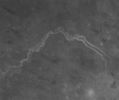
033-The Moon from Clem-Aristarchus-3.jpg041 - Aristarchus and Vallis Schroteri71 visiteThe plateau of the Aristarchus Crater has experienced intense volcanic activity, both effusive and explosive.
It includes the densest concentration of Lunar "sinuous rilles" ("snake-like" valleys) including the largest known, Vallis Schroteri, which is about 160 km long, up to 11 km wide and 1 km deep.
The rilles in this area begin at cobra-head craters, which are the apparent vents for a dark mantling deposit covering the plateau and nearby areas to the North and East.
|
|

034-The Moon from Clem-PolarAreas.jpg110 - Polar Areas: the Peaks of Eternal Light69 visiteAs Clementine flew over the Pole - every 5 hours - it began its photographic mapping pass by imaging the Pole. These images are composites, showing the addition of alternate orbit polar images over the course of 1 Lunar Day (such as 1 Earth month). In these composite maps, areas in permanent darkness are black, while areas of permanent illumination are white; areas of mixed lighting condition are represented in various shades of gray. Note that the South Polar Area has the largest area of permanent darkness, measuring more than 15,000 square kilometers. The north pole shows only about 500 square kilometers of darkness. Several areas are evident that have near-constant Sun illumination. Such zones would have great value as sites for a permanent lunar outpost.
|
|

035-The Moon from Clem-PolarAreas.jpg111 - Polar Areas: Views of the South Pole75 visiteThe spin axis of the Moon is nearly vertical (inclined 1,6°) to the ecliptic plane (the plane of its orbit around the Sun), in marked contrast to the Earth (axis inclination 23,5°). However, even this small inclination means that the hemispheres of the Moon experience seasons as the Pole tracks toward and away from the Sun. Clementine started its lunar mapping in the dead of Southern Winter (axis away from the Sun), but by the 2nd month of mapping, the axis had begun to point closer in that direction. These two mosaics show the difference in lighting conditions between the first month of mapping (left, maximum winter) and the second month's coverage (right, toward the solstice).
Careful examination of the two mosaics reveals some slight shadow changes; note in particular the shadows that cover the floors of the craters Amundsen and Scott (large central peak crater at about 3 o'clock and the crater just above it). However, the large region of permanent shadow near the center of the mosaics discovered by Clementine remains virtually unchanged in the two mosaics.
|
|

040-The Moon from Clem-Apollo 16 LandingSite.jpg216-0 - The Apollo 16 "Landing Site" (in natural colors)67 visiteThis is the Apollo 16 Landing Site as seen from Clementine. This is a natural color rendition of the site. Clementine images were deliberately taken at very low phase angles (which means high Sun angles) to emphasize color differences, so surface textures are much less apparent here than in the orbital Apollo view.
Note the very bright appearance of South Ray and North Ray Craters (center right).
Promemoria: l'angolo "di fase" è l'angolo formato da Sole, corpo/rilievo ripreso e Sonda.
|
|

040-The Moon from Clem-KeplerCrater-1.jpg151 - Kepler Crater69 visitenessun commento
|
|

043-The Moon from Clem-North Pole-2.jpg035 - Plaskett Crater (natural colors)72 visitePlaskett Crater ID:
Location: 82° North Lat. and 174° East Long.;
Dimension: about 110 Km in diameter
Interesting Features: the huge "central peak"
|
|

051-The Moon from Clem-Aristarchus.jpg043 - Aristarchus Plateau (natural colors)78 visiteA mosaic of more than 250 images showing the complex and diverse Aristarchus Region of the Moon in approximately natural colors (blue = 415 nanometers, green = 750 nanometers, red = 950 nanometers). The plateau is an uplifted block of complex, highland terrain, partly flooded by later mare basalt lavas. Dark, pyroclastic glasses partly cover the uplifted terrain. The crater Aristarchus (47 Km in diameter) has formed in the South-East corner of the plateau, excavating both highlands and mare rocks.
|
|
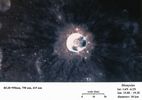
052-The Moon from Clem-Dionysus.jpg061 - Dionysius Crater (natural colors)67 visiteThe Crater Dionysius (3° North Lat. and, 17° East Long.; western edge of Mare Tranquillitatis; 18 Km in diameter) shows striking contrasts in albedo. The outside of the Crater is a very bright halo in its near-rim field, while farther out, darker material is exposed, including rare dark rays. Crater deposits on the left side of this mosaic are on light Cayley plains of highland composition, while deposits on the right side are on the basalts of Mare Tranquillitatis.
|
|
| 81 immagini su 7 pagina(e) |
2 |  |
|
|
|
|





