Original Nasa Apollo Frames: from Apollo 4 to Apollo 17
|
|
|

as16-107-17473.JPGAS 16-107-17473 - The "Sample Container"78 visiteThis picture is showing the Rover in the background, while the SCB that John Young brought to hold individual sample bags is in the foreground. Charlie is at the back of the Rover. Note the footprints that John made as he made his way up to the Station 4 Crater.
MareKromium
|
|
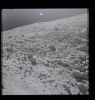
as16-107-17476.JPGAS 16-107-17476 - Station 4 Crater (ejecta crater)66 visitenessun commentoMareKromium
|
|
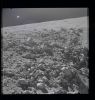
as16-107-17477.JPGAS 16-107-17477 - Station 4 Crater (ejecta crater)78 visitenessun commentoMareKromium
|
|
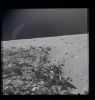
as16-107-17483.JPGAS 16-107-17483 - Station 4 Crater (ejecta crater)66 visiteStation 4 crater. Note that there is very little debris on the Western (right) side of the Crater. As John Young recognized in the field, this crater was almost certainly formed by a large piece of highly-shocked ejecta from South Ray Crater which plowed into the side of Stone Mountain at relatively low velocity and came apart.
Hence, this is a Secondary Crater.
Notes (from "Glossary of Geology", 2nd Edition, American Geological Inst., Falls Church (VA) - 1980)
Ejecta — The material thrown out of an impact crater by the shock pressures generated during the impact event. Ejecta generally covers the surface around an impact crater to a distance of at least one crater diameter, with individual streamers of material extending well beyond this distance ("rays"). The ejecta blanket of a crater becomes less visible with increasing age of the crater.
Secondary craters — Craters produced by the impact of debris thrown out by a large impact event. Many secondary craters occur in clusters or lines where groups of ejecta blocks impacted almost simultaneously.MareKromium
|
|

as16-107-17510.JPGAS 16-107-17510 - "Bad Aim" for John...80 visite145:46:03 MT - John Young took this "locator" for the Magnetometer at Station 5 at the back of the Rover. John did not aim his camera high enough to actually show the instrument.
MareKromium
|
|
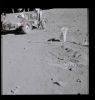
as16-107-17537.JPGAS 16-107-17537 - The "Rake Site"75 visite"After" of the Station 8 Rake Site, showing Charlie Duke at the back of the Rover with the double core.
MareKromium
|
|

as16-107-17560.JPGAS 16-107-17560 - Station 9 "Sneak" Boulder66 visiteJohn Young stepped back to get this "locator" of the "Sneak" Boulder at Station 9.
MareKromium
|
|
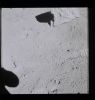
as16-107-17570.JPGAS 16-107-17570 - Station 9 Boulder78 visiteJohn Young has moved around to the East Side of the Station 9 Boulder.
MareKromium
|
|
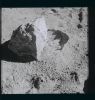
as16-107-17573.jpgAS 16-107-17573 - Unusual boulder at Station 9 (additional processing by Lunexit)79 visiteCaption NASA:"148:14:17 MT - Cross-Sun "after" of the tipped boulder at Station 9".
MareKromium
|
|
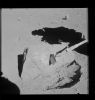
as16-107-17579.JPGAS 16-107-17579 - After the sampling...84 visite148:18:45 MT - In this "after" photograph of the sample John Young chipped off the tipped boulder, Charlie Duke is pointing to the place from which John removed the chip.
MareKromium
|
|
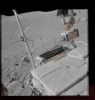
as16-107-17581.JPGAS 16-107-17581 - Slightly Sunstruck81 visite148:24:47 MT - John Young took this excellent picture of the front of the Rover before changing film magazines. It shows the dustbrush, the closed battery covers, the uncovered LCRU mirrors, and the TV, which is pointed at John himself.MareKromium
|
|
as16-113-18289.jpgAS 16-113-18289 - Earthrise, Lunar Horizon and Casper76 visiteCaption NASA:"Pre-landing photo of Earthrise, with the Command Module visible just above the Lunar Horizon to the left of Earth".MareKromium
|
|
| 1322 immagini su 111 pagina(e) |
 |
|
|
|
|
82 | |
|
|
|
|








