|
|

APOLLO 16-4136-B.jpgAS 16-4136 - Cratered Region near Mandel'shtam (2)74 visiteThis enlarged view of part of frame AS 16-4136 shows some of the smooth flows that originate near the crest of the crater rim at the left side of photograph. Arrows point to the lower ends of two flows.
The origin of the flow material is controversial.
It was probably molten material generated by shock-wave compression of lunar rocks and ejected at relatively low velocities during the late stages of the formation of the impact crater; or it may have resulted from the flow of rock debris mixed with a fluidizing agent such as gas or water; or it may have been volcanically generated lava.
|
|

APOLLO 17 AS 17-149-22838.jpgAS 17-49-22838 - Crater Chain (Far-Side)63 visiteThis oblique view taken with the Hasselblad camera shows a crater chain on the Far-Side, about 500 Km North of Tsiolkovsky. For an idea of the scale, the large crater near the upper left corner is about 26 Km wide. The origin of this chain is controversial. To some geologists, the irregular shape of many of the craters suggests that the chain was formed by the impact of a stream of ejecta from a large primary crater. The presence of herringbone ridges would have strengthened this interpretation, but none are visible; perhaps the high Sun angle and the oblique viewing angle of this scene have obscured them. To others the simple geometry of the chain suggests a volcanic origin. However, there is an apparent lack of faulting to control the alinement of the craters and an apparent absence of a blanket of volcanic ejecta.
The origin of this chain may not be decipherable until, and unless, additional photography becomes available.
|
|

APOLLO 17 AS 17-151-23260.jpgAS 17-151-23260 - Copernicus Crater68 visiteThe large Crater Copernicus has served as a type example of Lunar Impact Craters since the classic analysis was made by E. M. Shoemaker in 1962. Bright rays of ejecta radiate outward from Copernicus across a large part of the Moon's Near-Side. Material from one of the rays may have been sampled at the Apollo 12 Landing Site, 370 Km South of the center of the crater. This photograph shows how the Crater appeared from the Apollo 17 spacecraft looking Southward over the Montes Carpatus (Carpathian Mountains).
Notice that the rim deposits immediately adjacent to the Crater have a very crisp, blocky appearance in contrast to the softer appearance of the rest of the ejecta blanket. This crisp zone is also found on many other craters and suggests the ejecta here was swept clean by some erosion process late in the cratering event. The terraced slumps on the Crater wall appear like giant stair steps leading to the floor, 3 to 4 Km below the rim. The 1-Km-high central peaks were made famous in 1966 by a "Picture of the century" view looking into the crater from the south by Lunar Orbiter 2. Now Apollo has given us scores of even more spectacular photographs.
|
|

APOLLO 17 AS 17-1672.jpgAS 17-1672 - "D" like "Depression"...64 visiteThe steep-walled but shallow D-shaped depression near the center of the photograph is apparently a unique feature. It is located in a patch of mare on the foothills of the Montes Haemus, west of Mare Serenitatis. Measured along its straight side, the depression is about 3 Km wide. It is situated atop a very gentle circular dome that appears to be somewhat smoother than the surrounding mare surface. As is more clearly shown in AS 15-9960, the many bulbous structures on the floor give it a blisterlike appearance.
The depression is believed to be volcanic, probably a caldera (...).
|
|
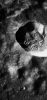
APOLLO 17 AS 17-2265.jpgAS 17-2265 - Proclus Crater65 visiteThis oblique view looks South over the 26-Km-diameter crater Proclus in the highlands at the Western edge of Mare Crisium. Proclus is a young rayed crater that is distinctive because of the marked asymmetry of its ray system-a characteristic visible even in Earth-based telescopic views. The excluded zone is along the South-West edge (top of photograph) but is visible in this moderate Sun photo only as a slight albedo change. Laboratory experiments suggest that a low trajectory angle might account for the asymmetry. A number of large blocks can be seen at the edge of the crater rim. The exceptionally large block (arrow) is about 200 mt wide and, judging from the length of the shadow it casts, nearly as high. As in several other craters shown in this chapter, a darker layer is present in the upper part of the crater wall.
|
|

APOLLO 17 AS 17-2321.jpgAS 17-2321 - Crater Chain76 visiteThis crater chain in Southern Mare Serenitatis is clearly of internal origin because it is lined up parallel to several fault valleys or grabens.
The craters in the chain do not appear to have any rims; consequently, they may have formed by collapse and not by the explosive ejection of volcanic material.
The large crater in the right side of this scene, however, has a rim and so cannot be the result of collapse alone.
The finely lineated texture across the left side of the photograph is caused by ejecta from the crater Dawes to the south.
|
|

APOLLO 17 AS 17-2444.jpgAS 17-2444 - Mare Imbrium & Copernicus Crater72 visiteThis oblique view across southern Mare Imbrium looks toward Copernicus, the large crater near the horizon. The distance from the lower edge of the picture to the center of Copernicus is 400 km. The mountains at the edge of Mare Imbrium are the Montes Carpatus, and the large crater near the center of the picture is Pytheas, almost 19 km in diameter. Copernicus is one of the youngest of the Moon's large craters. It is visible from Earth, even without the aid of a telescope because of its bright ejecta blanket and its extensive bright rays. The many chains and clusters of small irregular craters and the many bright streaks or rays extending across Mare Imbrium are caused by the secondary impact of debris ejected from Copernicus. The viewing angle accentuates the radial pattern of the secondary impact features. The Sun angle is sufficiently low to show their relief, but high enough to show the contrast between the bright streaks and the normal dark mare surface. As in figure 124, herringbone ridges point toward the primary crater, and the flaring sides of the secondary craters point away from it. The arrow midway between Copernicus and the left edge of the photograph points to a less common pattern of secondary craters; these are concentric to Copernicus.
|
|

APOLLO 17 AS 17-2744.jpgAS 17-2744 - Crater's "Rays"70 visiteThis is an oblique view of another crater that probably was formed by a meteoroid following a relatively low-angle trajectory. This crater, 4 Km in diameter, is located in the highlands East of Mare Serenitatis. Compared to the crater described in AS 15-9524, this one is less elliptical and its bilobate ray pattern is much less pronounced. The differences may be attributed to a higher trajectory angle of the impacting body that formed this crater as it struck the surface.
H. J. Moore (1976), in his study of craters formed by impacting missiles at White Sands Missile Range, recognized a characteristic asymmetric profile along the axis of trajectory for craters formed in this manner.
The wall beneath the missile trajectory is typically less steep than the opposite or down-trajectory wall, and its rim crest is lower and more rounded. These observations, when applied to the lunar crater in this photograph, indicate that the impacting body was traveling toward the East when it struck the Moon.
|
|
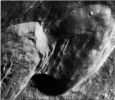
APOLLO 17 AS 17-2773.jpgAS 17-2773 - Overlapping Craters64 visiteThis pair of overlapping medium-sized craters illustrates some of the criteria used to determine relative ages: material ejected from the larger polygonal crater on the left partially fills the smaller crater on the right; thus, the crater on the left is younger. Furthermore, the wall of the large crater is complete, whereas the West wall of the smaller crater is absent, obviously having been destroyed by the larger crater.
Even if the 2 craters did not overlap, the sharp rim, terraced walls and prominent central peak of the larger crater clearly identify it as the younger of the two. The frames used in the stereogram were selected to show exaggerated relief, a technique very helpful to photointerpreters in determining shapes and relative elevations of surface features.
These 2 craters are located in the rugged terrain of the Far-Side highlands, approx. 250 Km north of Tsiolkovsky.
|
|
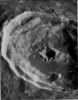
APOLLO 17 AS 17-3072.jpgAS 17-3062 - Timocharis Crater75 visiteThis oblique view of the crater Timocharis in Southe-Eastern Mare Imbrium illustrates how the original diameter of a crater is enlarged by slumping of its walls. Its present diameter is about 35 Km. The sparsity of small superposed craters on the walls of Timocharis - in contrast to their density on its floor and rim - is caused by the erosive effect of downslope movement of material on the steep walls. Timocharis, like many other young impact craters of similar size, possesses a well-defined central peak complex. Such structures are believed to result from elastic rebound of the bedrock immediately after the impacting event. However, the central peak of Timocharis apparently has been substantially modified by a large superimposed crater.
|
|

APOLLO 17 AS 17-3081.jpgAS 17-3081 - Pytheas Crater (HR)75 visiteThe Apollo 17 Panoramic Camera provided this high-resolution, enlarged view of the South Wall of Pytheas. Pytheas is about the same size as Bessel, but is located in South-Central Mare Imbrium, almost 1100 km West of Bessel.
The outcrops in the walls of the two craters are remarkably similar.
These and the many other craters in mare areas that contain outcrops of dark horizontally layered rock demonstrate the moonwide uniformity of conditions in the upper part of the mare basins.
|
|

APOLLO 17 AS 17-3107.jpgAS 17-3107/3105/3103 - Euler Crater (HR)64 visiteParts of 3 frames from the Apollo 17 PanCam were mosaicked to form this HR view of the crater Euler, in South-Western Mare Imbrium (an exceptionally fine example of a young mediumsized crater). 27-Km in diameter, Euler has most of the features that typify young craters in this size range. Its sharp rim shows little evidence of rounding. A solid blanket of ejecta is visible for approximately 1/2 crater diameter outside the rim and the radial pattern of secondary craters, crater clusters, ridges and grooves is visible outward to a full crater diameter.
Terraces formed by slumping of the steep crater walls, probably contemporaneously with the formation of the crater, are clearly evident. The steepness of the walls and the fact that the crater floor is below the level of the surrounding mare surface indicate that relatively little erosion and infilling have occurred. Other features typical of medium-sized craters are the central peak and the level floor surrounding the central peak. The pattern of ejecta around Euler is notably asymmetric because the area was later flooded by mare lavas that inundated parts of the ejecta blanket and other ejecta features.
|
|
| 86 immagini su 8 pagina(e) |
 |
|
4 | |
|
|
|





