|
|

APOLLO 15 AS 15-9328.jpgAS 15-9328 - Bessel Crater69 visiteOutcrops of layered rock are strikingly evident in the upper part of the far wall of the crater Bessel (17- Km diameter) in South-Central Mare Serenitatis. The outcrop is most evident where it forms shadows; however, the dark debris that streams downslope from the layered rock is visible even on parts of the crater wall where the Sun has washed out all details of relief. The outcrop is at a uniform distance below the crater rim, indicating that the strata are horizontal. Thus, Bessel furnishes convincing evidence that mare surfaces are underlain by dark layered rock. The dark rock is now known to be basalt that accumulated as successive flows or layers of lava.
Bessel is youthful enough that boulders are abundant on its rim and floor.
An anomalously high number of boulders is visible in and around the 750-m diameter crater (arrow) on the floor.
|
|

APOLLO 15 AS 15-9591.jpgAS 15-9591 - Tsiolkovsky74 visiteModerate enlargement of part of a panoramic camera frame provides greater detail of the central peak complex of Tsiolkovsky. A relatively large population of superposed craters has been preserved on level areas of the peaks (near the left-center of the photograph). In contrast, very few craters are present on steep slopes-most have been destroyed by the downslope movement of erosional debris. An intermediate population of craters on the dark mare shows that the mare surface is younger than the level areas of the peak complex but older than the freshly exposed steep slopes of the peaks. The youngest part of the mare surface is the dark, smooth area adjacent to the small angular rifle in the upper left corner. Here small craters have been almost completely filled by the flow and are barely discernible. The rifle may have served as the vent for the young lavas.
|
|

APOLLO 15 AS 15-9596.jpgAS 15-9596 - Tsiolkovsky74 visiteDrastic enlargement of a panoramic camera frame provides a wealth of detail within the small area outlined in AS 15-9591. Note the many large blocks on the slope. The largest block is about 125 mt wide. Most blocks apparently originated at the discontinuous ledge near the top of the slope. Note also the fillets on the upslope side of many of the blocks. They probably consist of fine-grained debris that was trapped behind the blocks as it moved downslope. The arrows identify what appear to be two craters in the process of being destroyed by erosion. Otherwise, craters are absent on the steeply dipping slope, although numerous craters are present on the gentler slopes above.
|
|

APOLLO 15 AS 15-9866.jpgAS 15-9866 - Jansen "B" Crater63 visiteHigh Sun views such as this often show fascinating dark and bright patterns that would be overwhelmed by highlights or shadows if the Sun were lower in the sky. This view of the 17-Km-wide crater Jansen "B" shows numerous bright avalanche deposits on the steep crater walls, apparently originating at outcrop ledges near the top of the wall. Most avalanches stop in a moat at the base of the wall, but a few in the foreground extend out onto the irregular, inward- sloping floor.
The floor is a jumble of slump blocks.
Avalanching appears to be a major means of erosion on steep lunar slopes.
|
|

APOLLO 15 AS 15-9874.jpgAS 15-9874 - Dawes Crater62 visiteThis is a near vertical view of the crater Dawes, 18 Km in diameter. Morphologically it is typical of many lunar craters in the 15- to 20-Km size range. It lacks terraced walls and distinct central peaks but has an extremely rough floor. Small terracelike structures on the crater floor (upper left, lower right) occur where the wall is bowed outward and probably represent slump deposits where portions of the crater wall have collapsed into the crater. Local stratigraphy is revealed in the walls of the crater, and material of different albedo is seen streaming down into the crater from various levels. The dark layer clearly visible in the upper part of the crater wall represents the thin mare deposits in this part of Northern Mare Tranquillitatis. The lighter gray material below it is a combination of underlying submare material and talus from units higher on the crater wall. The highest unit (white and gray) probably represents the ejecta blanket and may consist primarily of lighter lunar crustal material excavated from beneath the mare.
|
|
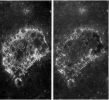
APOLLO 15 AS 15-9960.jpgAS 15-9960 - The "D" in "Detail"...65 visiteThe enlarged view provided by this stereogram shows that there are at least 3 different types of material within the floor of the D-shaped depression (see AS 17-1672). A brighter annulus parallels the wall, and darker material fills the inner floor.
Within both areas numerous bulbous and slightly raised comical structures are easily distinguishable.
There are craters on the summits of many of the structures, suggesting that each one is probably an extrusive dome with a summit crater.
Many similar features on Earth are caused by the subterranean drainage of lavas following extrusion and release of pressure following the upward movement of a central plug.
|
|
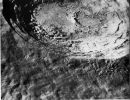
APOLLO 15-0326.jpgAPOLLO 15-0326 - Aristarchus71 visiteAristarchus is a large crater on the edge of a plateau within Northern Oceanus Procellarum. In this scene the crater is viewed obliquely from the North. One of the brightest and youngest craters of its size on the Near-Side of the Moon, Aristarchus is believed to be younger even than Copernicus. The general appearance of Aristarchus and of parts of the plateau around it led Alfred Worden, the Apollo 15 CMP, to describe this part of the Moon as "... probably the most volcanic area that I've seen anywhere on the surface". For many years before the Apollo Missions, Earth-based viewers had reported telescopic sightings of TLP's centered on Aristarchus. These brief, subtle changes in color or in sharpness of appearance have been suggested as evidence for volcanic activity or the venting of gases from the lunar interior. The sightings are controversial, but Aristarchus remains a center of interest.
About 39 Km in diameter, Aristarchus is on the borderline between medium-sized and large- sized craters. We have included it among the large craters because its welldeveloped concentric terraces are characteristic of most large craters that have not been too severely degraded. Its terraced walls, as well as its arcuate range of central peaks, are particularly well shown in this view. The walls and parts of the crater floor are extremely rough and cracked, a characteristic feature of other young impact craters of this size range, such as Tycho and Copernicus. The rough deposits in the floor are probably made up largely of shockmelted material formed at the time of the impact. The inner, rougher portions of the rim show a series of channels, lobate flows, and smooth puddlelike deposits that may represent shock-melted material deposited on the crater rim. The outer, smoother portions show the rhomboidal pattern characteristic of crater ejecta blankets.
|
|

APOLLO 16 AS 16-120-19266.jpgAS 16-120-19266 - The "Playa" of King Crater64 visiteThe Apollo 16 Astronauts captured this spectacular view of the large dark "pool" on the North flank of the crater King as they approached from the East.
The pool (also known as a "lake", "pond" or "playa") is in an old crater swamped by King ejecta. The maximum width of the pool is about 21 Km. The peculiar dark material that forms the large pool and also coats adjacent hills was first discovered on Apollo 10 and was later seen again from Apollo 14.
The most exciting part of the discovery had to wait until the mapping and Panoramic Cameras of Apollo 16 showed that this material contains some of the freshest and most spectacular flow structures on the Moon.
These structures, some of which are seen in the following figures, show that the material behaved like lava.
The material is very similar in appearance to that filling parts of the floor of King.
|
|

APOLLO 16 AS 16-120-19268.jpgAS 16-120-19268 - King Crater75 visiteThe similarity in appearance of the Southern part of the central peak and the slump terraces on the Southern wall of the crater is emphasized in this oblique view of the crater King.
The parallelism of the two arms of the central peak and the Southern segment of the peak suggests that the unique shape of the structure is caused by a preexisting tabular body that was excavated during the formation of the crater.
Numerous comical structures with summit pits are present on the crater floor in the lower right part of the photograph.
|
|
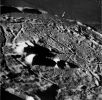
APOLLO 16 AS 16-120-19295~0.jpgAS 16-120-19295 - Gassendi72 visiteThis view into the shallow crater Gassendi shows another strongly fractured crater floor. Gassendi is about 110 Km wide. Dark mare lavas in the distance embay the rim and a little of the interior of Gassendi. They may have entered the crater through the narrow gap partly in shadow below the arrow. Most craters that have fractured floors are near areas of mare flooding. This suggests that the fracturing is a consequence of volcanic activity. An area next to the central peaks of Gassendi was the runnerup choice for a landing site for Apollo 17.
|
|

APOLLO 16 AS 16-122-19580.jpgAS 16-122-19580 - King Crater72 visiteThis vertical view of the crater King on the Lunar Far-Side was taken with the Apollo 16 Hasselblad camera. King, approx. 75 Km in diameter and 4 Km deep, is one of the most interesting features on the Far-Side. It is a superb example of a youthful, large crater. It attracted much attention and was the object of numerous scientific studies (Young, Brennan and Wolfe, 1972).
King is the freshest crater on the Far-Side in its size range. Among its many interesting features are:
1) a unique lobster-claw-like central peak;
2) a flat poollike area of dark material on the North rim believed to have once been molten;
3) a very-well-developed field of fine ejecta extending outward for approx. two crater diameters, and
4) a massive landslide on the South-East rim (see arrow).
In this view the Southern part of the central peak has a distinctly ropey appearance and is segmented parallel to the terraces of the adjacent crater wall. The low Sun illumination enhances the fine texture of King's ejecta. Northeast of King the ejecta mantles an old large crater and in the southwest corner of the picture it mantles a relatively smooth terra unit. The slightly raised plateau on which the crater is situated may be part of the ring of an old basin.
|
|

APOLLO 16 AS 16-1973.jpgAS 16-1973 - The "Davy Crater Chain"73 visiteThe Davy Crater Chain (arrow) is one of the most spectacular chains of craters on the Moon. It extends for about 50 Km across the floor of the large, very old crater Davy "Y" and onto its eastern rim. The chain may be related in origin to the pair of irregular craters Davy "G" and Davy "GA", 75 Km from the furthest end of the chain.
Two origins have been proposed: some lunar geologists believe it is a chain of secondary impact craters and others believe it is a line of volcanic craters. The simple geometry of the Davy Chain, the symmetry and uniform spacing of its individual craters and its alinement with Davy "G", strongly support, in my opinion, a volcanic origin. Also arguing against a secondary impact origin is the fact that the Davy Chain is a lone feature. There are no other similar chains with this trend in the area. Secondary crater chains tend to occur in large numbers within the belt of secondary craters surrounding a large primary crater.
On Earth some rocks from deep within the crust have been brought to the surface through volcanic orifices, thus providing a means of studying material that would otherwise be inaccessible. For this reason the Davy area was once seriously considered as a landing site. However, when the originally planned number of Apollo missions was reduced, the Davy area was one of those eliminated.
|
|
| 86 immagini su 8 pagina(e) |
2 |  |
|
|
|
|
|





