| |

|
|

Comets-Comet_Holmes-UZ.gifThe Inner Coma of Comet Holmes82 visiteCaption NASA:"What's happening to Comet Holmes?
The rare comet remains visible to the unaided eyes of northern observers as an unusual small puff ball in the constellation of Perseus. A high resolution set of images of the comet's inner coma, taken last week and shown above, reveals significant detail. Close inspection shows numerous faint streamers that are possibly the result of jets emanating from the comet's nucleus. Comet Holmes has remained surprisingly bright over the past week, with luminosity estimates ranging from between visual magnitudes 2 to 3, making it brighter than most stars visible on a dark sky.
The above image of Comet Holmes was made with a small automated 0,38-meter telescope hirable over the web for a small fee".MareKromium
|
|

Comets-Comet_Holmes-UZ.jpgComet 17-P-Holmes, from Italy88 visiteRecent development from 17-P-Holmes: this picture is a deep image from L'Aquila, Italy on November 8, 2007.
It shows the ion tail disconnecting from the comet (just like it happened to the Encke Comet).
MareKromium
|
|
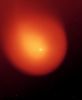
Comets-Comet_Holmes-UZ_PIA11228-1.jpgComet 17-P Holmes now in the Outer Solar System (IR)77 visiteNASA's Spitzer Space Telescope captured the picture of comet Holmes in March 2008, 5 months after the comet suddenly erupted and brightened a millionfold overnight. The contrast of the picture has been enhanced (see the next frame) to show the anatomy of the comet.
Every 6 years, comet 17P/Holmes speeds away from Jupiter and heads inward toward the Sun, traveling the same route typically without incident. However, twice in the last 116 years, in November 1892 and October 2007, comet Holmes mysteriously exploded as it approached the Asteroid Belt. Astronomers still do not know the cause of these eruptions.
Nota Lunexit: la "causa" di queste repentine eruzioni della Cometa 17-P Holmes le quali avvengono - guarda caso - durante il transito della medesima attraverso la Fascia degli Asteroidi potrebbe essere RAGIONEVOLMENTE rinvenuta nella verificazione di impatti con corpi erranti di piccole/piccolissime dimensioni (l'occorrere di impatti con uno o più oggetti di dimensioni medie o medio/grandi porterebbe inevitabilmente alla frammentazione/distruzione completa del nucleo di 17-P Holmes ed alla sua relativa e definitiva sparizione). Che gli "outbursts" possano essere (anche) l'ovvia conseguenza di un impatto ad altissima velocità è stato recentemente dimostrato dall'esperimento (come ricorderete contestatissimo) effettuato dalla NASA sulla Cometa Tempel-1, la quale fu centrata da un'ogiva metallica e, all'atto dello "scontro spaziale", aumentò la sua luminosità in maniera agevolmente percepibile anche da Terra.MareKromium
|
|

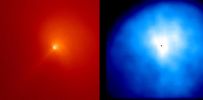
Comets-Comet_Holmes-UZ_PIA11228-2.jpgComet 17-P Holmes now in the Outer Solar System79 visiteSpitzer's infrared picture at left hand side of this frame reveals fine dust particles that make up the Outer Shell, or "Coma", of the Comet. The Nucleus of the Comet is within the bright whitish spot in the center, while the yellow area shows solid particles that were blown from the Comet in the explosion.
The Comet is headed away from the Sun, which lies beyond the right-hand side of these pictures.
The contrast-enhanced picture on the right shows the Comet's Outer Shell, and strange "filaments", or "Streamers", of dust. The Streamers and shell are a yet another mystery surrounding Comet Holmes. Scientists had initially suspected that the Streamers were small dust particles ejected from fragments of the Nucleus, or from hyerpactive jets on the Nucleus, during the October 2007 explosion.
If so, both the Streamers and the Shell should have shifted their orientation as the Comet followed its orbit around the Sun.
Radiation pressure from the Sun should have swept the material back and away from it. But pictures of Comet Holmes taken by Spitzer over time show the Streamers and Shell in the same configuration, and not pointing away from the Sun. The observations have left astronomers stumped.
The horizontal line seen in the contrast-enhanced picture is a trail of debris that travels along with the Comet in its orbit.
The Spitzer picture was taken with the Spacecraft's multiband imaging photometer at an infrared wavelength of 24 microns.MareKromium
|
|

Comets-Comet_Holmes.jpgComet 17-P-Holmes68 visiteCaption NASA, da "NASA - Picture of the Day" del 26 Ottobre 2007:"Comet 17 P-Holmes stunned comet watchers across planet Earth earlier this week.
On October 24th, 2007, it increased in brightness over half a million times in a matter of hours. The outburst transformed it from an obscure and faint comet quietly orbiting the Sun with a period of about 7 years to a naked-eye comet rivaling the brighter stars in the constellation of Perseus. Recorded on that date, this view from Teheran, Iran, highlights the comet's (enhanced and circled) dramatic new visibility in urban skies.
The inset (left) is a telescopic image from a backyard in Buffalo, New York showing the comet's greatly expanded coma, but apparent lack of a tail. Holmes' outburst could be due to a sudden exposure of fresh cometary ice or even the breakup of the comet nucleus. The comet may well remain bright in the coming days".MareKromium
|
|
Comets-Comet_Hyakutake-PIA01288_modest.jpgThe "Hyakutake" Comet73 visiteOriginal caption:"These are 2 images of the inner coma of Comet Hyakutake made on April 3 and 4, 1996, using the NASA HST-WFPC2. The 1st one, shown in red, was taken through a narrow-band red filter that shows only sunlight scattered by dust particles in the inner coma of the comet. The 2nd one, shown in blue, was taken with an ultraviolet "Woods" filter image that shows the distribution of scattered ultraviolet radiation from H atoms in the inner coma (the "coma" is the head - or dusty-gas atmosphere - of a comet). The square field of view is 14.000 Km on a side and the Sun is toward the upper right corner of the image. H atoms represent the most abundant gas in the whole coma of the comet. They are produced when solar ultraviolet light breaks up molecules of water, the major constituent of the nucleus of the comet. The inner yellow region near the center of the red dust image is dominated by the contribution from the dust which shows sunward directed spiral jets to the upper right".
|
|
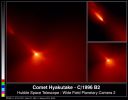
Comets-Comet_Hyakutake-PIA01290_modest.jpgThe "Hyakutake" Comet77 visiteFULL-FIELD VIEW (Left)--->This image is 3340 Km acroos and shows that most of the dust is being produced on the sunward-facing hemisphere of the comet. Also at upper left are 3 small pieces which have broken off the comet and are forming there own tails. Icy regions on the nucleus are activated as they rotate into sunlight, ejecting large amounts of dust in the jets that are faintly visible in this image. Sunlight striking this dust eventually turns it around and "blows" it into the tailward hemisphere. What might be another jet is emanating from the nightside of the nucleus, but this direction might be misleading due to the angle of the jet relative to our line-of-site.
CLOSE-UP OF NUCLEUS (Bottom Right) This expanded view of the near-nucleus region is only 760 Km across. The nucleus is near the center of the frame, but the brightest area is probably the tip of the strongest dust jet rather than the nucleus itself. Presumably, the nucleus surface lies just below this bright jet.
CLOSE-UP OF COMET FRAGMENTS (Top Right) This image shows pieces of the nucleus that apparently broke off and were first detected during ground-based observations on March 24. The Hubble image shows at least three separate objects that are probably made up of coarse-grained dust. Large fragments of the nucleus would not be accelerated into the tail, which appears to be the case in this image.
|
|

Comets-Comet_Hyakutake.jpgComet Hyakutake68 visiteDa "NASA - Picture of the Day" del giorno 16 Dicembre 2009:"In 1996, an unexpectedly bright comet passed by planet Earth. Discovered less than two months before, Comet C/1996 B2 Hyakutake came within only 1/10th of the Earth-Sun distance from the Earth in late March. At that time, Comet Hyakutake, dubbed the Great Comet of 1996, became the brightest comet to grace the skies of Earth in 20 years. During its previous visit, Comet Hyakutake may well have been seen by the stone age Magdalenian culture, who 17.000 years ago were possibly among the first humans to live in tents as well as caves.
Pictured above near closest approach as it appeared on 1996 March 26, the long Ion and Dust Tails of Comet Hyakutake are visible flowing off to the left in front of a distant star field that includes both the Big and Little Dippers.
On the far left, the blue Ion Tail appears to have recently undergone a magnetic disconnection event. On the far right, the Comet's green-tinted Coma obscures a dense nucleus of melting dirty ice estimated to be about 5 Km across. A few months later, Comet Hyakutake began its long trek back to the outer Solar System.
Because of being gravitationally deflected by massive planets, Comet Hyakutake is not expected back for about 100.000 years...".MareKromium
|
|

Comets-Comet_ISON-4-10-2013-HST.jpgComet ISON (Hubble Space Telescope's View)82 visiteCaption originale:"Comet C/ISON was imaged with the Hubble Space telescope on April 10, 2013, using the Wide Field Camera 3, when the Comet was 394 million miles from Earth. View larger. Image via NASA, ESA, J.-Y. Li (Planetary Science Institute), and the Hubble Comet ISON Imaging Science Team".
MareKromium
|
|
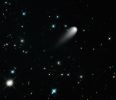
Comets-Comet_ISON-HST-30Apr-V_I-L-800.jpgComet ISON (Hubble Space Telescope's View)177 visiteAdvanced amateur astronomers are already getting good images of Comet ISON, which currently shines at around +12th magnitude in the constellation Cancer. And although NASA’s Deep Impact/EPOXI mission is down for the count, plans are afoot for the Curiosity rover and the Mars Reconnaissance Orbiter to attempt imaging the comet when it makes its closest approach to the Red Planet on October 1st at 0.0724 Astronomical Units (A.U.) or 10,830,000 kilometres distant. If MSL is successful, it would be the first time that a comet has been observed from the surface of another world.
Currently, ISON sits about a magnitude below the projected light curve, (see below) but that isn’t all that unusual for a comet. Already, there’s been increasing talk of “ISON being a dud,” but as Universe Today’s Nancy Atkinson pointed out in a recent post, these assertions are still premature. The big question is what ISON will do leading up to perihelion, and if it will survive its passage 1.1 million kilometres above the surface of the Sun on November 28th to become a fine comet in the dawn skies in the weeks leading up to Christmas.
ISON is already starting to show a short, spikey tail in amateur images. Tsutomu Seki estimated it to be shining at about magnitude +11.1 on September 16th. Keep in mind, a caveat is in order when talking about the magnitudes of comets. Unlike stars, which are essentially a point source, the brightness of a comet is spread out over a large surface area. Thus, a comet may appear visually fainter than the quoted magnitude, much like a diffuse nebula. Although +6th magnitude is usually the limit for naked eye visibility, I’ll bet that most folks won’t pick up ISON with the unaided eye from typical suburban sites until it breaks +4th magnitude or so.
The forward scattering of light also plays a key role in the predicted brightness of a comet. The November issue of Astronomy Magazine has a great article on this phenomenon. It’s interesting to note that ISON stacks up as a “9” on their accumulated point scale, right at the lower threshold of comet “greatness,” versus a 15 for sungrazing Comet C/1965 S1 Ikeya-Seki. Another famous “9” was Comet C/1996 B2 Hyakutake, which passed 0.1018 A.U. or 15.8 million kilometres from Earth on March 25, 1996.
ISON will pass 0.429 A.U. or 64.2 million kilometres from Earth the day after Christmas. Bruce Willis can stay home for this one.
Here is a blow-by-blow breakdown of some key dates to watch for as ISON makes its plunge into the inner solar system:
-September 25th: ISON crosses the border from the astronomical constellation of Cancer into Leo.
-September 27th: ISON passes 2 degrees north of the planet Mars.
-October 1st: The 12% illuminated waning crescent Moon passes 10 degrees south of Mars & ISON.
-Early October: ISON may break +10th magnitude and become visible with binoculars or a small telescope.
-October 4th: New Moon occurs. The Moon then exits the dawn sky, making for two weeks of prime viewing.
-October 10th: ISON enters view of NASA’s STEREO/SECCHI HI-2A CAMERA:
-October 16th: ISON passes just 2 degrees NNE of the bright star Regulus, making a great “guidepost” to pin it down with binoculars.
-October 18th: The Full Moon occurs, after which the Moon enters the morning sky.
-October 26th: A great photo-op for astro-imagers occurs, as ISON passes within three degrees the Leo galaxy trio of M95, M96, & M105.
-October 30th: The 17% illuminated Moon passes 6 degrees south of ISON.
-Early November: Comet ISON may make its naked eye debut for observers based at dark sky sites.
-November 3rd: A hybrid (annular-total) solar eclipse occurs, spanning the Atlantic and Central Africa. It may just be possible for well placed observers to catch sight of ISON in the daytime during totality, depending on how quickly it brightens up. The Moon reaching New phase also means that the next two weeks will be prime view time for ISON at dawn.
-November 5th: ISON crosses the border from the astronomical constellation of Leo into Virgo.
-November 7th: ISON passes less than a degree from the +3.6 magnitude star Zavijava (Beta Virginis).
-November 8th: ISON passes through the equinoctial point in Virgo around 16:00 EDT/20:00 UT, passing into the southern celestial hemisphere and south of the ecliptic.
-November 14th: ISON passes less than a degree from the 10th magnitude galaxy NGC 4697.
-November 17th: The Moon reaches Full, passing into the morning sky.
-November 18th: ISON passes just 0.38 degrees north of the bright star Spica.
-November 22nd: ISON crosses into the astronomical constellation of Libra.
-November 23rd: ISON sits 4.7 degrees SSW of the planet Mercury and 4.9 SSW of Saturn, respectively.
-November 25th: ISON pays a visit to another famous comet, passing just 1.2 degrees south of short period comet 2P/Encke which may shine at +8th magnitude.
-November 27th: ISON enters the field of view of SOHO’s LASCO C3 coronagraph.
-November 28th: ISON reaches perihelion at ~18:00 PM EST/ 23:00 UT.
After that, all bets are off. The days leading up to perihelion will be tense ones, as ISON then rounds the Sun on a date with astronomical destiny. Will it join the ranks of the great comets of the past? Will it stay intact, or shatter in a spectacular fashion? Watch this space for ISON updates… we’ll be back in late November with our post-perihelion guide!
Be sure to also enjoy recently discovered Comet C/2013 R1 Lovejoy later the year.
(source: http://www.universetoday.com/104818/comet-ison-a-viewing-guide-from-now-to-perihelion/#ixzz2fpLTKJwD)
Read more: http://www.universetoday.com/104818/comet-ison-a-viewing-guide-from-now-to-perihelion/#ixzz2fpLG75usMareKromium
|
|

Comets-Comet_ISON-Nucleus.jpgComet ISON (Tian Lian 1 - Satellite's View - Controversial: possible fake)104 visiteEd ecco il Nucleo di ISON: come vedete, assomiglia TANTISSIMO a quello di Tempel-1 e Wild-2. Mia opinione? Immagine genuina. Con tutto quanto ne segue e consegue... Il punto è che, a quanto leggo (ma NON sul Sito dell'Agenzia Spaziale Cinese, sul quale non posso capirci nulla), il Satellite Geostazionario Tian-Lian 1 NON ha fotocamere! E se questo è vero (ma non so se è vero), allora è evidente che siamo davanti all'ennesima bufala...MareKromium
|
|

Comets-Comet_ISON-Nucleus_Crop_Chumack.jpgComet ISON106 visite"Comet ISON is probably at least twice as big as Comet Lovejoy and will pass a bit farther from the sun’s surface" notes Knight. “This would seem to favor Comet ISON surviving and ultimately putting on a good show.
One of the most exciting possibilities would be a partial break-up. "If Comet ISON splits, it might appear as a 'string of pearls' when viewed through a telescope," speculates Battams. “It might even resemble the famous Comet Shoemaker-Levy 9 that hit Jupiter in 1994.”
A break-up would pose no threat to Earth, assures Yeomans. "Comet ISON is not on a collision course. If it breaks up, the fragments would continue along the same safe trajectory as the original comet."
Whatever happens, northern sky watchers will get a good view. For months after it swings by the sun, Comet ISON will be well placed for observers in the northern hemisphere. It will pass almost directly over the North Pole, making it a circumpolar object visible all night long.
Will Comet ISON fizzle ... or sizzle? Stay tuned to Science@NASA for updates.MareKromium
|
|
| 289 immagini su 25 pagina(e) |
|
|
|
|
|
7 | |
|
|
|
|
|
|








